



HDPE Pipe Plant Machine List: Every Machine You Need

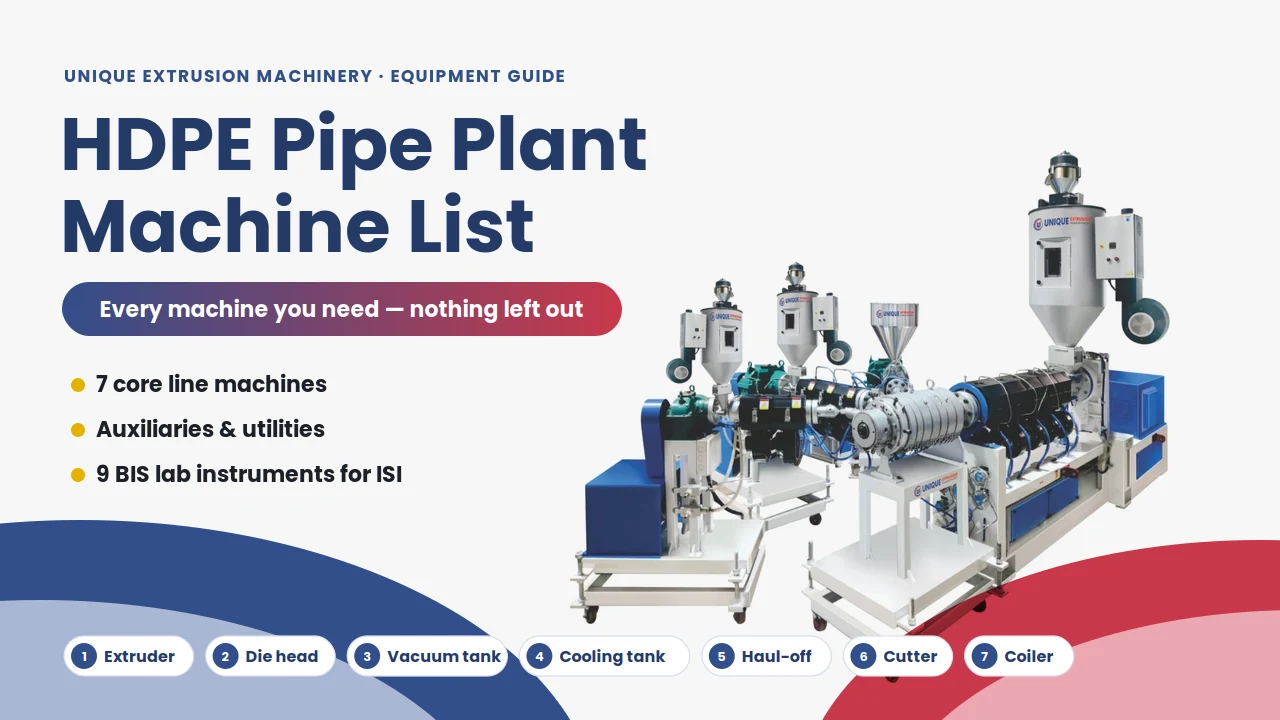
Equipment Guide
The seven machines that make the pipe — plus the auxiliaries, utilities and BIS lab instruments that most quotations quietly leave out.
By Unique Extrusion Machinery Technical Team, pipe extrusion machinery manufacturers at Vatva GIDC, Ahmedabad · Last reviewed · 25 min read
Ask ten suppliers for an HDPE pipe plant machine list and you will get ten different lists — and not one of them will contain everything you have to buy before the first ISI-marked pipe leaves your gate. So what does a complete plant actually need?
An HDPE pipe plant needs seven core machines, in this order: a single-screw extruder, a die head, a vacuum calibration tank, a cooling tank, a haul-off (traction) unit, a planetary cutting unit, and a coiler or tilting unit. Around them you also need material-handling auxiliaries, plant utilities, and — if you want an ISI mark — an in-house testing lab.
- Single-screw extruder — melts the granules and sets your output
- Die head — forms the pipe and sets the diameter
- Vacuum calibration tank — fixes the outside diameter
- Cooling tank — finishes the cooling
- Haul-off / traction unit — pulls the pipe and sets the wall thickness
- Planetary cutting unit — cuts to length without chips
- Coiler or tilting unit — takes the finished pipe away
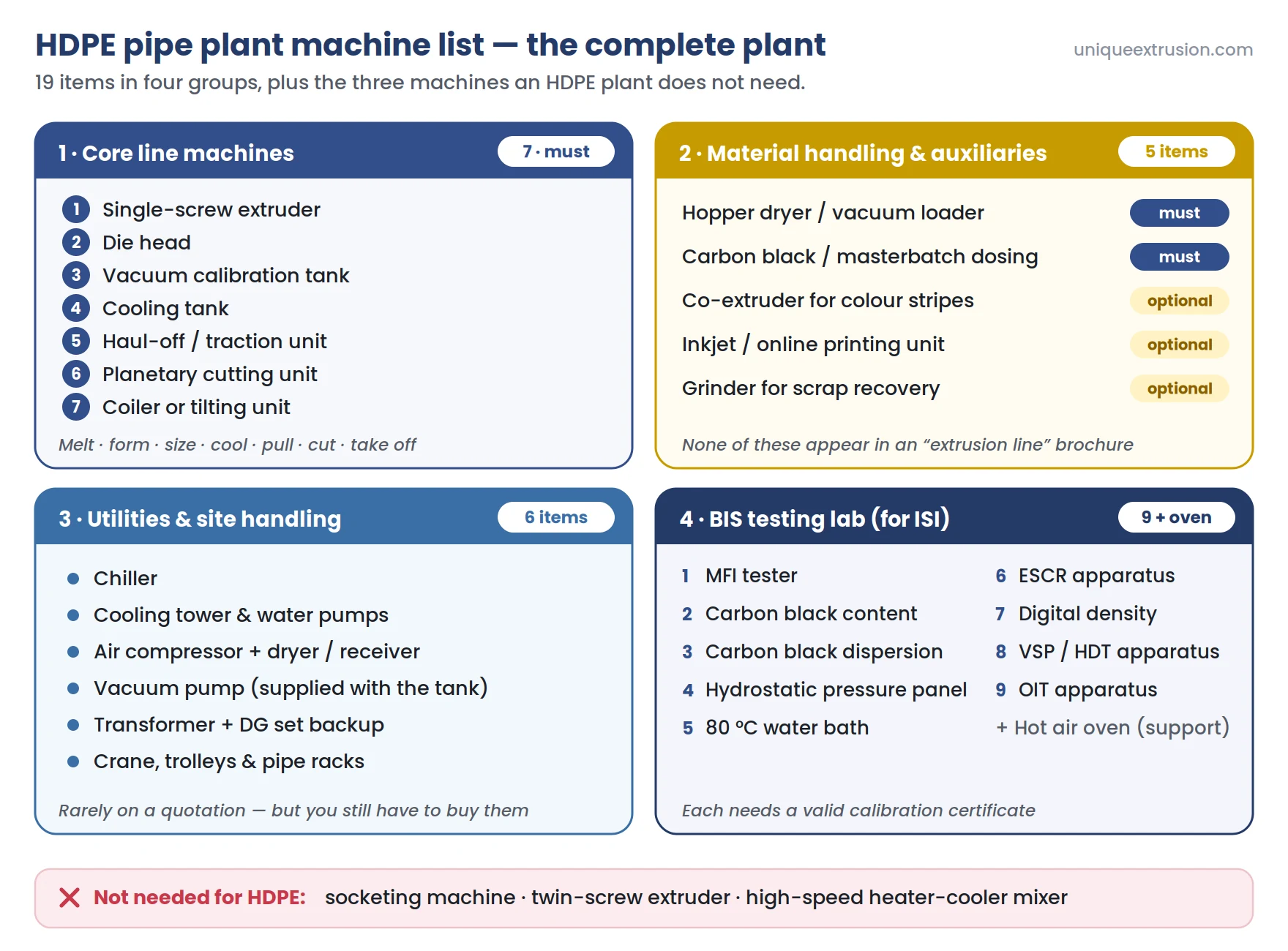
That is where almost every other guide stops — at the machines a supplier sells you. The gap between “the line” and “a plant that can ship ISI-marked pipe” is where first-time buyers lose money. Below, from a company that builds these machines at Vatva GIDC, Ahmedabad: the full list in production order, what is compulsory and what can wait, the utilities nobody itemises, the nine lab instruments BIS expects — and the machine a PVC maker always budgets for that an HDPE plant does not need at all.
HDPE pipe plant machine list: key facts
| Core machines on the line | 7 |
|---|---|
| Items in the complete plant | 19, including utilities and the lab |
| Extruder type for HDPE | Single-screw, high-speed, grooved feed, 37:1 L/D |
| Typical extruder range | 45–250 kW · 140–850 kg/hr |
| Pipe diameters covered | 16–630 mm, depending on die and tank selection |
| What sets the outside diameter | The vacuum calibration tank, not the die |
| What sets the wall thickness | The haul-off speed, not the die |
| Take-off below ~110 mm | Coiler (50 / 100 / 200 m coils) |
| Take-off above ~110 mm | Cut lengths, usually 6 m, onto a tilting unit |
| BIS lab instruments for ISI | 9, plus a hot air oven as support |
| Relevant Indian Standards | IS 4984, IS 14333, IS 14151, IS 14885 |
| Machines an HDPE plant does not need | Socketing machine, twin-screw extruder, heater-cooler mixer |
| Indicative shed length, 20–110 mm coil line | About 30 m |
On this page
- How an HDPE pipe line is laid out
- The complete HDPE pipe plant machine list
- The seven core machines, one by one
- Must-have vs optional: the honest split
- The auxiliary machines almost no list includes
- The utilities nobody puts on a machine list
- The testing lab BIS expects before an ISI mark
- What an HDPE plant does not need
- What decides the cost of your machine list
- Floor space and line length
- Starting small: the minimum viable machine list
- Choosing an HDPE plant supplier
- Why buyers choose Unique Extrusion Machinery
- Frequently asked questions
How an HDPE pipe line is laid out
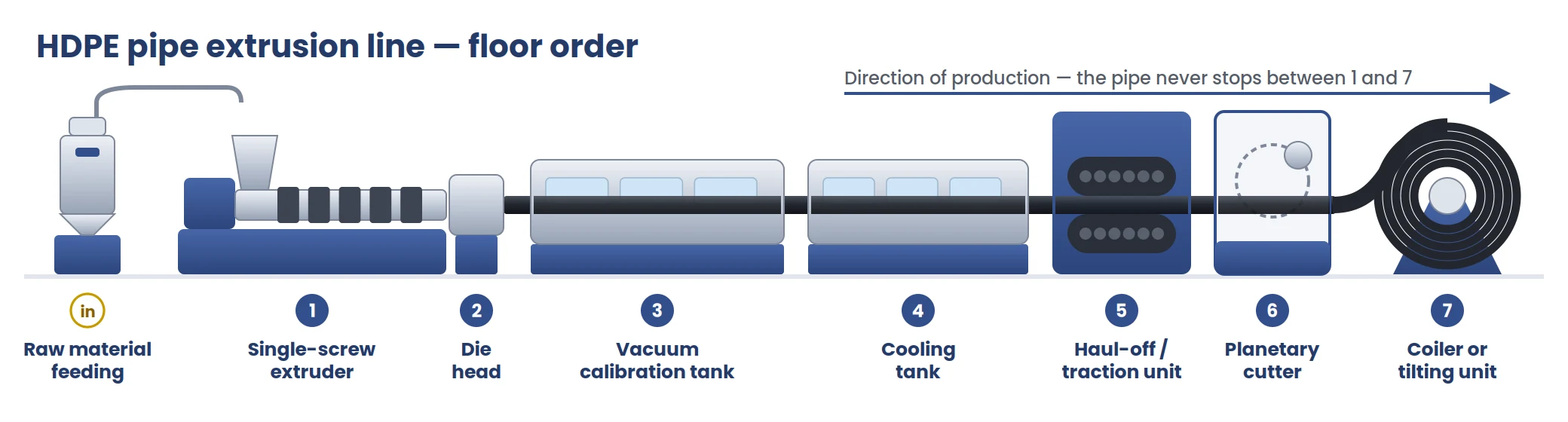
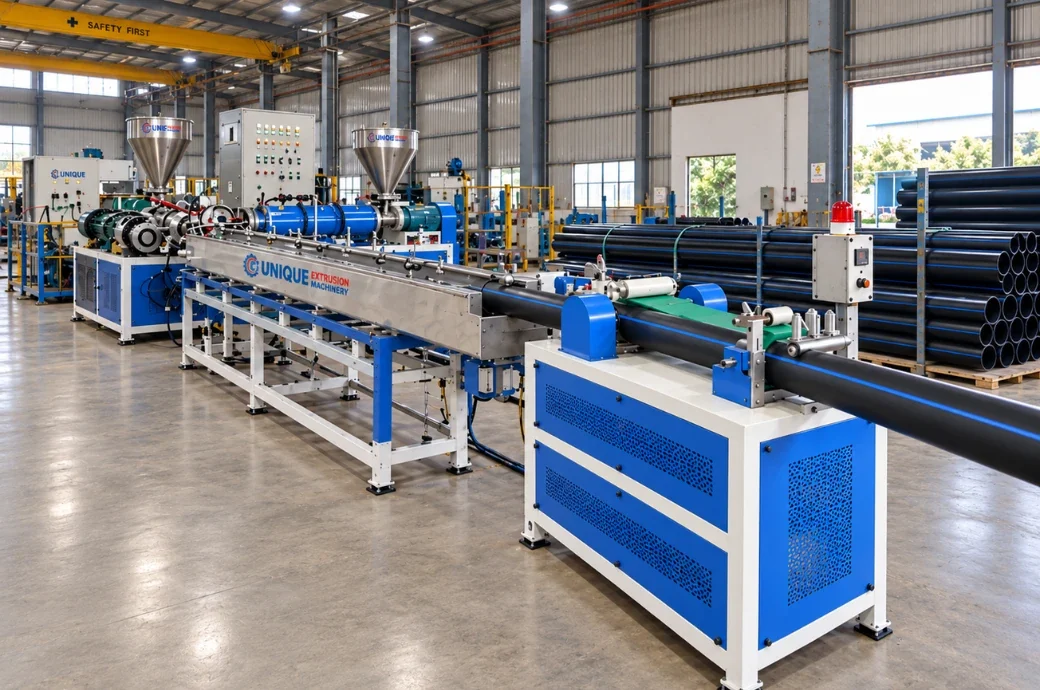
An HDPE pipe extrusion line is a straight line of machines arranged in the order the pipe passes through them: feeding, extruder, die head, vacuum calibration tank, cooling tank, haul-off, cutter, coiler or tilting unit. Material enters at one end as granules and leaves the other end as finished pipe.
Once you can picture the line, the machine list stops being a shopping list and becomes a sequence — much easier to check a quotation against. For what physically happens to the polymer at each station, read our HDPE pipe manufacturing process guide.
The complete HDPE pipe plant machine list
A complete HDPE pipe manufacturing plant uses 19 items of equipment: seven core line machines, two compulsory material-handling auxiliaries, three optional auxiliaries, six plant utilities, and an in-house testing laboratory.
Must-have means the plant cannot physically run without it. Optional depends on what you make, how big you are, and whether you are chasing an ISI licence. Use the table as a checklist when costing a plant, and as a yardstick when you compare two quotations.
| # | Machine | What it decides | Status | Our range |
|---|---|---|---|---|
| 1 | Single-screw extruder | Output in kg/hr; melt quality | Must-have | 45–250 kW, 140–850 kg/hr |
| 2 | Die head | Pipe diameter; wall uniformity | Must-have | 16–450 mm |
| 3 | Vacuum calibration tank | Outside diameter; roundness | Must-have | UEVST 110–630 |
| 4 | Cooling tank | Final cooling; internal stress | Must-have | UECT 110–630 |
| 5 | Haul-off / traction unit | Wall thickness; line speed | Must-have | Up to 8 belts, servo |
| 6 | Planetary cutting unit | Cut length; chip-free cut face | Must-have | Carbide / diamond blade |
| 7 | Coiler or tilting unit | How finished pipe leaves the line | Must-have | Coiler 20–110 mm |
| 8 | Hopper dryer / vacuum loader | Moisture removal; feeding | Must-have | Sourced to spec |
| 9 | Masterbatch / carbon black dosing unit | Carbon black %; UV life | Must-have | Sourced to spec |
| 10 | Co-extruder (stripe marking) | Colour stripes for pipe class | Optional | On request |
| 11 | Inkjet / online printing unit | ISI marking, batch, metre marks | Optional | Sourced to spec |
| 12 | Grinder (scrap recovery) | Reclaims start-up and reject pipe | Optional | UEM 60–120, 60–160 kg/hr |
| 13 | Chiller | Stable cooling-water temperature | Must-have | Utility — sourced |
| 14 | Cooling tower & water pumps | Heat rejection; water circulation | Must-have | Utility — sourced |
| 15 | Air compressor | Pneumatics on haul-off and cutter | Must-have | Utility — sourced |
| 16 | Vacuum pump | Calibration-tank vacuum | Must-have | Supplied with tank |
| 17 | Transformer / DG set | Power supply and backup | Must-have | Utility — sourced |
| 18 | Material handling (crane, trolleys, racks) | Moving coils and 6 m lengths | Optional | Site-specific |
| 19 | In-house testing lab (9 instruments) | Your ISI licence | Optional* | See the lab section |
* The testing lab is optional only if you never intend to carry an ISI mark. In practice it is compulsory for anyone selling to government or utility tenders.
The seven core machines, one by one
These seven are the HDPE pipe production line equipment proper. Every specification below comes from our own published catalogue, so you can hold it against whatever a supplier puts in front of you.
1. Single-screw extruder — must-have
The extruder melts the polyethylene granules and pushes the melt forward under pressure. It is the biggest item on the list and it sets a hard ceiling on everything else: whatever the extruder can push in kg/hr is the most the rest of the line can turn into pipe.
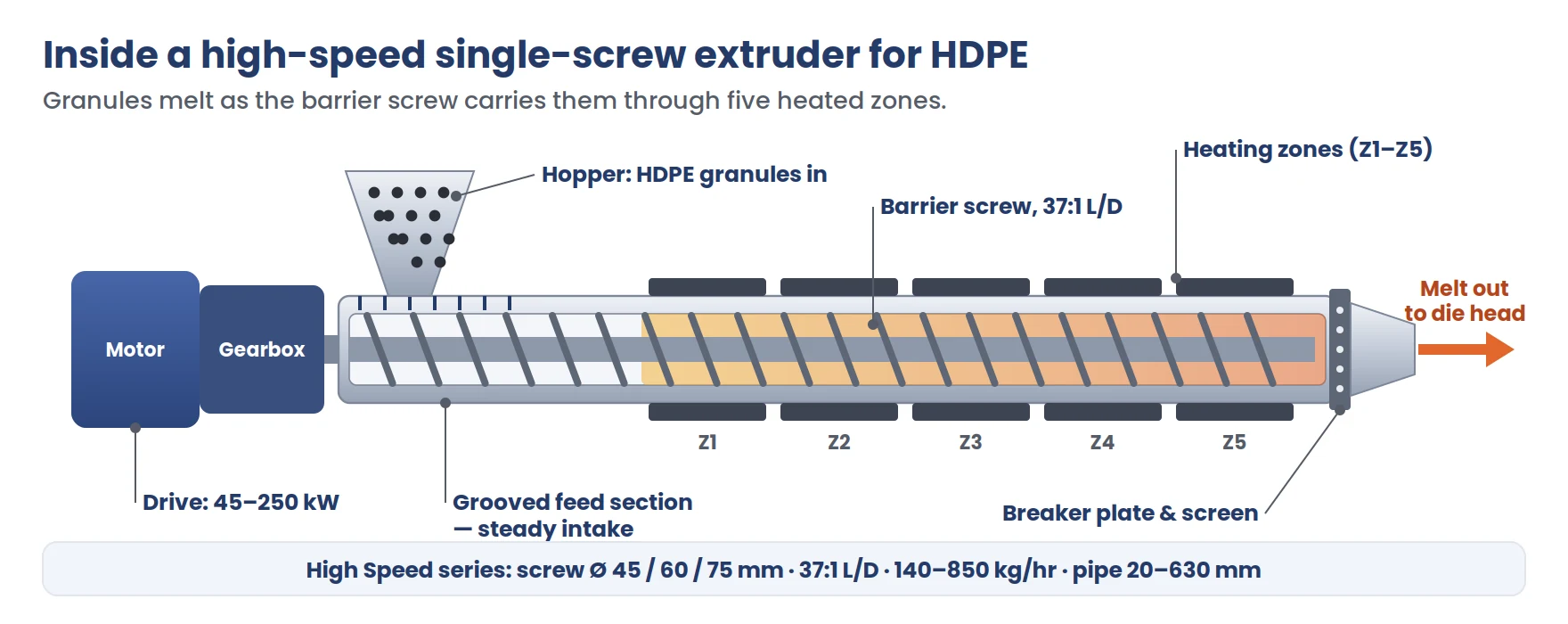
Key specifications on our High Speed series: 45–250 kW motor, 140–850 kg/hr output, screw diameters of 45, 60 and 75 mm, 37:1 L/D, covering pipe from 20 mm to 630 mm.
HDPE uses a single screw, not a twin screw. Polyethylene arrives already compounded, so it only needs melting; PVC powder has to be mixed and fused as it travels, which only a twin screw can do. If a supplier offers a twin screw for HDPE pipe, ask why — see twin screw vs single screw extruder.
| Model | Screw Ø | L:D | Motor | Output | Pipe range |
|---|---|---|---|---|---|
| High Speed 45-45 | 45 mm | 37:1 | 45 kW | 140–160 kg/hr | 20–110 mm |
| High Speed 45-55 | 45 mm | 37:1 | 55 kW | 180–190 kg/hr | 20–110 mm |
| High Speed 45-75 | 45 mm | 37:1 | 75 kW | 220–240 kg/hr | 20–200 mm |
| High Speed 45-90 | 45 mm | 37:1 | 90 kW | 300–330 kg/hr | 63–315 mm |
| High Speed 60-110 | 60 mm | 37:1 | 110 kW | 380–400 kg/hr | 63–315 mm |
| High Speed 60-132 | 60 mm | 37:1 | 132 kW | 500–550 kg/hr | 63–400 mm |
| High Speed 75-200 | 75 mm | 37:1 | 200 kW | 650–700 kg/hr | 110–400 mm |
| High Speed 75-250 | 75 mm | 37:1 | 250 kW | 800–850 kg/hr | 110–630 mm |
2. Die head — must-have
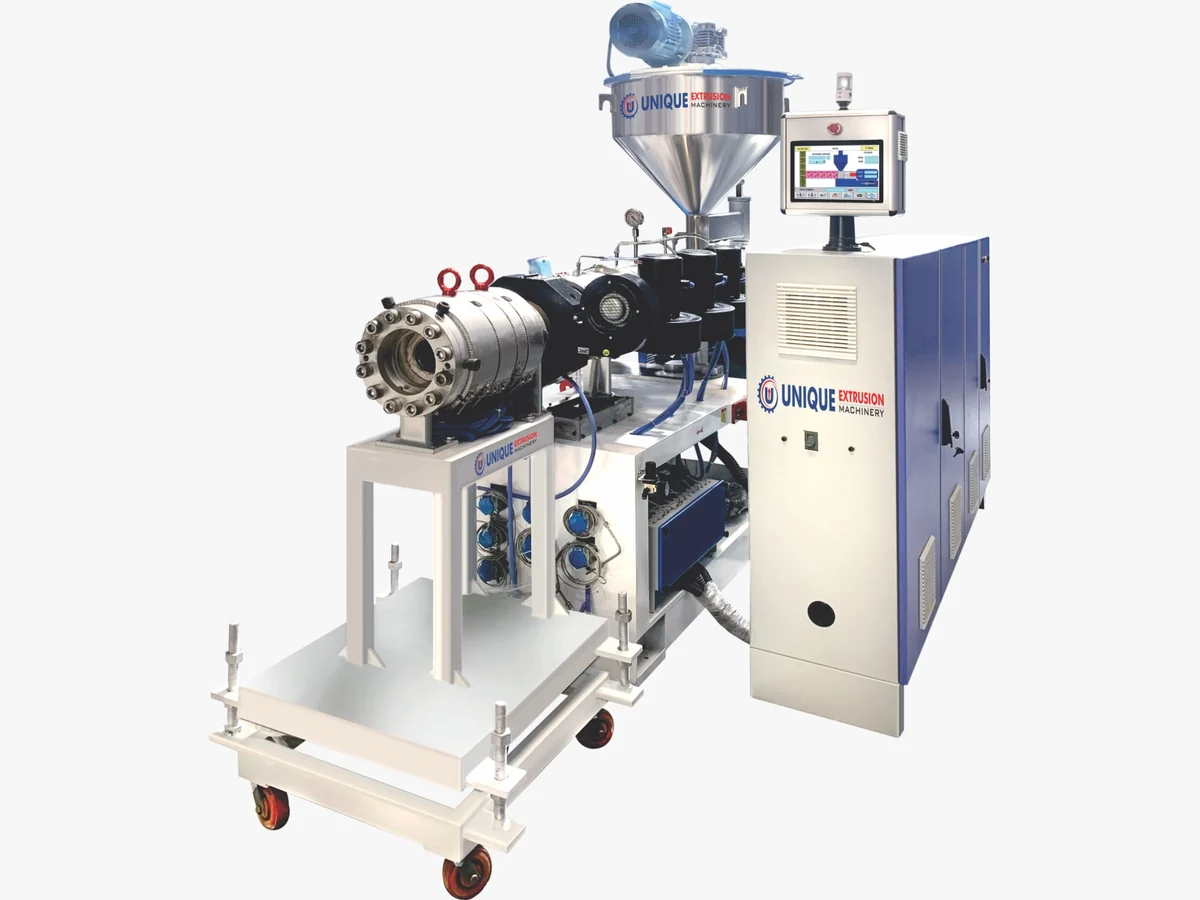
The die head turns a solid stream of melt into a hollow tube. Melt splits around a centre mandrel and rejoins into a ring before leaving through the die gap. How evenly it rejoins decides whether the wall is the same all the way round — and an uneven wall is the commonest reason a pipe fails a pressure test.
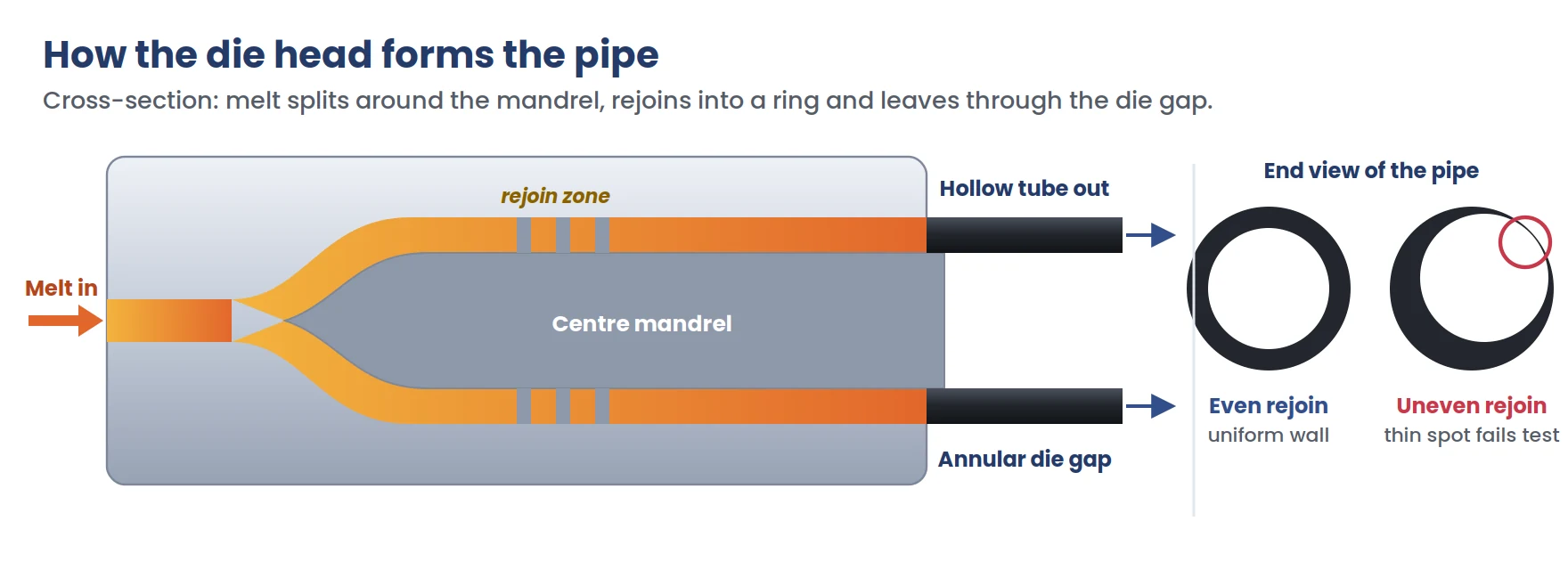
One die head does not cover every pipe size. Each die covers a band of diameters, so a plant making 20–315 mm pipe needs several, each a separate line item. Ask any supplier for a die list, not just a die. Our die head range runs in two series:
| Series | Models | Pipe range covered |
|---|---|---|
| Standard (P) | P-63, P-110, P-200/LV, P-200/HV, P-250, P-315, P-400 | 16–400 mm |
| Single melt (SM) | SM-75, SM-110, SM-160, SM-200, SM-250, SM-450 | 16–450 mm |
For small bores a twin die head extrudes two pipes side by side from one extruder — on a 20–63 mm irrigation or telecom order book that roughly doubles output, and it is usually the cheapest capacity you will ever buy.
3. Vacuum calibration tank — must-have
The vacuum calibration tank is what actually sets your outside diameter — not the die. Pipe leaving the die is soft and slightly oversized. Suction pulls it against a sizing sleeve while cold water sprays over it, holding it there until it is rigid enough to keep that shape.
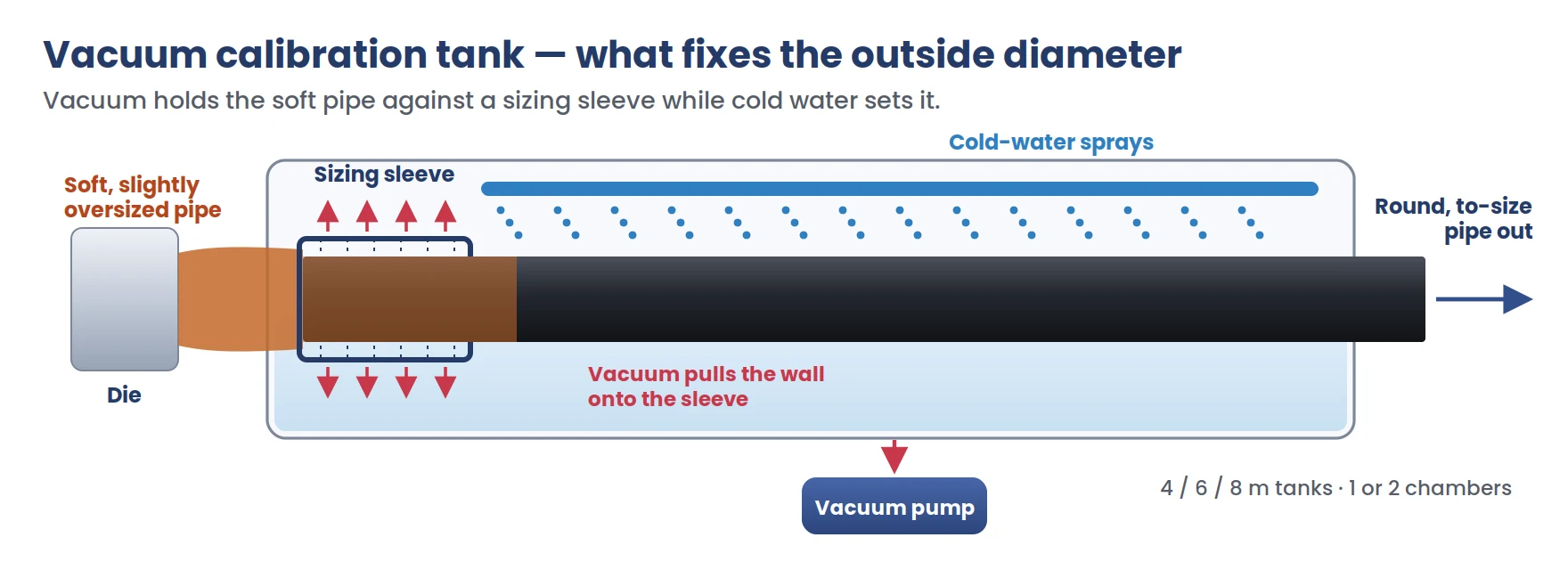
You cannot skip it or improvise it: without vacuum a soft HDPE pipe sags under its own weight within a metre of the die and goes oval, a reject-able defect under IS 4984. Our UEVST 110 to UEVST 630 range covers 16–630 mm pipe in 4, 6 or 8 m tanks with one or two vacuum chambers — model by model on the vacuum calibration tank page. Two things are worth paying for: accurate vacuum, water-level and temperature control, and motorised axial movement, so the tank can be positioned against the die without four people pushing it.
4. Cooling tank — must-have
The cooling tank finishes the cooling the vacuum tank started. The vacuum tank only cools the outside skin, and HDPE walls are thick, so the cooling tank sprays the pipe over several more metres until it is cold and dimensionally stable.
Under-cooling is a false economy. Too short a tank and the pipe reaches the haul-off still warm: the belts mark it, and it keeps shrinking after it is cut, so lengths come out short. Thick walls and large diameters need proportionally more cooling length — which is why plants making 400 mm and above run extra tanks in series.
Our UECT 110 to UECT 630 tanks cover 20–630 mm pipe in 4 or 6 m single-chamber lengths, with extra tanks added in series for heavy walls — the full table is on the cooling tank page.
5. Haul-off / traction unit — must-have
The haul-off grips the cooled pipe between rubber-padded belts and pulls it along at a precisely controlled speed — and that speed, not the die, is what sets your wall thickness. It is the quietest machine on the line and the one buyers understand least.
The extruder delivers a fixed mass of melt per hour; the haul-off decides how many metres that mass is stretched into. Pull faster and the wall gets thinner, slower and it gets thicker. In other words: wall thickness = extruder output ÷ line speed.
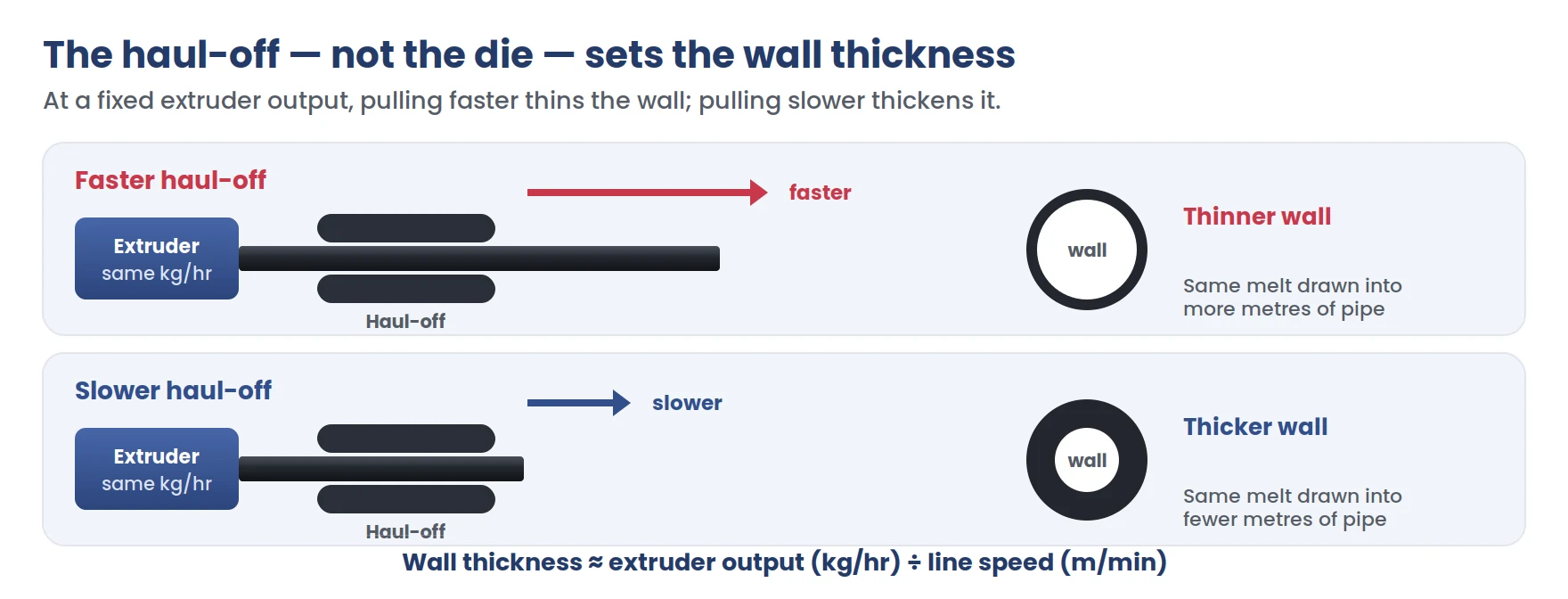
Two points follow. Speed stability matters more than top speed: a servo-driven traction unit with a gearbox per belt holds steadier speed than a cheap single-motor unit, and steady speed is steady wall. And the number of belts must suit the diameter — two or three for small pipe, six to eight above 400 mm so the grip does not flatten it.
6. Planetary cutting unit — must-have
The pipe never stops, so the cutter has to travel with it. A planetary cutter clamps onto the moving pipe, orbits a circular blade once around the outside, then releases and returns. Because the blade goes round the pipe rather than through it, the cut face comes out square and clean.
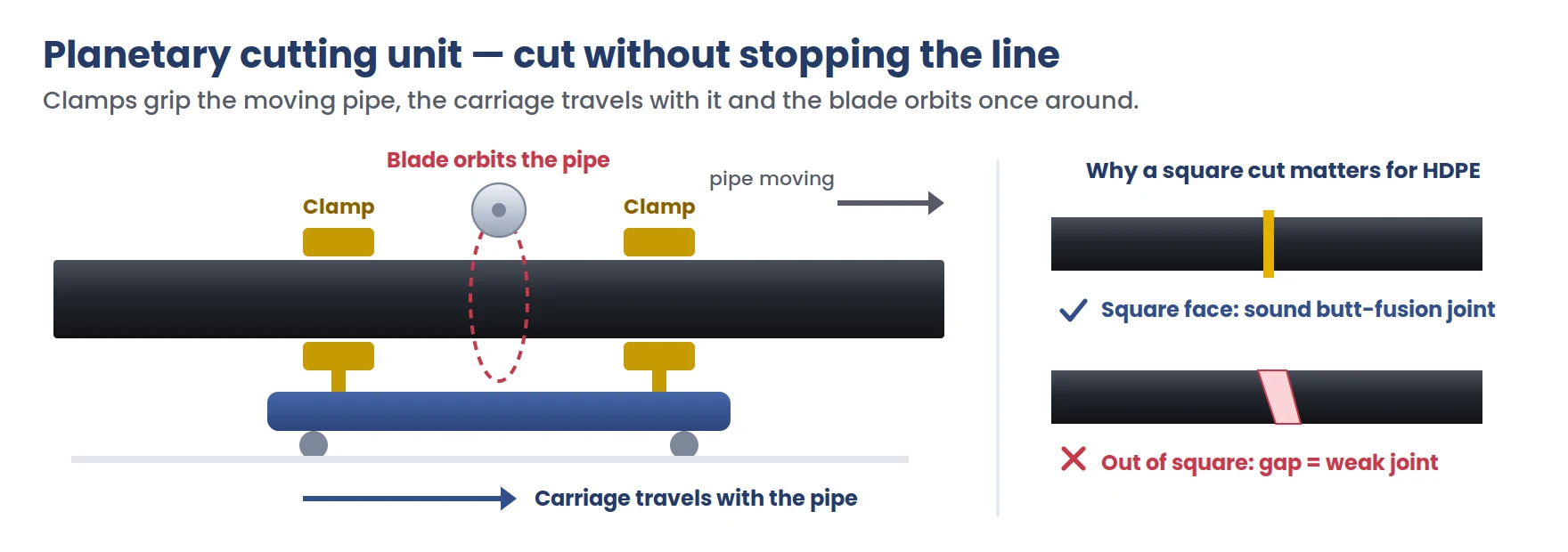
Square cut faces are not cosmetic for HDPE. The pipe is joined in the field by butt-fusion — two cut ends heated and pressed together — so an out-of-square cut makes a weak joint. Your cutter quality shows up at your customer’s trench, not in your factory. Look for clamping force that adjusts to wall thickness, and remember blades are a consumable that belongs in your running-cost sheet.
7. Coiler or tilting unit — must-have
How finished pipe leaves the line depends entirely on its diameter: pipe up to about 110 mm is coiled, and anything above that is cut into straight lengths and tilted onto a rack. This is the one point where an HDPE machine list differs most from a PVC one.
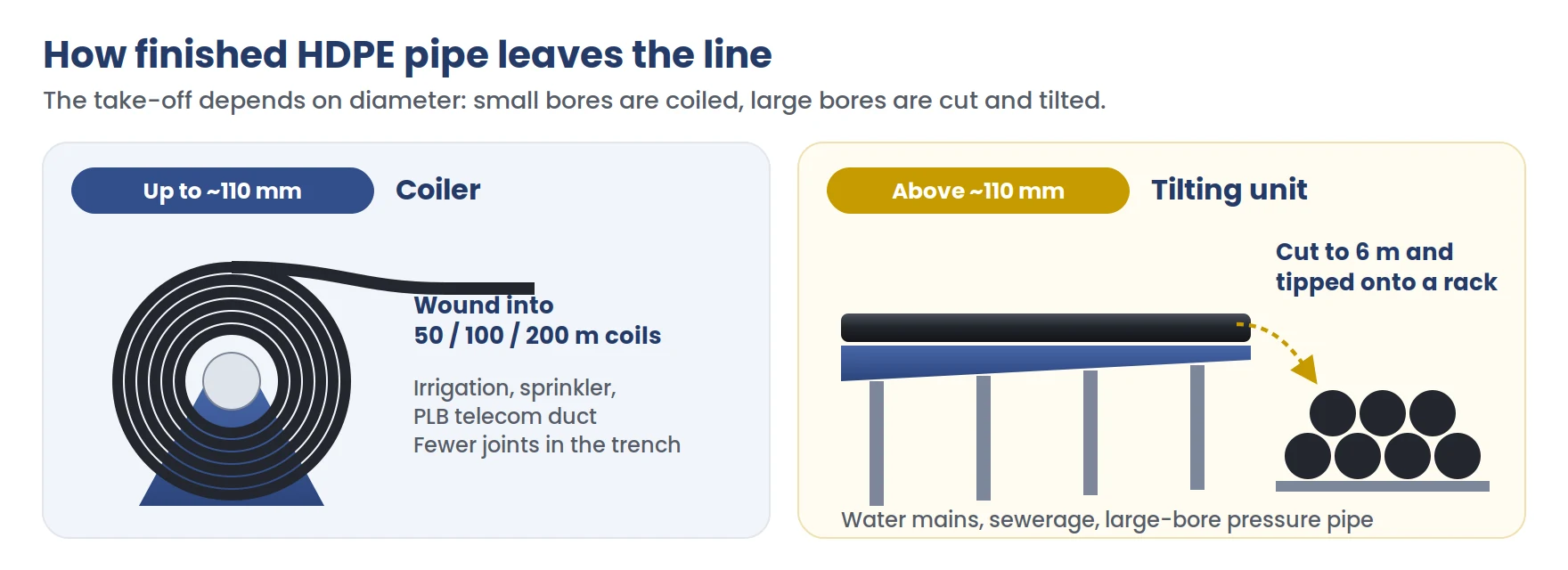
Small bores are coiled — HDPE up to about 110 mm winds into 50, 100 or 200 m coils, which is exactly why irrigation and telecom duct contractors prefer it: fewer joints in the trench. An auto-coiler with an AC drive keeps the tension even so the coil does not collapse. Large bores are cut and tilted — above roughly 110 mm the pipe is too stiff to coil, so it is cut to 6 m and a tilting unit lifts each length onto a rack.
Plants covering a wide range buy both. Decide early: on a sprinkler and PLB duct order book the coiler is critical and the tilting unit can wait.
Must-have vs optional: the honest split
Twelve items are compulsory and nine can wait. Every supplier’s machine list reads as though all of it is required. It is not — and the figure below is the split we would give a buyer sitting across the table.
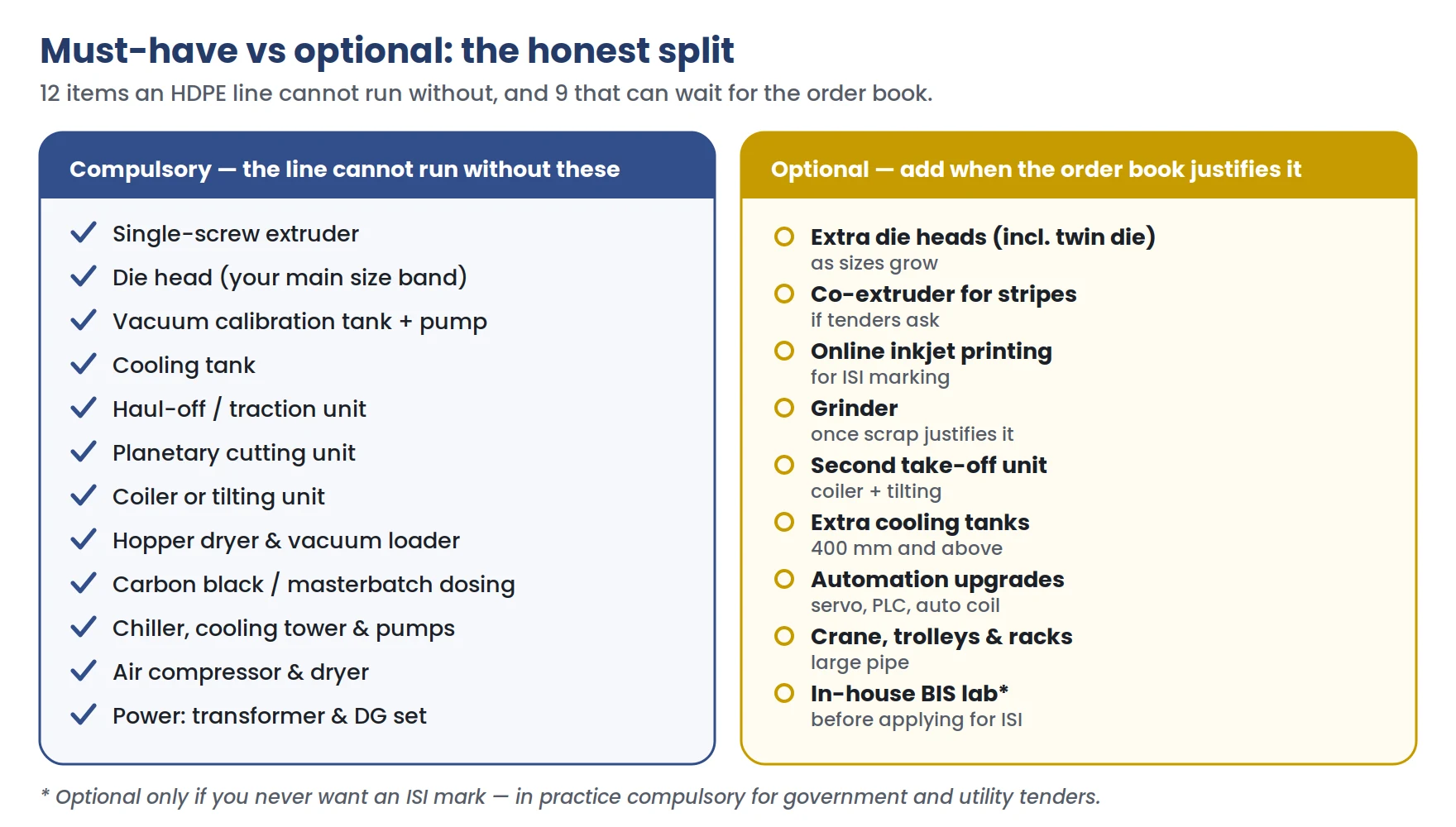
Where buyers overspend. The two most common mistakes we see are buying a larger extruder than the order book needs — you pay for the motor every month in electricity whether you use it or not — and buying every die size up front. Dies are easy to add later. Extruders are not easy to downsize.
The auxiliary machines almost no list includes
Five auxiliary machines sit around the line: a hopper dryer and vacuum loader, a carbon black dosing unit, a co-extruder for stripes, an online printing unit and a grinder. The first two are compulsory; the last three depend on what you sell. None appear in an “HDPE pipe extrusion line” brochure, and the line will not produce saleable pipe without the compulsory ones.
Hopper dryer and vacuum loader
Granules pick up moisture in storage, and moisture in the melt shows up as bubbles, silver streaks and weak spots in the wall. A hopper dryer holds them at a controlled temperature before the extruder; a vacuum loader moves material from bag or silo into the hopper so nobody is tipping sacks by hand all shift.
Carbon black / masterbatch dosing unit
Black HDPE pipe is black for a reason: carbon black protects polyethylene from ultraviolet light, and it is what lets a laid pipe survive Indian sun for decades. IS 4984 specifies about 2.5 % with a tight tolerance, evenly dispersed rather than clumped. You hit that with a gravimetric dosing unit, not by eye — a small machine that decides whether a batch passes or fails.
Co-extruder, printing and the grinder
A small secondary extruder lays coloured stripes along the pipe — blue for potable water, for example. Many tenders specify them, so check your customers before deciding it can wait. Online printing is not cosmetic either: pipe sold under an ISI licence must carry the standard number, licence number, class, batch and often metre marks, printed as it runs. And every start-up run, size change and reject length is material you have paid for — a grinder turns it back into chips you can re-feed at a controlled percentage.
Our UEM grinders run from 60 kg/hr to 160 kg/hr on 300–400 mm discs and 11.5–30 kW drives — see the grinder unit page.
The utilities nobody puts on a machine list
An HDPE pipe line needs eight plant utilities: a chiller, a cooling tower, water pumps and piping, an air compressor, a compressed-air dryer and receiver, a vacuum pump, a transformer or power connection, and a DG set. These are real purchases with real lead times, and they are the single most common reason a project budget overruns.
No supplier quoting an “HDPE pipe plant” includes them — they are site infrastructure rather than machines — but you still have to buy them.
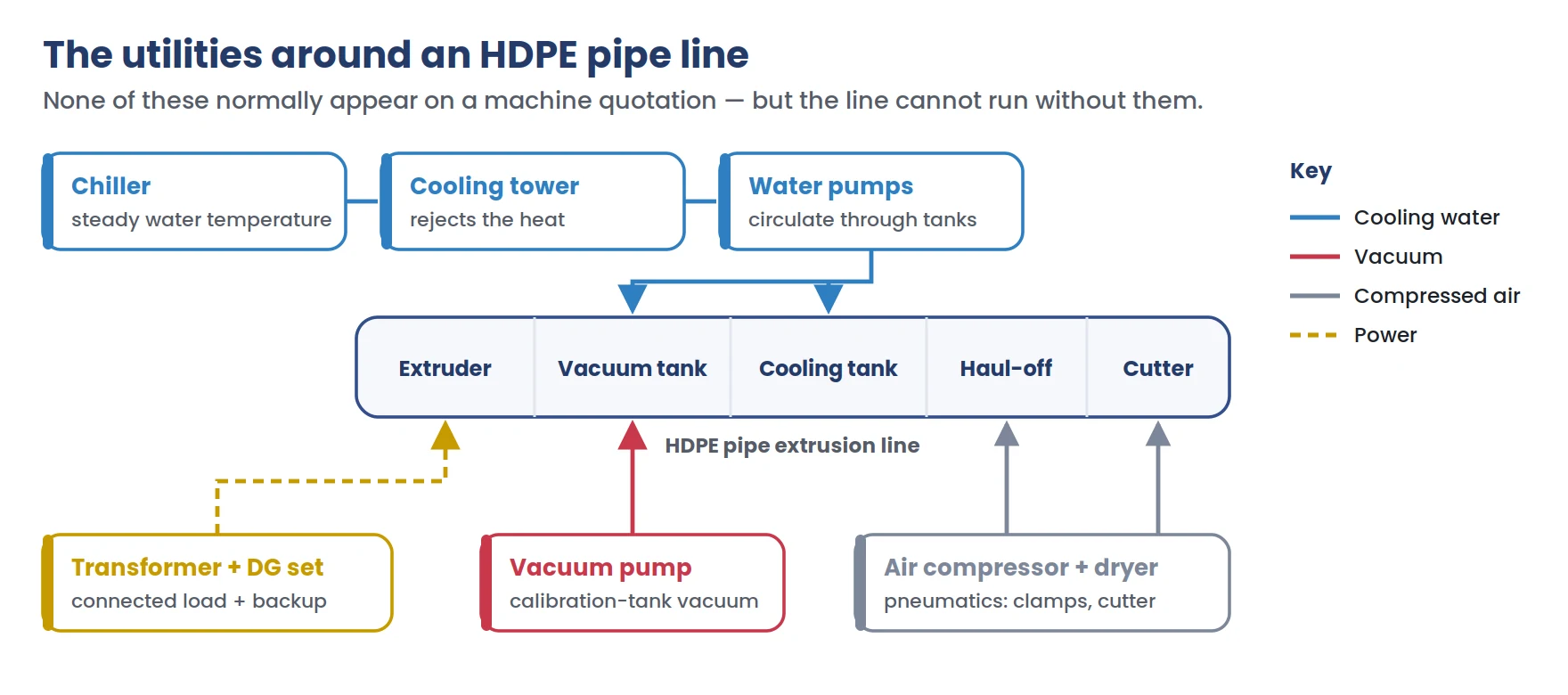
| Utility | Why the line needs it | What happens without it |
|---|---|---|
| Chiller | Holds cooling water at a steady low temperature | Water temperature drifts through the day, so pipe dimensions drift with it |
| Cooling tower | Rejects the heat the chiller removes | Chiller overloads; cooling capacity collapses in summer |
| Water pumps & piping | Circulates water through both tanks | Uneven spray; soft spots on the pipe |
| Air compressor | Drives pneumatics on the haul-off and cutter | Haul-off cannot clamp; cutter cannot travel |
| Vacuum pump | Creates the vacuum in the calibration tank | No calibration at all — the line simply cannot make pipe |
| Transformer / power connection | A 250 kW extruder plus auxiliaries is a serious connected load | Sanctioned load too small; the line trips under full output |
| DG set | Backup during supply cuts | Every power cut leaves solidified polymer in the die to be cleaned out |
| Compressed-air dryer / receiver | Clean dry air for the pneumatics | Moisture in air lines; erratic clamping |
Work out your total connected load — extruder motor, heaters, chiller, compressor, pumps, lighting — before you apply for a power connection; raising a sanctioned load later takes months in most industrial estates. Same for water: a cooling circuit loses it continuously to evaporation, so plan the make-up source on day one.
The testing lab BIS expects before it gives you an ISI mark
BIS expects around nine calibrated in-house instruments before it grants an ISI licence for PE pipe: a melt flow index tester, carbon black content apparatus, carbon black dispersion apparatus, a hydrostatic pressure testing panel, a temperature-controlled 80 °C water bath, an ESCR apparatus, a digital density apparatus, a VSP/HDT apparatus and an OIT apparatus — plus a hot air oven as a supporting instrument.
This is the part every other guide leaves off, and it is the one that stops projects. To sell into government water schemes, municipal tenders or any utility contract in India you need an ISI mark — and a BIS auditor will walk into your factory and ask to see the instruments, their calibration certificates, and a test register with recent results in it.
Which standard applies depends on what you make: IS 4984 for potable water supply, IS 14333 for sewerage and drainage, IS 14151 for sprinkler irrigation, IS 14885 for PLB telecom duct. Each needs its own licence.
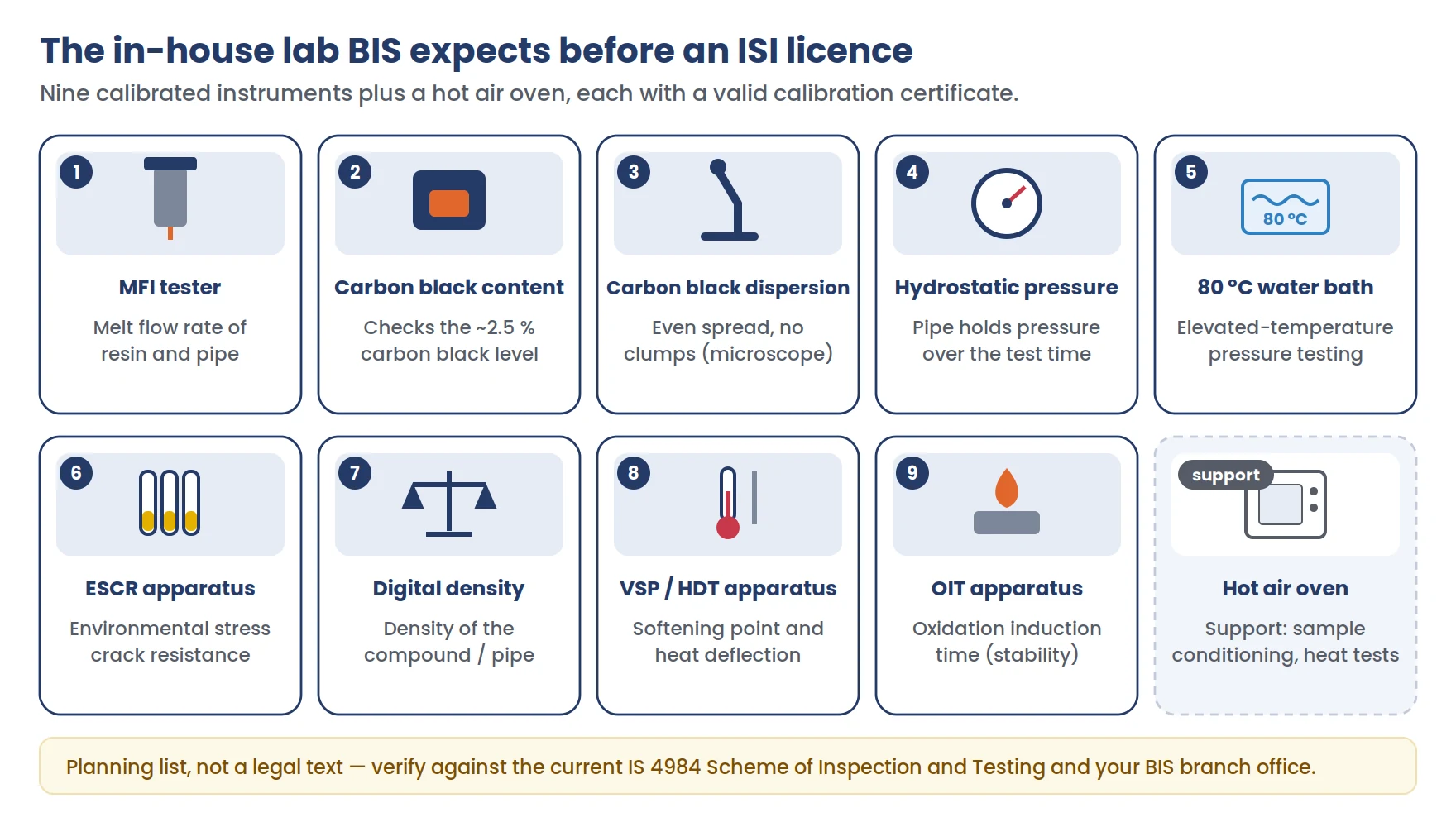
Every instrument needs a valid calibration certificate — an uncalibrated instrument counts as no instrument during an audit. And the hardware is only half of it: budget for the calibration contract and someone who can run the tests and keep the register.
Order the lab at the same time as the line, not after commissioning. Several instruments have long lead times and your BIS application cannot progress until they are installed and calibrated. Plants that treat the lab as a last step routinely lose a quarter waiting for it.
What an HDPE plant does not need
Do not budget for a socketing machine. HDPE pipe is not joined with solvent cement into a belled socket the way PVC is — it is joined in the field by butt-fusion (the two ends are heated and pressed together) or electrofusion (a fitting with an embedded heating coil). There are no sockets to form, so the SWR and plain socketing machines that are essential on a PVC line have no place on an HDPE one.
This matters because many HDPE project reports are adapted from PVC ones and the socketing machine survives the copy-paste. If it appears on an HDPE quotation, the supplier has not read your enquiry. Two more that should not be there: a twin-screw extruder (right for PVC, wrong for HDPE) and a high-speed heater-cooler mixer, which exists to blend PVC powder — HDPE granules arrive ready compounded.
HDPE vs PVC machine list: what carries over
If you already run a PVC pipe plant and are adding HDPE, this is the part you came for. The upstream half is all new, a good part of the downstream half can be shared, and the utilities usually scale.
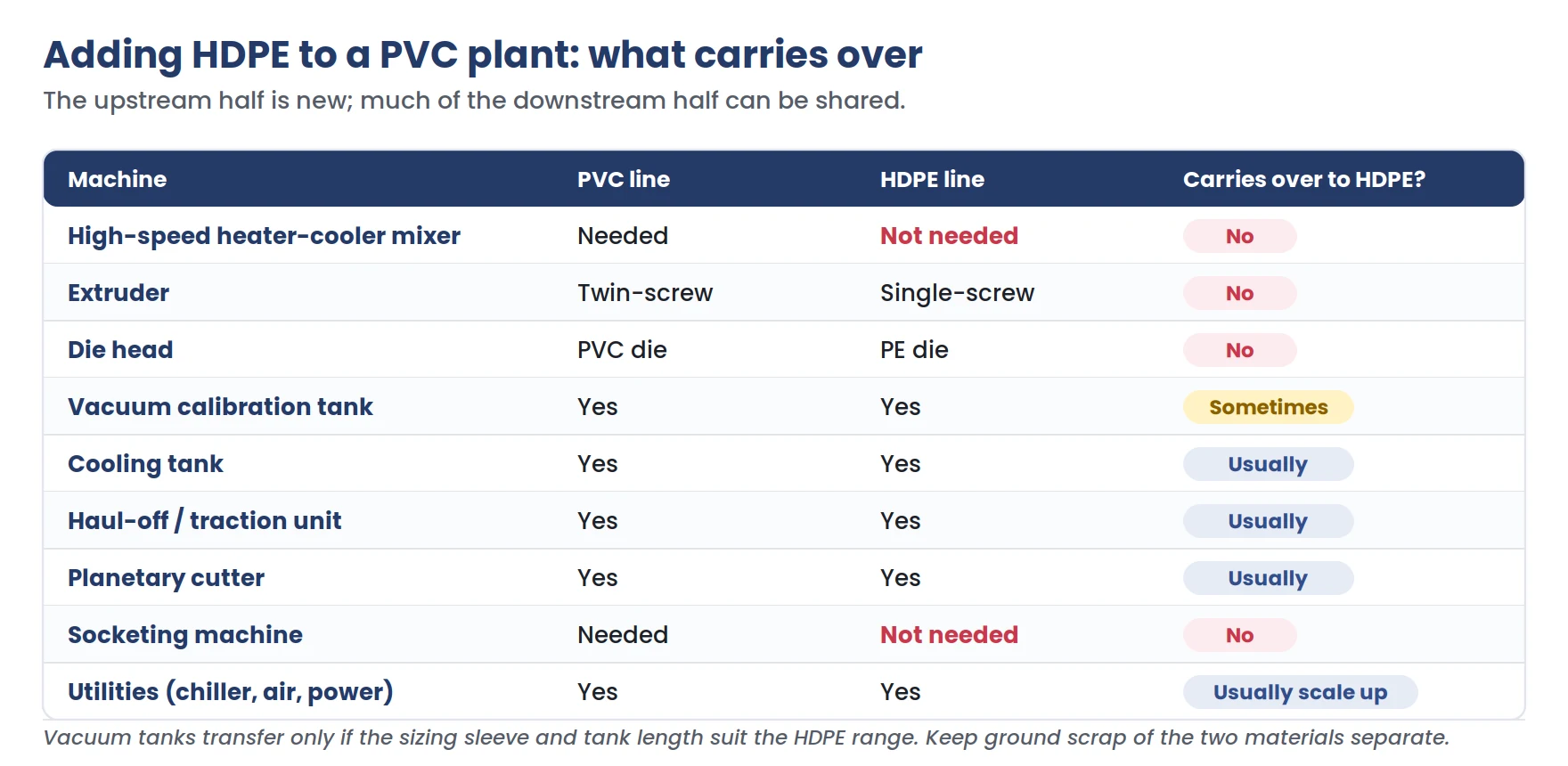
The equivalent list for the other material is in our PVC pipe manufacturing plant machine list. If you are still deciding which material to build around, we compare the two businesses in HDPE vs PVC pipe: which should you manufacture?
What decides the cost of your machine list
Five things move the price of an HDPE pipe plant: output in kg/hr, the diameter range, the number of die heads, the level of automation, and the downstream configuration. We do not publish prices: a meaningful number depends on the configuration, and a figure quoted without one is how buyers end up comparing two quotations that are not for the same plant.
| Cost driver | Why it moves the number | How to control it |
|---|---|---|
| Output in kg/hr | A 45 kW and a 250 kW extruder differ in every component — screw, barrel, gearbox, drive, heating | Size it to a realistic order book; you pay for the motor monthly in electricity either way |
| Diameter range | Reaching 630 mm needs longer tanks, more haul-off belts, heavier cutters and more floor | Decide your real range honestly — the biggest single saving in the project |
| Number of die heads | Each die covers a band of sizes; 20–315 mm needs several | Price the die list, not one die — and add dies later, not up front |
| Level of automation | PLC control, servo drives, motorised tank positioning, encoder length measurement, auto coil handling | All add cost and all cut scrap and labour; ask specifically about energy-saving heating control |
| Downstream configuration | Coiler, tilting unit or both; extra cooling tanks; printing; stripe co-extrusion | Insist each is a separate line item so you can see what you are paying for |
What is often left out of a quotation
- Utilities — chiller, cooling tower, compressor, DG set
- The full die list, as opposed to one die
- Spare screws, barrels, blades and belts
- Installation, commissioning and operator training
- Freight, insurance and unloading at your site
- Civil work — foundations, trenches, the water pit
- The BIS lab instruments
Ask every supplier to confirm in writing which of those seven are inside their price. The answers tell you more than the price itself.
Floor space and line length
A small HDPE coil line making 20–110 mm pipe fits comfortably in a shed of around 30 m length; a large-diameter line making up to 630 mm needs considerably more, plus crane access and a bigger stockyard. The length is driven by the tanks.
Count it up: extruder and die, a 4–8 m vacuum tank, a 4–6 m cooling tank (sometimes two in series), then haul-off, cutter and take-off. Add clearance at the die end for size changes and a run-out area at least as long as your cut length — a 6 m pipe needs 6 m of somewhere to go. These are planning rules of thumb; confirm the footprint against the layout drawing for your configuration.
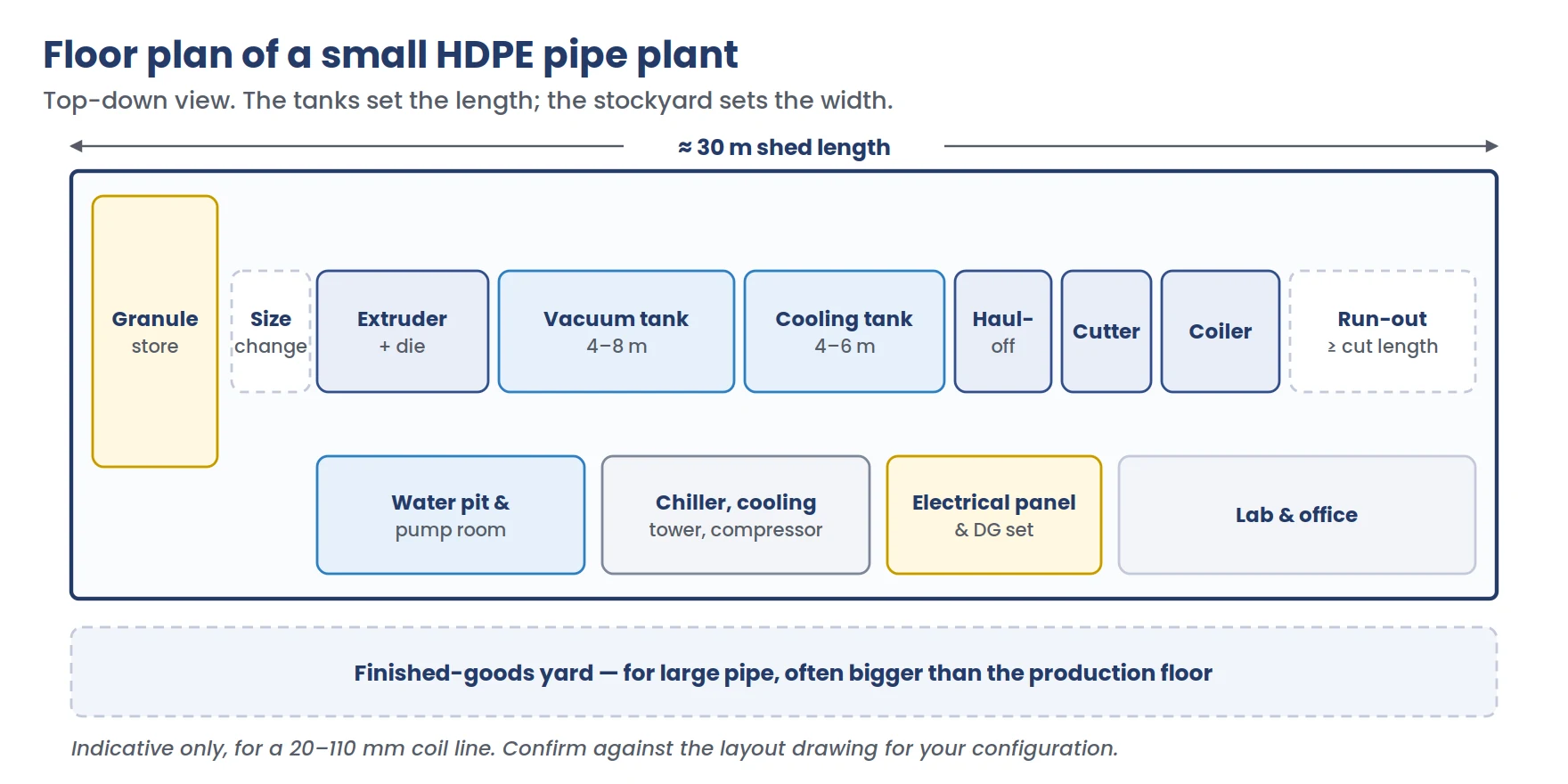
Three things people forget: the water pit and pump room, the granule store (a month’s raw material is a lot of bags), and the finished-goods yard, which for large pipe is usually bigger than the production floor itself.
Starting small: the minimum viable machine list
A credible small HDPE plant can start with one extruder, one or two die heads, one vacuum tank, one cooling tank, a haul-off, a cutter, a coiler and the material-handling auxiliaries. If capital is tight, you do not have to buy the whole list on day one.
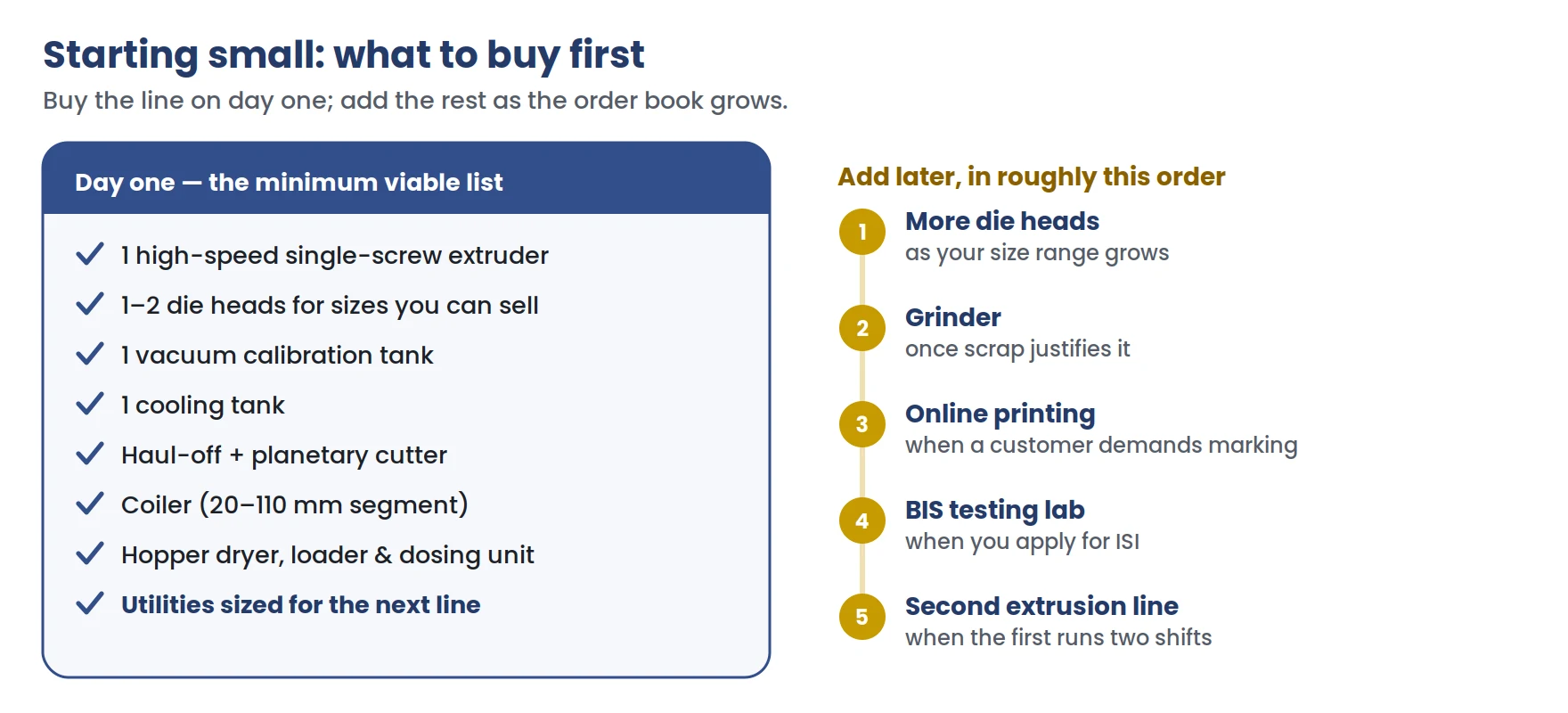
Add later, in roughly this order: more die heads as sizes grow, a grinder once scrap justifies it, printing when a customer demands marking, the lab when you apply for ISI, a second line when the first runs two shifts. At the business-plan stage, see how to start a pipe manufacturing business.
Size the utilities, not just the line. The one thing worth over-specifying is the power connection and cooling circuit. Adding a second line later is straightforward; raising a sanctioned load or rebuilding a cooling circuit mid-production is not.
Choosing an HDPE plant supplier: what to check before you commit
The best HDPE pipe plant supplier for a first plant is the one that builds the whole line itself, has it running somewhere you can go and see, holds spares locally, and commissions and trains on site. Price is the easiest thing to compare and the least useful.
An extrusion line is not a product you buy once. Screws wear, blades and belts are consumables, dies need re-chroming, and something will need a part at two in the morning during a tender run. A builder in the same city sends an engineer the same day; one on another continent sends an email and a six-week lead time. For a first plant, service distance is a specification. Five questions to put to every supplier on your shortlist:
- Can I see a line running? Not a photograph — a machine making pipe, under load, in a factory. Ask to see the one closest to your configuration.
- Is the line trial-run before dispatch? It should be assembled and run at the builder’s works, not first assembled at your site.
- Who makes the screw and barrel? They are the wearing heart of the machine. A builder who makes them in house can also replace and repair them.
- What spares are on the shelf today? Ask for the list, locally, not a promise about lead times.
- Who commissions and trains? Operator training is the difference between a line that hits its rated output in week one and one that takes six months.
Why buyers choose Unique Extrusion Machinery
Unique Extrusion Machinery Pvt. Ltd. builds complete HDPE, PVC, CPVC and uPVC pipe extrusion lines at Plot No. 5301, Vatva GIDC Estate, Ahmedabad. More than 10 years building extrusion machinery, over 900 extrusion lines installed, and an ISO certified manufacturer.
Here is how we answer our own five questions:
| What to check | Our answer |
|---|---|
| Can I see a line running? | Yes — at our works or at an installed plant. Watch lines running, or visit the manufacturing facilities |
| Trial-run before dispatch? | Every line is assembled and trial-run at Vatva before it ships — see our quality policies |
| Who makes the screw and barrel? | We do, in house — which is also why we can re-cut and replace them |
| Spares on the shelf? | Held in Ahmedabad. An engineer can reach a Gujarat plant the same day |
| Who commissions and trains? | Our own engineers — installation, commissioning and operator training |
One builder for the whole line, not a plant assembled from five suppliers
This is the difference that shows up on the shop floor. We make the single-screw extruder, the die heads, the vacuum calibration tank, the cooling tank, the traction unit, the planetary cutter, the coiler, the tilting units and the grinder ourselves, rather than reselling other people’s downstream.
Because one company engineers the whole line, the machines are matched to the same output — exactly the problem buyers hit when they assemble a plant from several suppliers. An extruder rated for 400 kg/hr in front of a tank sized for 250 kg/hr will never reach either number. It is also why one phone call fixes a problem, instead of three suppliers each explaining that the fault is in someone else’s machine.
We build for PVC as well, so the advice is not pre-decided
We build both HDPE pipe machines and PVC pipe machines, conical and parallel twin screws included. So when you ask whether to build around HDPE or PVC, we have no reason to steer you either way — which is why the twin screw vs single screw and conical vs parallel comparisons here say plainly when the machine you want is not the one we would rather sell.
Based where the machinery is built
Gujarat builds a large share of India’s plastic extrusion machinery, and Ahmedabad — particularly the Vatva, Naroda, Odhav and Changodar estates — is the centre of it. The GIDC estates already have the power connections, effluent infrastructure and transport links an extrusion plant needs, which saves months against unserviced land. If you are siting a plant here, start the Gujarat Pollution Control Board consents in parallel with the machine order, not after it.
Get your HDPE line configured and itemised
Tell us the diameter range and output you actually need, and we will put together a complete machine list for your plant — every item priced separately, so you can see what is included and compare it properly against any other quotation.
Frequently asked questions
What machines are needed for an HDPE pipe plant?
Seven core machines: a single-screw extruder, a die head, a vacuum calibration tank, a cooling tank, a haul-off or traction unit, a planetary cutting unit, and a coiler or tilting unit. A working plant also needs material-handling auxiliaries (hopper dryer, loader, carbon black dosing), plant utilities (chiller, cooling tower, air compressor, vacuum pump, power backup), and an in-house testing lab if you want an ISI mark.
How many machines are there in a complete HDPE pipe plant?
Nineteen, counting the whole plant rather than just the line: seven core line machines, two compulsory material-handling auxiliaries, three optional auxiliaries, six plant utilities, and the in-house testing laboratory. Most quotations describe only the first seven.
Do I need a twin-screw or a single-screw extruder for HDPE pipe?
Single-screw. HDPE arrives already compounded into a uniform granule, so the extruder only has to melt and convey it. Twin-screw extruders exist to compound and fuse PVC dry blend, which is a different job. A high-speed, grooved-feed single screw at 37:1 L/D is the standard choice for HDPE pipe.
Do I need a socketing machine for HDPE pipe?
No. HDPE pipe is joined in the field by butt-fusion or electrofusion, not by solvent cement into a belled socket, so there are no sockets to form. Socketing machines are essential on a PVC line and have no place on an HDPE one. If one appears on a quotation for an HDPE plant, it has most likely been copied from a PVC project report.
What does a vacuum calibration tank do, and can I skip it?
It sets the pipe’s outside diameter. Pipe leaving the die is soft and oversized; inside the tank, vacuum pulls it against a sizing sleeve while water cools it, locking in the diameter and keeping the pipe round. You cannot skip it: without vacuum a soft HDPE pipe sags under its own weight and goes oval within a metre of the die, and ovality is a reject-able defect.
What actually sets the wall thickness of the pipe?
The haul-off speed, not the die. The extruder delivers a fixed mass of melt per hour, and the haul-off decides how many metres that mass is drawn into. Pull faster and the wall gets thinner; pull slower and it gets thicker. Wall thickness is essentially extruder output divided by line speed, which is why haul-off speed stability matters more than top speed.
What testing equipment does BIS require for an ISI licence on HDPE pipe?
Around nine in-house instruments: a melt flow index tester, carbon black content apparatus, carbon black dispersion apparatus, a hydrostatic pressure testing panel, a temperature-controlled 80 °C water bath, an ESCR apparatus, a digital density apparatus, a VSP/HDT apparatus and an OIT apparatus, plus a hot air oven as support. All must be calibrated and a test register maintained. Confirm the current list against the IS 4984 Scheme of Inspection and Testing and with your BIS branch office before purchasing.
Which Indian Standards apply to HDPE pipe?
IS 4984 covers polyethylene pipes for potable water supply, IS 14333 covers HDPE pipes for sewerage and drainage, IS 14151 covers sprinkler irrigation pipes, and IS 14885 covers PLB HDPE telecom duct. Each requires its own BIS licence.
What utilities does an HDPE pipe line need?
A chiller and cooling tower with circulation pumps, an air compressor for the pneumatics on the haul-off and cutter, a vacuum pump for the calibration tank, an adequate sanctioned power connection with a transformer, and a DG set for backup. These are rarely included in a machine quotation but are compulsory purchases, and under-sizing the power connection or the cooling circuit is a common and expensive mistake.
Can I run HDPE and PVC pipe on the same line?
Not on the same extruder — PVC needs a twin screw and HDPE a single screw, and die heads are material-specific. Downstream can often be shared: the cooling tank, haul-off and cutting unit may suit both, the vacuum tank sometimes transfers if the sleeve and length suit, and the utilities usually scale. Plan it deliberately, and keep ground scrap from the two materials strictly separate.
How much space does an HDPE pipe line need?
The tanks drive the length. Add the extruder and die, a 4–8 m vacuum tank, a 4–6 m cooling tank, the haul-off, cutter and take-off, clearance at the die end, and a run-out area at least as long as your cut length. A small coil line making 20–110 mm pipe fits in a shed of around 30 m; large-diameter lines need considerably more, plus crane access and a larger stockyard.
What is the minimum machinery to start a small HDPE pipe unit?
One high-speed single-screw extruder sized to a realistic first-year order book, one or two die heads for sizes you already have buyers for, one vacuum calibration tank and one cooling tank matched to that diameter band, a haul-off, a planetary cutter, a coiler if you are starting in the 20–110 mm segment, plus a hopper dryer, loader and dosing unit.
How do I choose an HDPE pipe plant machine supplier?
Judge a supplier on four things rather than price: whether they build the complete line themselves, whether you can go and watch a comparable line running under load, whether spares are held near your plant, and who commissions and trains your operators. Unique Extrusion Machinery builds every machine on this list in house at Vatva GIDC, Ahmedabad, trial-runs each line before dispatch, holds spares locally, and commissions with its own engineers — with over 900 extrusion lines installed across more than 10 years.
Related reading
- HDPE pipe machine: the complete range
- HDPE pipe manufacturing process — what happens inside each machine
- HDPE vs PVC pipe: which should you manufacture?
- PVC pipe manufacturing plant machine list
- Twin screw vs single screw extruder
- Conical vs parallel twin screw extruder
- How to start a pipe manufacturing business
- PVC pipe manufacturing process
About the author. The Unique Extrusion Machinery Technical Team designs and builds plastic pipe extrusion machinery and complete turnkey lines at Vatva GIDC, Ahmedabad. This guide is written from what we see when we commission lines, and when buyers bring us quotations to check. Last reviewed .
Specifications are from our published product pages. Standards and BIS procedures are revised from time to time — confirm the current position with the Bureau of Indian Standards before buying equipment on the strength of this guide.