


HDPE Pipe Machine Manufacturer & Supplier in Ahmedabad
Unique Extrusion Machinery builds complete HDPE pipe making machine lines — extruder, die head, calibration, cooling, haul-off and cutter — for 20 mm to 630 mm pipe at up to 850 kg/hr, built and serviced from our own Vatva GIDC works, so your engineer and your spares are in your city.
No obligation — tell us your pipe size and target output.
Line Capability
- Pipe range
- 20–630 mm
- Output
- 18–850 kg/hr
- Models
- 15
- Screw Ø
- 25–120 mm
- L/D ratio
- 24:1 – 37:1
- Materials
- HDPE · MDPE · PPR
Why HDPE pipe capacity is worth adding right now
HDPE demand in India is not being driven by private construction cycles — it is being driven by budgeted government pipeline programmes with multi-year order books. If you are weighing an HDPE pipe machine, the constraint is usually delivery and commissioning time, not demand.
Rural water supply
The Jal Jeevan Mission household tap-connection programme has made HDPE the default substrate for millions of service connections and distribution lines.
City gas distribution
The national gas-grid rollout uses PE piping for the entire last-mile distribution network — a segment that barely existed for most pipe makers ten years ago.
Irrigation & sprinkler
Subsidised micro-irrigation keeps PE 63 grade sprinkler and lateral pipe in steady demand across Gujarat, Maharashtra, Rajasthan and Madhya Pradesh.
Know your pipe size and target tonnage? We will size the HDPE pipe machine line and quote it.
What an HDPE pipe machine actually includes
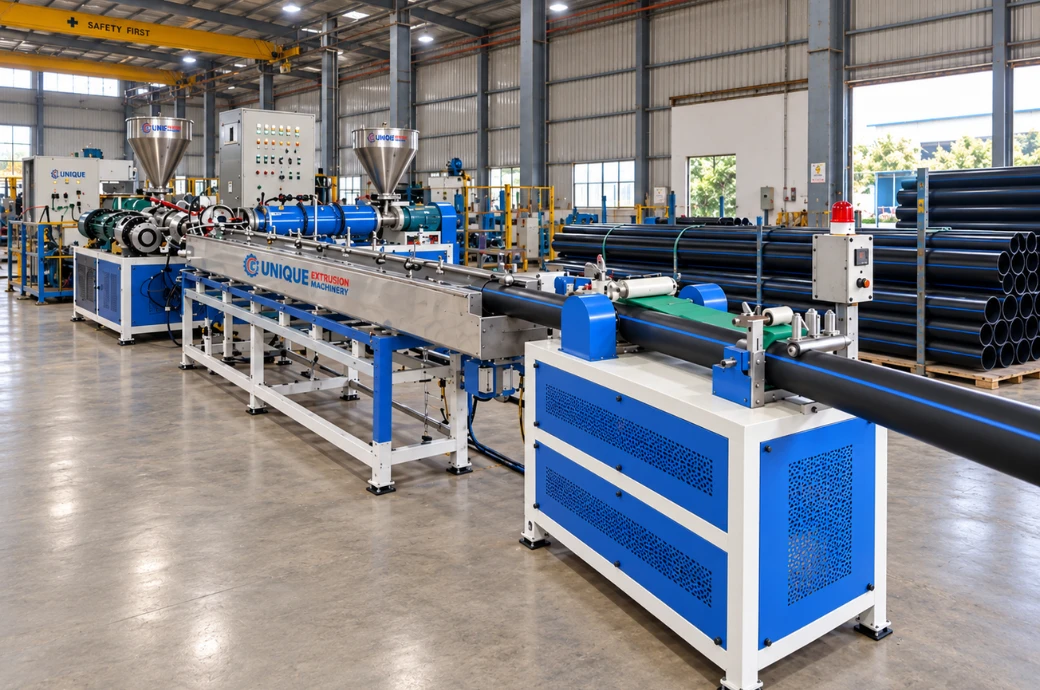
An HDPE pipe machine is not a single unit — it is an extrusion line. Buyers who compare only the extruder end up comparing a third of the plant. Every quotation from Unique Extrusion Machinery is built around the full line below, so you can see exactly what is and is not included before you commit.
Extruder
A single-screw extruder melts and homogenises the HDPE granules. Barrier screw design, 24:1 to 37:1 L/D.
Die head
A spiral-mandrel die head forms the melt into a tube and sets wall distribution. Single, dual or co-extrusion.
Vacuum calibration
The vacuum calibration tank fixes the outer diameter to tolerance — the stage that decides whether your pipe passes ISI testing.
Cooling tank
A spray or immersion cooling tank completes solidification without locking in stress.
Haul-off / traction
The traction unit pulls the pipe at a controlled speed. Line speed versus output is what actually sets wall thickness.
Cutting unit
A planetary cutter gives a square, chipless cut on rigid pipe at full line speed.
Coiler or tilting
Small-bore pipe goes to a pipe coiler; large-bore cut lengths go to tilting units for stacking.
Scrap recovery
A PVC/HDPE grinder returns start-up and off-spec pipe to the hopper instead of to the scrap yard.
Our HDPE pipe making machine range and specifications
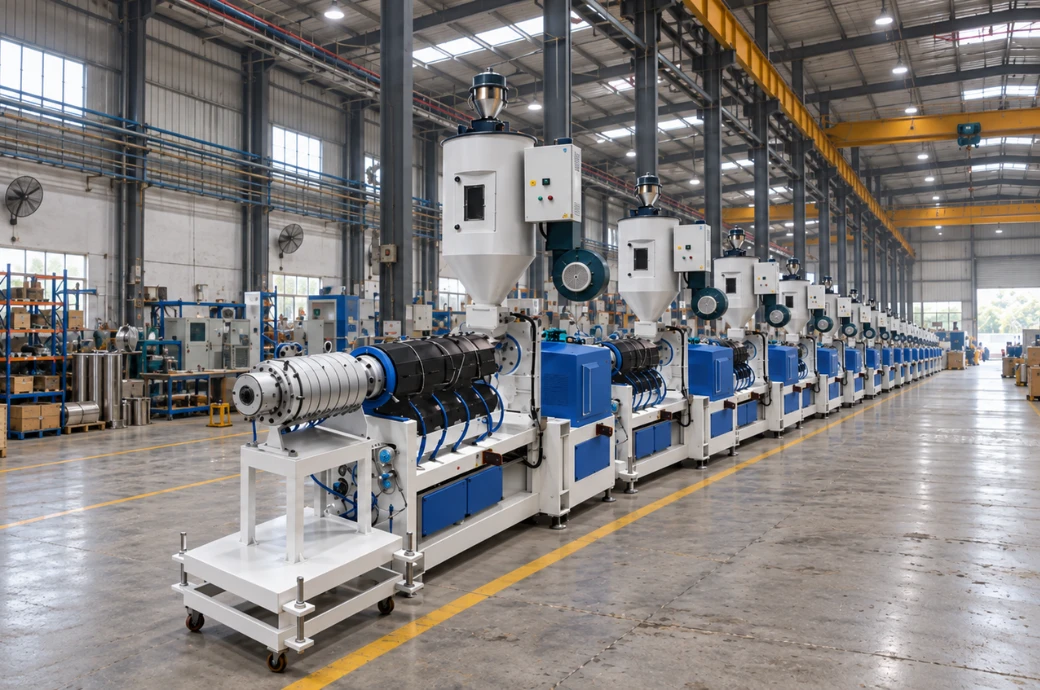
Two extruder families cover the whole HDPE market: the UES standard series for conventional throughput and the High-Speed series with 37:1 L/D barrier screws for high-output production. Both run HDPE, MDPE and PPR. These are the actual published specifications of the machines we build.
| Model | Drive (kW) | Screw Ø (mm) | L/D ratio | Output (kg/hr) |
|---|---|---|---|---|
| UES 25 | 3.7 | 25 | 24:1 | 45 |
| UES 40 | 7.5 | 40 | 26:1 | 18–20 |
| UES 50 | 15 | 50 | 26:1 | 36–40 |
| UES 65 | 30 | 65 | 26:1 | 90–100 |
| UES 75 | 37.5 | 75 | 26:1 | 120–130 |
| UES 90 | 60 | 90 | 26:1 | 170–190 |
| UES 120 | 110 | 120 | 26:1 | 300–320 |
| Model | Screw Ø (mm) | L/D ratio | Motor (kW) | Output (kg/hr) | Pipe range (mm) |
|---|---|---|---|---|---|
| HS 45-45 | 45 | 37:1 | 45 | 140–160 | 20–110 |
| HS 45-55 | 45 | 37:1 | 55 | 180–190 | 20–110 |
| HS 45-75 | 45 | 37:1 | 75 | 220–240 | 20–200 |
| HS 45-90 | 45 | 37:1 | 90 | 300–330 | 63–315 |
| HS 60-110 | 60 | 37:1 | 110 | 380–400 | 63–315 |
| HS 60-132 | 60 | 37:1 | 132 | 500–550 | 63–400 |
| HS 75-200 | 75 | 37:1 | 200 | 650–700 | 110–400 |
| HS 75-250 | 75 | 37:1 | 250 | 800–850 | 110–630 |
What the barrier screw changes
- Higher output from the same footprint — the barrier flight separates melted from unmelted polymer, so plasticising is more complete at a given screw speed.
- More uniform melt temperature — less material slippage and less thermal variation reaching the die head, which shows up as steadier wall thickness.
- Lower energy per kilogram — PLC-controlled heating zones cut heating power draw by a claimed 10–15% against conventional control.
- Operator safety built in — cold-bypass and zero-start interlocks stop the screw being driven before the barrel is at temperature.
Not sure which model fits your pipe programme? Send us your sizes — we will recommend one.
How to choose the right output capacity
The most expensive mistake when buying an HDPE pipe making machine is paying for output you cannot sell — or buying too little and being locked out of the tender sizes that actually pay. Work backwards from the pipe you intend to sell, not from the machine.
Small-bore coil line
140–240 kg/hr
20–200 mm pipe · HS 45-45 to HS 45-75
- Best for: sprinkler, lateral, PLB duct
- Finishing: coiler
- Motor: 45–75 kW
Choose this if your market is irrigation and telecom duct, and you sell in coils rather than cut lengths.
Mid-range water line
300–550 kg/hr
63–400 mm pipe · HS 45-90 to HS 60-132
- Best for: potable water, sewerage
- Finishing: planetary cutter + tilting
- Motor: 90–132 kW
Choose this if you are bidding municipal and Jal Jeevan supply work — this band covers most tender diameters.
Large-diameter line
650–850 kg/hr
110–630 mm pipe · HS 75-200, HS 75-250
- Best for: trunk mains, large sewerage
- Finishing: planetary cutter + tilting
- Motor: 200–250 kW
Choose this if you already have committed volume — large-bore lines earn only when kept loaded.
What you can produce on an HDPE pipe machine
The same HDPE pipe manufacturing machine serves several markets — but the standard your buyer tests against changes, and so does the diameter band you should specify.
Potable water supply
Distribution mains and household service connections for municipal and rural water schemes. The largest single demand pool in India today.
Sewerage & effluent
Non-pressure and low-pressure drainage, industrial effluent and chemical lines where corrosion rules out metal pipe.
Sprinkler & micro-irrigation
PE 63 grade laterals and sprinkler pipe sold in coils — high volume, price-sensitive, subsidy-driven.
City gas distribution
Yellow-striped PE piping for last-mile piped natural gas networks. Higher scrutiny on wall consistency and traceability.
PLB telecom duct
Permanently lubricated HDPE duct for optical fibre. Steady demand from national fibre rollout, sold in long coils.
MDPE & PPR
The same extruder runs MDPE and PPR, letting you add plumbing and hot-water pipe without a second line.
Will your pipe pass ISI testing?
This is the question that decides whether an HDPE pipe machine was a good purchase. ISI marking under IS 4984 is a legal precondition for supplying potable-water pipe in India, and BIS testing is dimensional as much as it is material. A line that cannot hold outer diameter and wall thickness within tolerance will fail you at the certification stage, regardless of how good the pellets were.
- Outer diameter is set by vacuum calibration, not by the die. Vacuum stability and water temperature control in the calibration tank are what hold OD inside the IS tolerance band.
- Wall thickness is set by the haul-off. Any speed drift in the traction unit shows up directly as a wall-thickness deviation — which is why we specify closed-loop speed control rather than open-loop drives.
- Ovality is set by cooling. Under-cooled large-bore pipe deforms under its own weight before it reaches the cutter; the cooling tank length must be matched to the diameter, not bought generically.
- Melt uniformity is set by the screw. Inconsistent plasticising produces wall variation and weak points that show at hydrostatic pressure testing.
- Every line is trial-run before dispatch so you see the machine producing pipe to your specification before it leaves Ahmedabad — not after it is bolted down in your shed.
What decides your HDPE pipe machine price
We do not publish a price list, because no two HDPE pipe making machine lines are the same specification — a number without a configuration behind it is not a quotation, it is a guess. These are the variables that actually move the figure, so you can read any quotation, from us or anyone else, and know what you are comparing.
Rated output (kg/hr)
The single biggest driver. Motor size, gearbox, screw and barrel all scale with it, and so does the downstream equipment that has to keep up.
Pipe diameter range
A 20–110 mm line and a 110–630 mm line are different machines. Wider range means larger calibration and cooling tanks, heavier haul-off and a bigger cutter.
Number of die heads and sizes
Each diameter you intend to run needs its own die and calibration tooling. Buyers routinely under-budget this and get surprised at changeover.
Automation and control level
PLC with recipe storage and closed-loop haul-off costs more than basic control — and pays for itself in scrap reduction and consistency at ISI testing.
Downstream configuration
Coiler versus cutter and tilting units, single or dual take-off, co-extrusion for a striped layer — all optional, all priced separately.
Auxiliaries and scrap recovery
Mixer, grinder, chiller, material handling and compressed air are real line costs that thin quotations quietly leave out.
We will configure a line to your pipe sizes and target output, and quote it itemised — no obligation.
Installation, training and after-sales support
An HDPE pipe making machine only earns money while it is running. The question that matters after purchase is not what the machine cost — it is how quickly someone competent can be standing next to it when it stops.
- Installation and commissioning at your site, with our engineers setting the line up and running it into production rather than handing over a crate and a manual.
- Operator and maintenance training on your own machine — screw pulling, die changeover, calibration setting and routine maintenance.
- Spares held and made in Ahmedabad. Screws, barrels, heaters and calibration tooling are manufactured at our own works, so a replacement is a production decision, not an import lead time.
- Direct access to the people who built the line — you are dealing with the manufacturer, not a trading house reselling somebody else’s machine.
Why choose Unique Extrusion Machinery among HDPE pipe machine manufacturers in Ahmedabad
Ahmedabad is the centre of India’s plastic extrusion machinery industry, and Vatva GIDC alone holds a large share of it. That is good for buyers — but it means the shortlist is long and most of it looks identical online. Here is what actually separates us.
We build the whole line, not just the extruder
Extruder, die head, calibration, cooling, haul-off, cutter, coiler, mixer, grinder and pulverizer are all our own products — so there is one party responsible when the line is commissioned.
Published specifications, not vague claims
Fifteen extruder models with stated kW, screw diameter, L/D ratio and output are on this page. You can hold us to them at the trial run.
Same-city service
Our works is at Plot 5301, Vatva GIDC Estate Phase-4. For a Gujarat plant, that is an engineer on site the same day rather than a support ticket in another time zone.
In-house screw and barrel manufacturing
The wear parts that decide your output are made by us. That is why a worn screw is a scheduled replacement here instead of a three-month import.
Trial run before dispatch
Your line produces pipe to your specification at our works before it ships. You approve output and dimensional consistency before it is crated.
PVC and HDPE under one roof
Already running PVC? Our PVC pipe manufacturing machine range shares tooling philosophy, spares channel and service team with your HDPE line.
More about how we work: our manufacturing facilities · quality policies · why us · machines on video · full machine range.
HDPE pipe machine — frequently asked questions
What is the price of an HDPE pipe machine in India?
There is no single price, because an HDPE pipe machine is a line rather than one unit. The figure is driven by rated output in kg/hr, the pipe diameter range, how many die and calibration sizes you need, the level of automation, and the downstream configuration you choose. Published “starting from” numbers almost always exclude tooling, installation and auxiliaries. Send us your pipe sizes and target output and we will quote an itemised HDPE pipe machine price for a line that matches them.
What output capacity should I choose for my HDPE pipe making machine?
Work backwards from the pipe you can actually sell. For sprinkler, irrigation lateral and PLB telecom duct in 20–200 mm, a 140–240 kg/hr coil line is usually right. For municipal potable water and sewerage in 63–400 mm, most buyers land in the 300–550 kg/hr band. Above that, 650–850 kg/hr large-diameter lines only earn their cost if you already have committed volume, because they lose money standing idle between orders.
What is the difference between an HDPE pipe extruder machine and a complete HDPE line?
The HDPE pipe extruder machine is the extruder alone — the barrel, screw, drive and heating that melt the granules. A complete line adds the die head, vacuum calibration tank, cooling tank, haul-off, cutting unit and coiler or tilting units. You cannot make saleable pipe with the extruder alone, so when comparing quotations always confirm which of the two you are being priced for.
Can the same machine run HDPE, MDPE and PPR?
Yes. Our single-screw UES and High-Speed series are designed for HDPE, MDPE and PPR, which lets you serve water, gas, irrigation and plumbing markets from one line. Changing material does mean a screw and temperature-profile review, and in some cases a different die head, so tell us at the enquiry stage which materials you intend to run.
Will pipe from your HDPE pipe manufacturing machine pass IS 4984 ISI certification?
The ISI licence is granted against your pipe and your factory, not against our machine — but passing depends heavily on the line holding dimensional tolerance. Our lines are specified with vacuum calibration and closed-loop haul-off control precisely so outer diameter, wall thickness and ovality stay within the IS 4984 (potable water) and IS 14333 (sewerage) bands. Every line is trial-run to your specification before dispatch so you see the tolerance being held before you take delivery.
What is the maximum pipe diameter your HDPE pipe extrusion machine can produce?
Up to 630 mm on our High-Speed 75-250 line, which runs 110–630 mm at 800–850 kg/hr. Below that, the range steps down through 63–400 mm, 63–315 mm, 20–200 mm and 20–110 mm depending on the model — the full breakdown is in the specification table above.
Do you install the machine and train our operators?
Yes. Installation and commissioning are carried out at your site by our engineers, and operator plus maintenance training is given on your own machine — covering screw pulling, die changeover, calibration setting and routine maintenance. Confirm the scope in writing on your purchase order so there is no ambiguity later.
Are you the same company as Unique Machinery, Ahmedabad?
No. Unique Extrusion Machinery Pvt. Ltd. operates from Plot No 5301, Vatva GIDC Estate Phase-4, Ahmedabad, and our only website is uniqueextrusion.com. “Unique Machinery” is a different business with a similar name. Please verify company details and bank particulars before making any payment.
Get your HDPE pipe machine configured and quoted
Tell us the pipe diameters you want to run and the tonnage you need. Our engineers will size the extruder, die head, calibration, cooling and downstream equipment, and send you an itemised quotation — with nothing hidden outside the price.
Unique Extrusion Machinery Pvt. Ltd. · Plot No 5301, Vatva GIDC Estate Ph-4, Vatva, Ahmedabad, Gujarat 382445
sales@uniqueextrusion.com · +91 96876 81992 · +91 78744 94840