



HDPE vs PVC Pipe: Which Should You Manufacture?

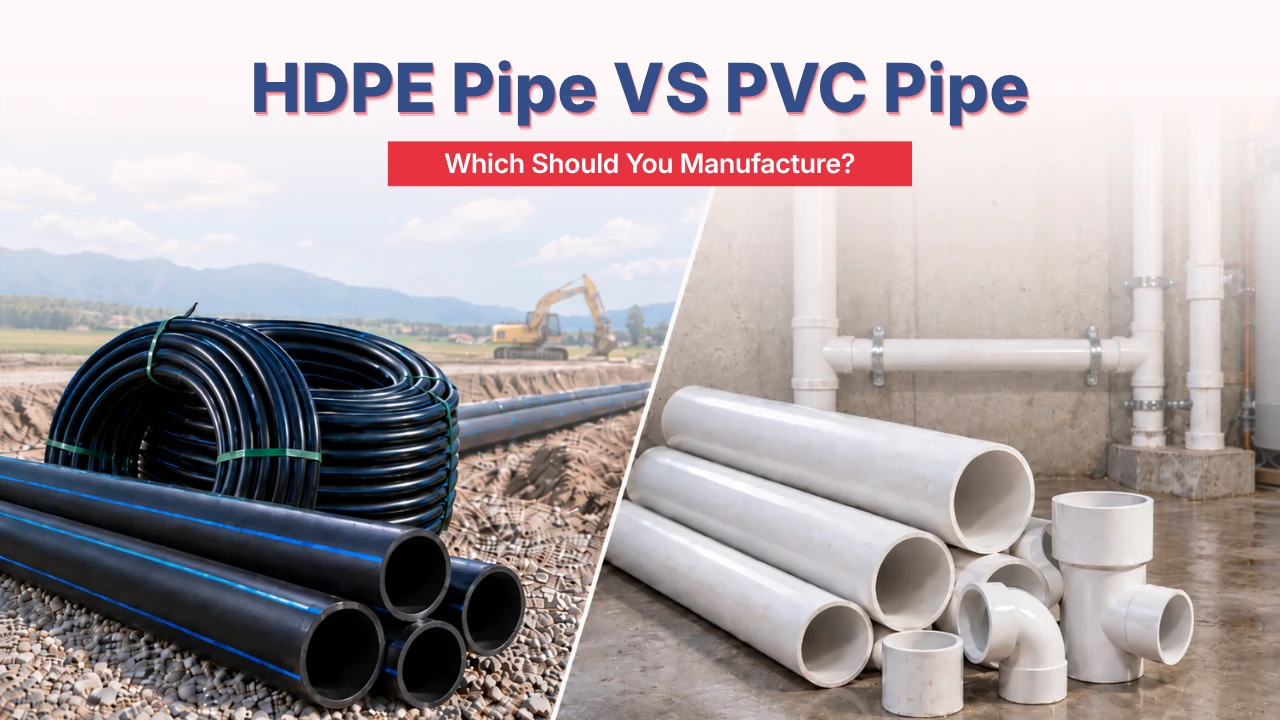
Pipe manufacturing guide
Almost every “HDPE vs PVC pipe” article is written for the person buying pipe. This one is written for the person deciding which pipe to make — by the people who build the machines that make both.
Manufacture uPVC pipe if you want faster stock rotation, a dealer-led market and a lower raw-material bill. Manufacture HDPE pipe if you can fund longer credit cycles and want government water and irrigation tenders. The two need different extruders, different BIS licences and different buyers — so the market decision comes first, and the machine decision follows it.
Key takeaways
- HDPE vs PVC pipe manufacturing is a market decision, not a materials one. Both pipes have strong, growing demand in India. What separates them is who buys them and how fast they pay.
- Different machines, not a setting. uPVC pipe needs a twin-screw extruder with a vacuum calibration tank. HDPE pipe needs a single-screw extruder and a coiler. You cannot make one properly on the other’s line.
- Different licences. uPVC water pipe is certified to IS 4985; HDPE water pipe to IS 4984. Both carry a mandatory ISI mark, and each is a separate BIS application.
- Different buyers. uPVC mostly sells through plumbing and agri dealers. HDPE leans heavily on government schemes and irrigation projects, which pay later.
- Raw material differs in form and price. uPVC starts as a powder blend you mix yourself; HDPE arrives as ready-to-run granules and costs more per kg.
- Most established units end up making both — but almost nobody should start with both.
Why “which pipe is better” is the wrong question
Search for HDPE vs PVC pipe and you will find a hundred pages arguing about which is better on bend radius, pressure class and joint strength. Those pages are written for engineers and contractors choosing what to install. They are useful, and we cover that comparison below.
But if you are setting up or expanding a pipe factory, none of it decides anything for you. Both pipes sell in India. Both have real demand. Neither is going away.
The question that actually decides your investment is different: which business do you want to be in? HDPE pipe manufacturing and uPVC pipe manufacturing are two different businesses that happen to use similar-looking equipment. They differ in the machine you buy, the material you buy, the licence you apply for, the customer you chase, and how long you wait to get paid.
Those five things are what HDPE vs PVC pipe manufacturing really comes down to, and they are what the rest of this guide compares.
HDPE vs PVC pipe manufacturing: side by side
Here is the comparison that matters when you are choosing what to manufacture. Read it as two business models, not two materials.
| Factor | uPVC pipe manufacturing | HDPE pipe manufacturing |
|---|---|---|
| Main extruder | Twin-screw or conical twin-screw | Single-screw / high-speed single-screw |
| Raw material form | Dry powder blend you mix in-house (resin + stabiliser + filler) | Ready-made pipe-grade granules, run straight from the bag |
| Indicative material cost | PVC suspension resin K-67 roughly ₹88–95/kg | Pipe-grade HDPE granules roughly ₹100–110/kg |
| Extra plant needed | Heater-cooler mixer, and usually a pulverizer and grinder | No mixer needed; scrap grinder still useful |
| Sizing after the die | Vacuum calibration tank (essential) | Vacuum calibration plus long cooling; larger water demand |
| How pipe leaves the line | Cut to length, then socketed | Coiled for small sizes; cut to length for large |
| Jointing at site | Solvent cement or rubber ring | Butt fusion or electrofusion (buyer needs a welding machine) |
| BIS standard (water) | IS 4985 — ISI mark mandatory | IS 4984 — ISI mark mandatory |
| Typical buyer | Plumbing and agri dealer networks, builders, hardware trade | Government water schemes, irrigation projects, telecom duct, gas utilities |
| How you get paid | Shorter cycles through the dealer channel; faster stock rotation | Tender-linked, often long credit; needs deeper working capital |
| Main risk | Resin price swings hitting inventory value | Order concentration — a few large buyers, lumpy demand |
| Competition | Very crowded, especially in Gujarat | Crowded but fewer small units, because tenders demand scale |
What is HDPE pipe, and what is uPVC pipe?
A short definition of each, then the material comparison the buyer-side articles argue about.
uPVC pipe
Made from unplasticised polyvinyl chloride. It is rigid, holds its shape, and is joined with solvent cement or a rubber sealing ring. In India it dominates plumbing, borewell casing, agricultural delivery lines and drainage (SWR).
HDPE pipe
Made from high-density polyethylene. It is flexible enough to be supplied in coils, and joined by heat fusion so the joint becomes part of the pipe. In India it dominates rural water supply, sprinkler and drip irrigation, telecom ducting and gas distribution.
The material difference in one table
| Property | uPVC | HDPE |
|---|---|---|
| Stiffness | Rigid | Flexible, bends without cracking |
| Joint type | Solvent cement / rubber ring | Butt fusion or electrofusion — leak-free |
| Ground movement | Can crack if soil shifts | Absorbs movement well |
| Supply form | Straight lengths | Coils (small bore) and straight lengths |
| Best suited to | Indoor plumbing, drainage, borewell casing | Buried mains, farm lines, uneven terrain, long runs |
| UV exposure | Needs protection when exposed | Carbon-black grades handle sunlight well |
For a manufacturer, the practical read of this table is simple: HDPE wins where pipe is buried over long distances, and uPVC wins where pipe runs inside buildings and through dealer counters. That is why the two have such different customers.
Do HDPE and PVC pipes need different machines?
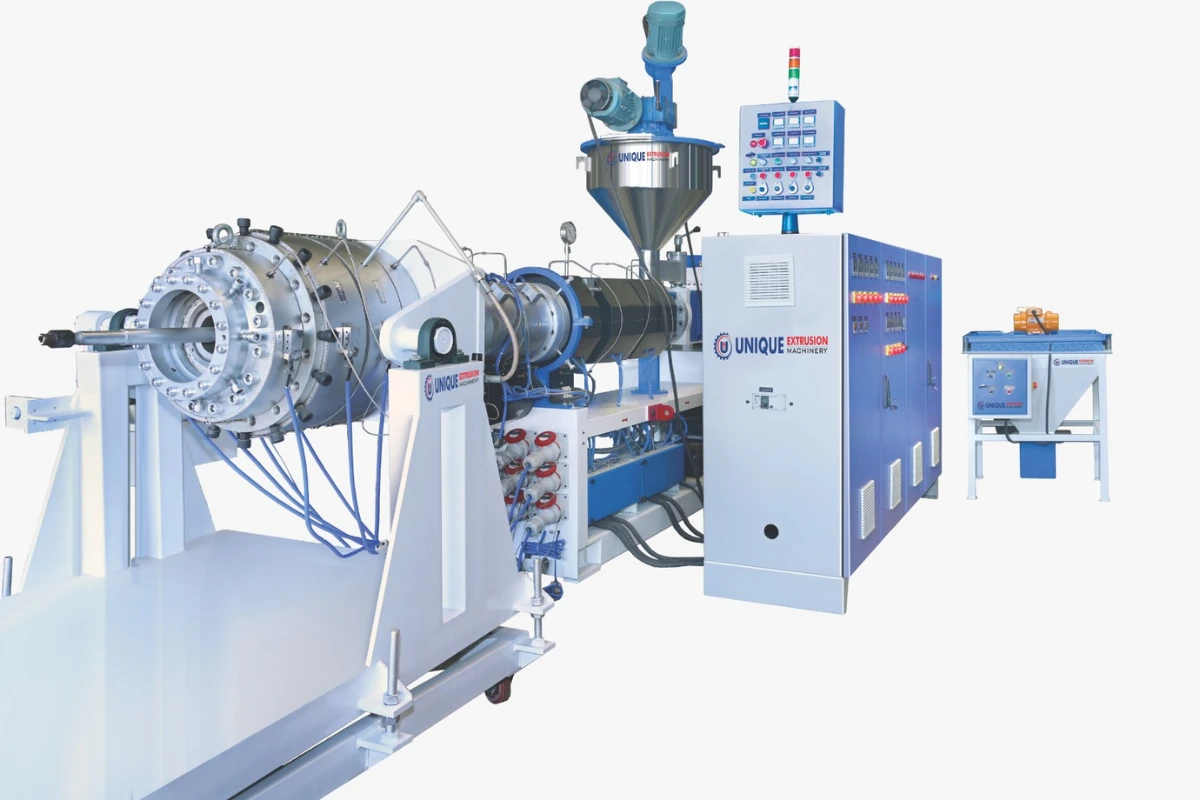
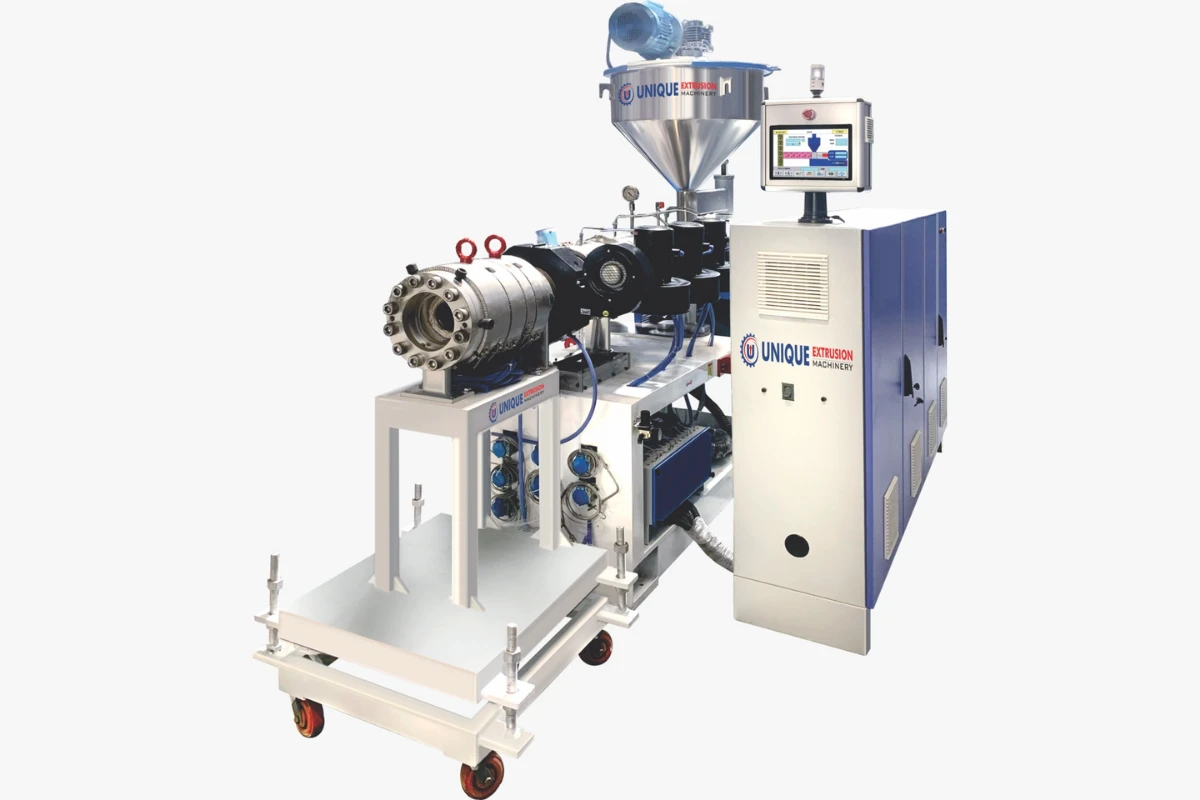
Yes. HDPE and uPVC pipe need different extruders, and the difference is not a setting you change. uPVC is a heat-sensitive powder blend that needs the gentle, controlled mixing of a twin-screw extruder. HDPE arrives as pre-compounded granules that a single-screw extruder melts and pushes efficiently. Using the wrong one degrades the material or wastes capacity.
For uPVC: twin-screw
- Two intermeshing screws mix the dry blend gently and evenly
- Handles heat-sensitive PVC without burning it
- Strong, positive conveying of powder
- Vents moisture and volatiles out of the blend
See our twin-screw extruder for PVC, uPVC and RPVC and the conical twin-screw extruder.
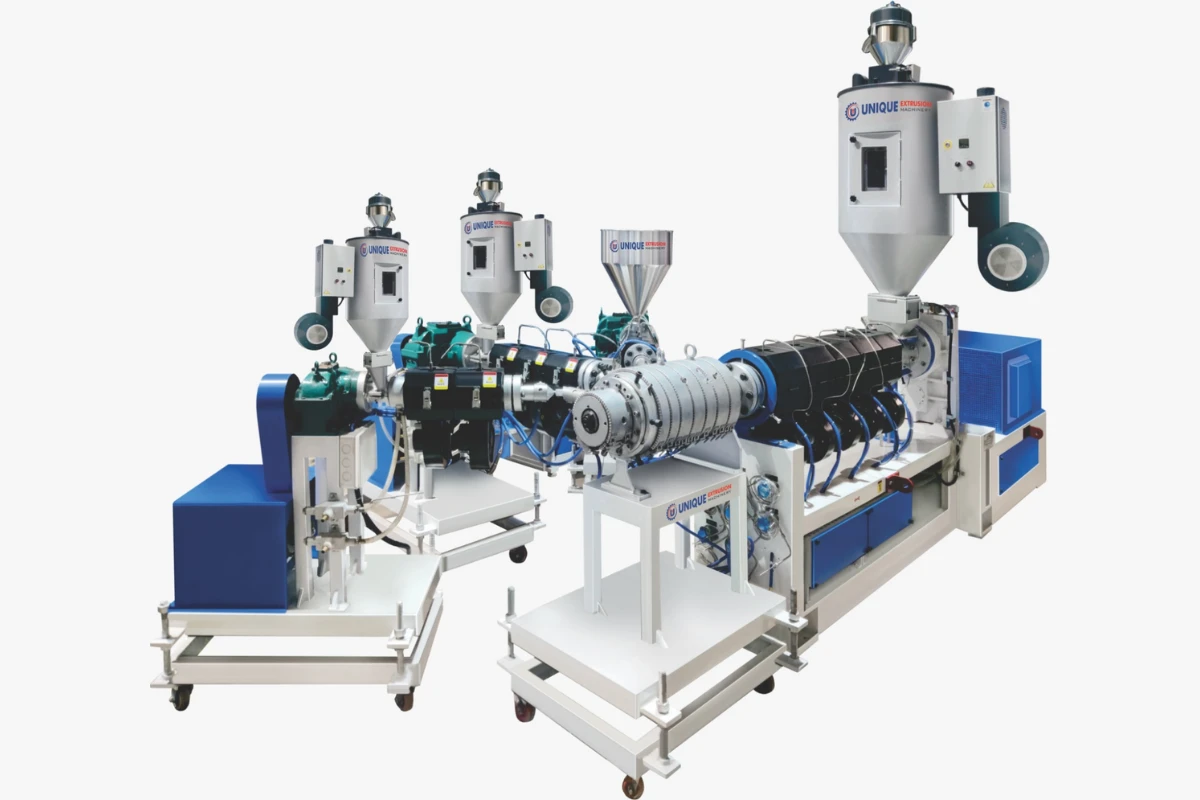
For HDPE: single-screw
- One screw melts and pumps ready-made granules
- Longer barrel (higher L/D) for a stable, uniform melt
- Much higher output per rupee of machine on PE
- Simpler to run, simpler to maintain
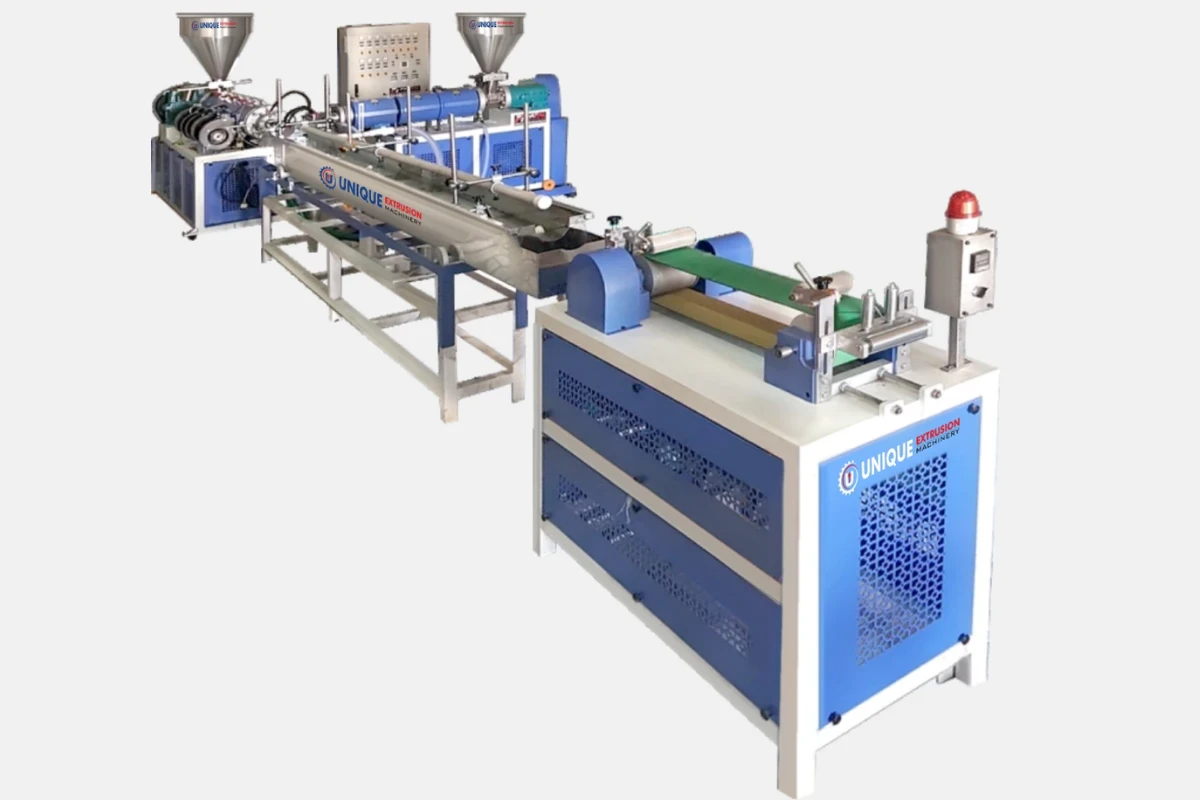
The downstream equipment differs too. A uPVC line finishes with a planetary cutting unit and then a plain socketing machine or SWR socketing machine, because uPVC pipe is sold in socketed lengths. An HDPE line usually finishes with a pipe coiler instead, because small-bore HDPE is sold in coils. A uPVC plant also needs a high-speed heater-cooler mixer to make the dry blend in the first place — an HDPE plant does not.
Some equipment is genuinely shared: the die head (sized per pipe), the vacuum calibration tank, the cooling tank, the traction unit and a PVC/HDPE grinder for scrap.
Which raw material is cheaper and easier to source?
PVC resin is cheaper per kg than HDPE granules, but it is not ready to use. Pipe-grade PVC suspension resin has been trading in the region of ₹88–95/kg, and pipe-grade HDPE granules around ₹100–110/kg. Those are indicative market levels, not quotations — polymer prices are revised every few weeks and move with crude.
The per-kg gap is only half the story. The two materials behave differently in your factory and on your balance sheet:
uPVC: you compound it
You buy resin and separately buy stabiliser, lubricant, filler and pigment, then mix your own dry blend. That gives you real control over cost and quality — a good formulation is a genuine competitive advantage. It also means one more process, one more skill to hire for, and one more place to go wrong.
HDPE: you run it
Pipe-grade granules come compounded and ready. Less process risk, fewer people, faster to get consistent pipe. But you have very little room to engineer your cost down — you pay close to what everyone else pays, so you compete on efficiency and scale instead.
There is a working-capital point too. PVC resin prices have been volatile: a sharp fall can leave you holding inventory worth less than you paid, and dealers destock while they wait for the bottom. That volatility hits uPVC makers harder because they carry more inventory in the channel.
Which BIS licence do you need — IS 4984 or IS 4985?
You need IS 4985 to make uPVC water pipe and IS 4984 to make HDPE water pipe. Both carry the ISI mark and both are mandatory under Quality Control Orders — you cannot legally sell these pipes in India without the licence. They are separate applications, with separate factory inspections and separate test reports.
The process is broadly the same for both: apply through the BIS Manak Online portal, host a BIS factory inspection, have samples drawn and tested at a BIS-recognised laboratory, and receive the licence to use the ISI mark. Published timelines commonly quoted are around 20–30 days once testing begins, with testing itself taking 7–15 days — treat these as best-case indicators, not guarantees, and confirm current timelines with BIS or your consultant.
If you plan to make both pipes eventually, you will hold both licences eventually. Most units get one, start selling, and add the second later.
Who buys HDPE pipe, and who buys PVC pipe?
This is the section most people skip, and it is the one that decides whether your factory survives its first two years. The machine makes pipe. The buyer pays for it.
uPVC buyers
- Plumbing and hardware dealer networks
- Agricultural pipe distributors
- Builders and plumbing contractors
- Borewell casing traders
Many small buyers, repeat orders, shorter credit. You need a sales team and a distribution network — and you are fighting large branded players on the same shelf.
HDPE buyers
- Government rural water supply schemes
- Irrigation projects and sprinkler suppliers
- Telecom duct (PLB) contractors
- City gas distribution utilities
Fewer, bigger buyers. Tenders need registration, certification and often past-performance records — and payment terms are long.
India’s HDPE demand is heavily tied to public spending. The Jal Jeevan Mission, which aims to give every rural household a tap connection, requires BIS-certified HDPE pressure pipe under IS 4984 — and irrigation schemes under PMKSY drive a large share of HDPE demand on top of that. That is a genuine opportunity, but it is also concentration risk: a scheme’s pace, and its payment cycle, becomes your pace and your payment cycle.
uPVC demand is broader and steadier because it comes from thousands of private buyers rather than a handful of public ones. It is also more price-competitive for exactly the same reason.
Which needs more investment, and which earns more?
A comparable HDPE line usually costs less in machinery than a uPVC line, but needs more working capital. A single-screw extruder is meaningfully cheaper to buy than a parallel twin-screw of similar class, and an HDPE plant skips the mixer and pulverizer entirely. Then the tender credit cycle takes back what the machine saved.
Published industry figures put net margins for HDPE pipe manufacturing in the region of 8–14%, with gross margins around 18–25% at reasonable scale. These are third-party analyst figures for indicative plant sizes, not a promise about your unit — your actual margin depends on your material cost, your power tariff, your scrap rate and your selling channel.
On market size, both are growing. India’s PVC pipe market is projected to grow from roughly 3.1 million tonnes in 2025 to about 5.6 million tonnes by 2034, while the India HDPE pipes market is put at roughly USD 718 million in 2025 rising to about USD 1,029 million by 2034. Different research houses publish materially different numbers for both, so use these as direction, not as a business plan input.
Can you manufacture both HDPE and PVC pipe?
Yes, and many established Indian pipe makers do — but you need a second extruder, not a second setting. The extruder is material-specific. What you can genuinely share is much of the downstream: the vacuum calibration tank, cooling tank, traction unit and scrap grinder can serve either line with the right tooling.
The realistic path most units take:
- Start with one pipe — whichever matches the market you can actually reach today.
- Get the BIS licence and build the customer base for that pipe first.
- Add the second extruder once the first line is running near capacity and the cash flow is predictable.
Running both does real work for you: it lets you shift capacity toward whichever segment — plumbing, agriculture, or government water supply — is strongest that season, instead of being exposed to one demand cycle. That resilience is why diversified pipe makers ride out resin price swings and tender slowdowns better than single-product units. But it is a step two, not a step one. Buying two lines before you can sell one pipe is the most expensive mistake in this business.
How to decide: four questions
Answer these four honestly and the decision usually makes itself.
1. Who can you actually sell to in the next six months?
Not who you hope to sell to eventually — who will take your pipe now. If you already know dealers and hardware distributors, that points to uPVC. If you have contacts in government contracting, irrigation supply or telecom ducting, that points to HDPE. Market access beats every technical argument on this page.
2. How long can you wait to be paid?
Tender-linked HDPE work can leave you funding production for months. If your working capital is tight or expensive, the dealer channel’s faster rotation on uPVC is safer, even at thinner margins.
3. Do you want to compound your own material?
Formulating a uPVC dry blend is a genuine cost advantage if you have or can hire the skill — and a genuine source of rejects if you cannot. HDPE granules remove that variable completely.
4. What does your own region already make?
A crowded local segment means price pressure, but it also means available operators, available spares and a proven material supply chain. A thin local segment means less competition and more of everything to arrange yourself. Both are workable — just go in knowing which one you picked.
HDPE vs PVC pipe manufacturing in Ahmedabad and Gujarat
Gujarat is one of India’s densest plastic-processing regions, and Ahmedabad sits at the centre of it. If you are setting up here, a few things are genuinely different from the national picture.
The uPVC segment is crowded — and that cuts both ways
The GIDC estates around Ahmedabad — Vatva, Naroda, Odhav, Kathwada — already hold a large number of PVC pipe units. Competition on price is real. But so is the ecosystem: trained extruder operators, same-day spares, local resin and additive traders, and machine builders in the same estate who can be at your line in an hour. That last point matters more than most new entrants expect. A line that is down for three days because a part is coming from another state costs more than the price difference that made you buy it.
HDPE demand in Gujarat is project-driven
Gujarat’s HDPE pull comes mainly from rural water supply work, sprinkler and drip irrigation across the state’s farming belts, and telecom and gas ducting. That work is tender-led, so it favours units that can hold certification, deliver volume on a schedule, and wait for payment. Fewer small units chase it, which is precisely why there is room in it — if you are funded for it.
Practical local advantages
- Port access. Gujarat’s ports shorten the supply chain for imported resin and granules compared with landlocked states.
- GIDC plots. Ready industrial plots with power and effluent infrastructure already in place, rather than converting land yourself.
- Machinery on your doorstep. Both twin-screw and single-screw pipe lines are built in Ahmedabad, so commissioning, training and service do not depend on a supplier in another country.
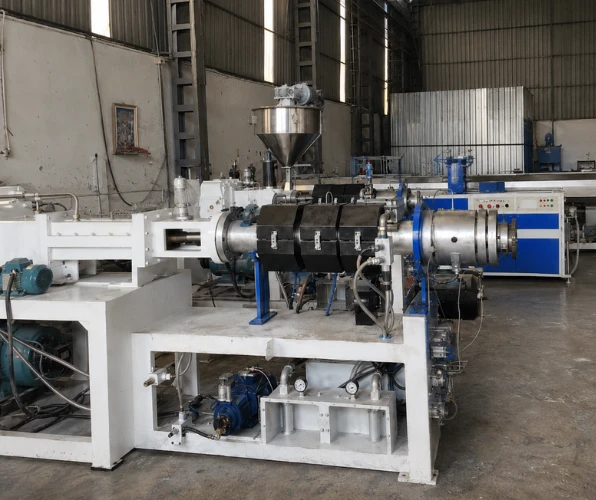
We build our pipe extrusion lines at Vatva GIDC in Ahmedabad, and a large share of the units we commission are within a few hours’ drive. If you are planning a line in Gujarat, you can see where and how the machines are made before you order.
Common mistakes when choosing what to manufacture
- Picking the pipe with the better technical specs. HDPE outperforms uPVC on several properties. That is a reason buyers choose it for certain jobs — not a reason it is the better business for you.
- Buying the machine before finding the market. The commonest and costliest error. Machinery is the easy part to arrange; distribution is not.
- Assuming one extruder can do both. It cannot, not properly. Budget for the right machine for the pipe you are actually selling.
- Treating the BIS licence as paperwork at the end. It shapes your equipment and your in-house lab. Plan it into the project from day one.
- Under-funding working capital. Especially on the HDPE side. Many units that failed had a perfectly good line sitting idle for want of cash to buy material.
- Undersizing the line to save money. An output class you outgrow in a year is more expensive than the right machine bought once. Decide capacity from your realistic year-three volume.
Frequently asked questions
Which is more profitable to manufacture — HDPE or PVC pipe?
In HDPE vs PVC pipe manufacturing, neither is reliably more profitable on its own. Published figures put HDPE pipe manufacturing net margins around 8–14% at reasonable scale ⚠, but uPVC often rotates stock faster, which can matter more than headline margin. Profitability is decided by your material cost, your scrap rate, your power tariff and your access to buyers — not by the polymer.
What is the main difference between HDPE and PVC pipe?
uPVC is rigid and joined with solvent cement or rubber rings; HDPE is flexible, supplied in coils for small sizes, and joined by heat fusion so the joint is as strong as the pipe. uPVC dominates indoor plumbing and drainage; HDPE dominates buried water mains, irrigation and ducting.
Can I make HDPE and PVC pipe on the same machine?
No. uPVC needs a twin-screw extruder to handle its heat-sensitive powder blend; HDPE runs best on a single-screw extruder designed for granules. You need a separate extruder for each. Much of the downstream — calibration tank, cooling tank, traction unit, grinder — can be shared with the right tooling.
Which BIS licence do I need to make water pipe?
IS 4985 for uPVC water pipe and IS 4984 for HDPE water pipe. Both require the ISI mark and both are mandatory. They are separate applications with separate factory inspections and lab tests, so holding one does not cover the other.
Which needs more investment to start?
Machinery for a comparable HDPE line is usually cheaper — a single-screw extruder costs less than a parallel twin-screw, and you skip the heater-cooler mixer and pulverizer. But HDPE typically needs more working capital because tender buyers pay later. Add both together before comparing.
Is HDPE pipe replacing PVC pipe in India?
Not replacing — expanding into different jobs. HDPE is winning buried water supply, irrigation and gas and telecom ducting, helped by schemes like the Jal Jeevan Mission. uPVC keeps plumbing, drainage and borewell casing. Both markets are projected to keep growing through the next decade.
Which raw material is cheaper — PVC resin or HDPE granules?
PVC resin is cheaper per kg — pipe-grade suspension resin has traded around ₹88–95/kg against roughly ₹100–110/kg for pipe-grade HDPE granules. ⚠ But PVC resin still has to be compounded with stabilisers and fillers in your own mixer, while HDPE granules run straight from the bag.
Should a first-time manufacturer start with HDPE or PVC?
Start with whichever market you can already reach. If you know dealers and distributors, start with uPVC. If you have access to government or irrigation contracts and the working capital to fund long credit, start with HDPE. Add the second line once the first is running near capacity.
How long does BIS certification take for pipe manufacturing?
Commonly published timelines are around 20–30 days once the process is under way, with laboratory testing taking 7–15 days of that. ⚠ Treat those as best-case figures — the real timeline depends on your factory readiness, your in-house testing setup and BIS scheduling. Confirm current timelines with BIS before planning around them.
Not sure which line your market needs?
Tell us which pipe you plan to make, the diameter range and the output you need, and our team will spec the right extrusion line and itemise what it includes — whether that is uPVC, HDPE, or both.
About the author
Unique Extrusion Machinery Technical Team — we design and build plastic pipe extrusion machinery at Vatva GIDC, Ahmedabad: twin-screw and conical twin-screw extruders for PVC, uPVC, RPVC and CPVC, single-screw and high-speed extruders for HDPE, PPR and MDPE, and the full downstream line from die head to socketing machine.
Because we build lines for both materials, we have no stake in which pipe you choose — only in you choosing the one your market will actually buy. More about us · Why manufacturers choose us · Quality policy