


Twin Screw vs Single Screw Extruder

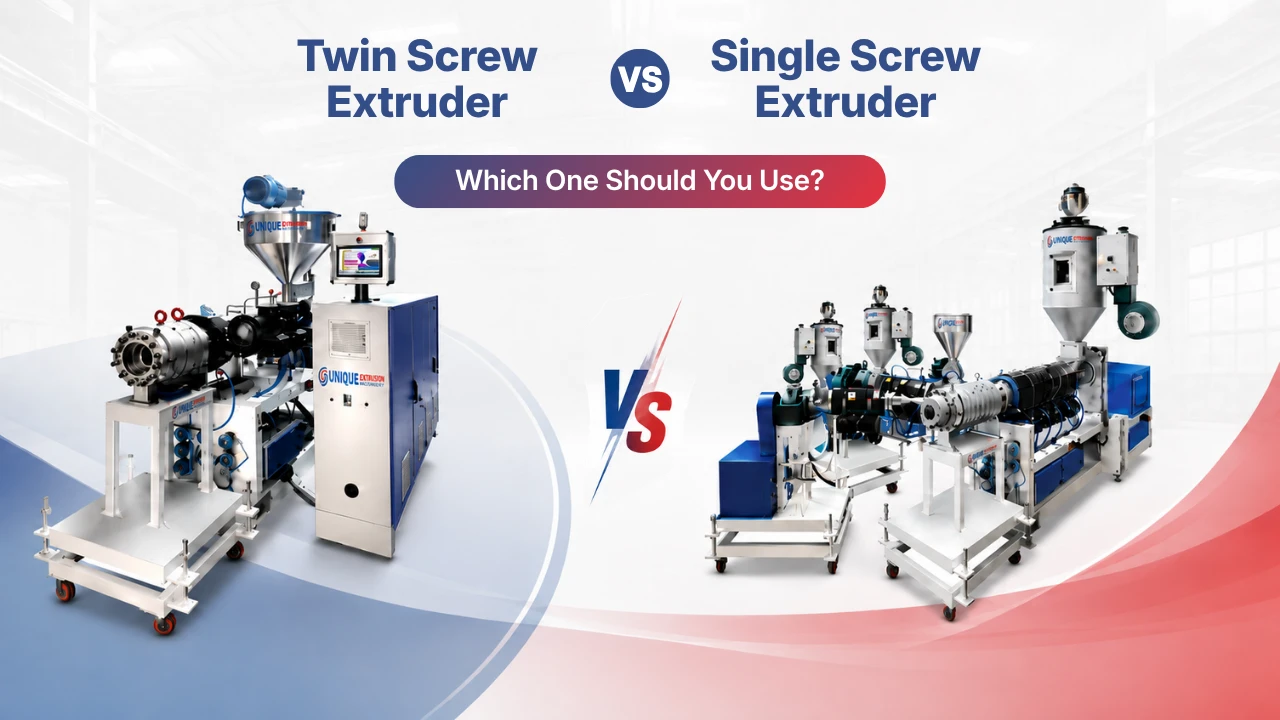
Twin Screw vs Single Screw Extruder: Which One Should You Use?
A real spec-by-spec comparison, a simple decision framework, and the India-specific factors most guides skip — written by the team that builds both machine types.
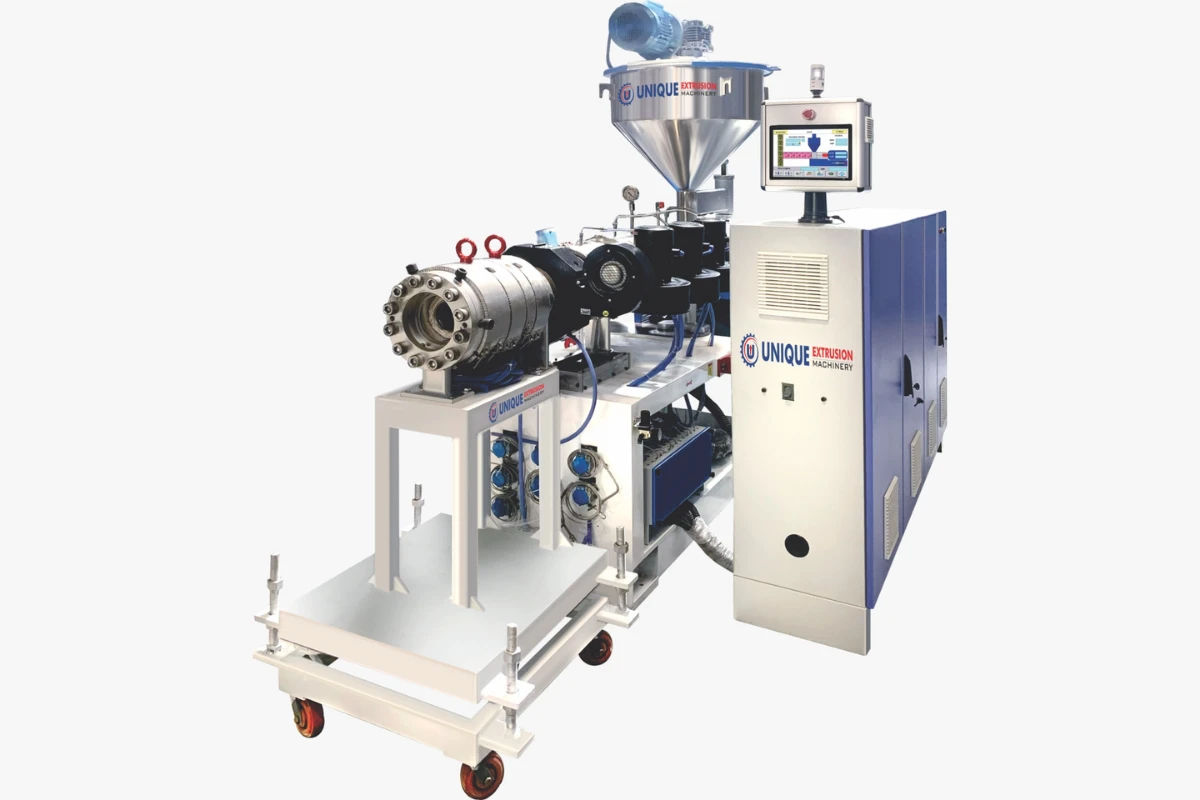
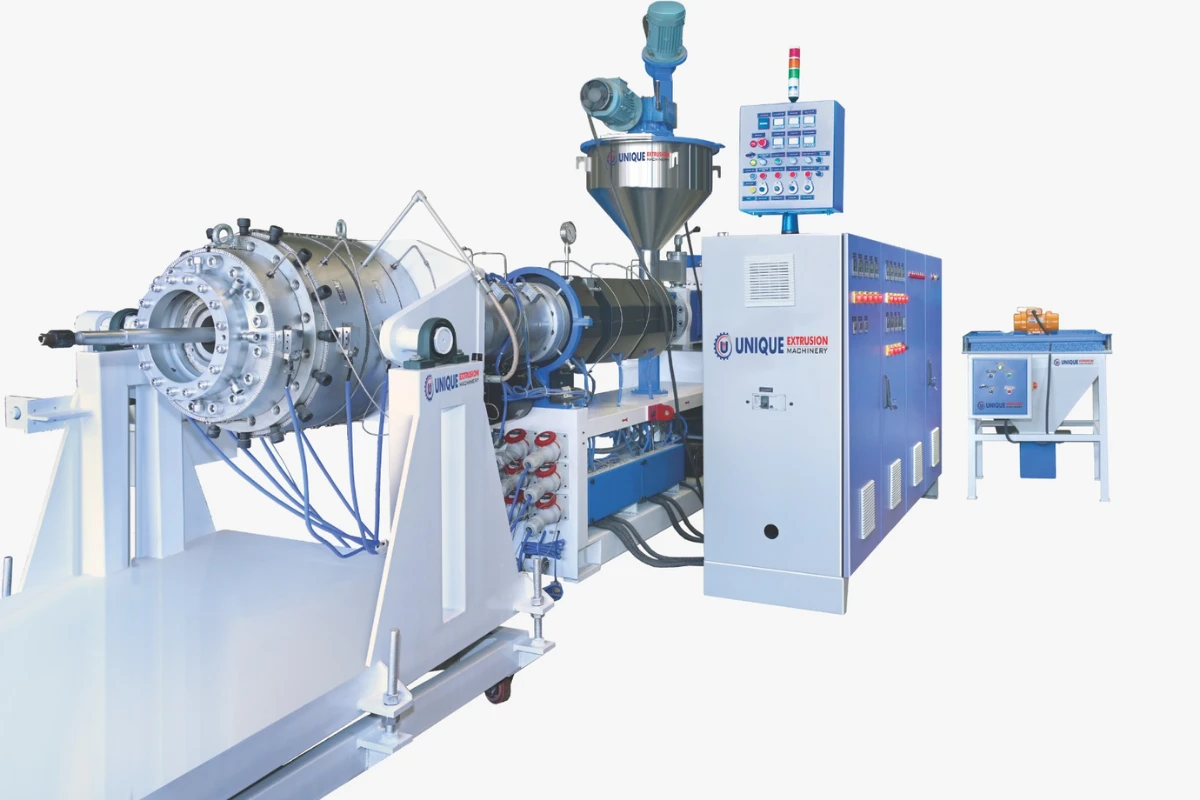
Twin-Screw Extruder
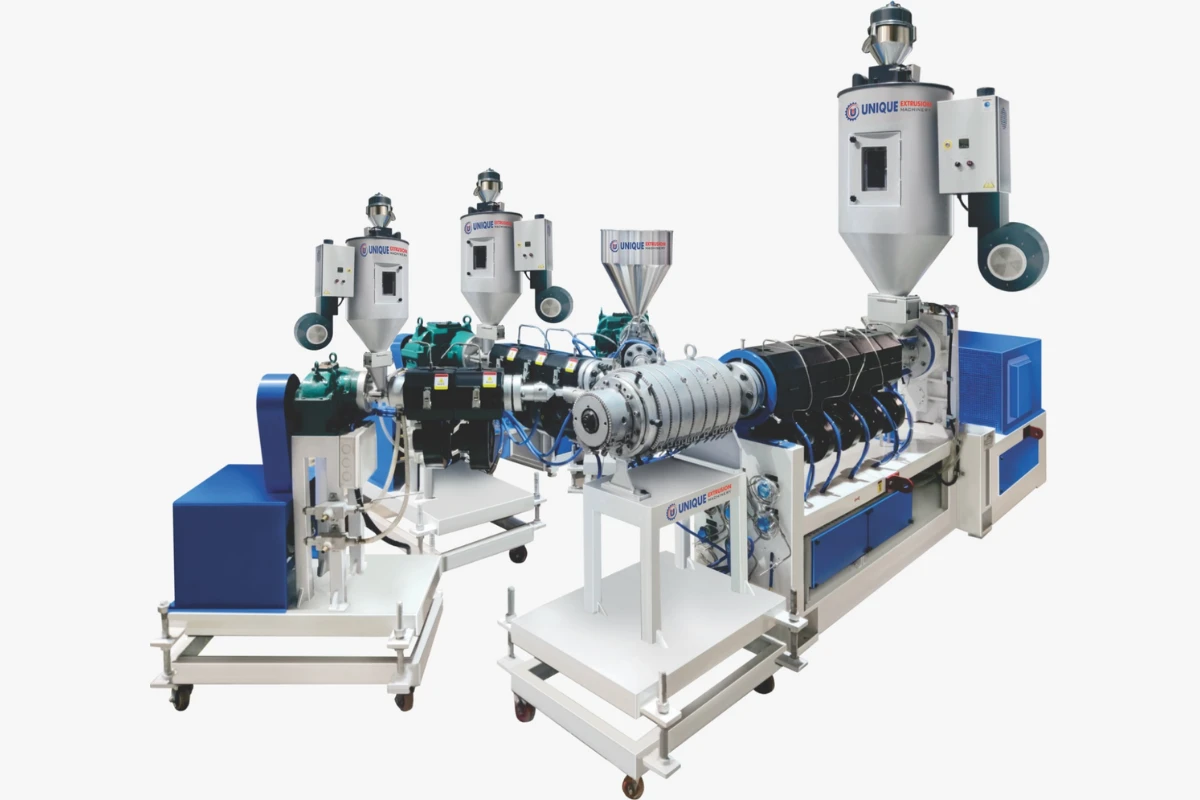
Single-Screw Extruder
Use a twin-screw extruder for PVC, uPVC, RPVC or CPVC pipe made from powder/dry-blend material that needs strong in-line mixing — and a single-screw extruder for HDPE, PPR or MDPE pipe made from pre-compounded pellets. The deciding factor isn’t output or price; it’s the raw material’s form (powder vs pellet) and how much mixing it needs before it can be shaped into pipe.
If you build pipe for a living, this question comes up early and it comes up often: twin screw or single screw? Both machines push molten plastic through a die to make pipe, but they’re built for two different jobs. Get the match wrong and you’ll fight melt quality, output consistency or unnecessary capex for years. This guide is written by Unique Extrusion Machinery, a pipe extrusion machinery manufacturer in Vatva GIDC, Ahmedabad that builds and sells both extruder types — so, unlike most comparison articles online, this one isn’t trying to sell you just one of them.
Key takeaways
- The real decision driver is raw material form — powder/dry-blend PVC needs a twin-screw extruder; pre-compounded HDPE/PPR/MDPE pellets run well on a single-screw extruder.
- Twin-screw extruders mix and melt faster and handle harder-to-feed powder formulations; single-screw extruders are simpler, cheaper to buy and cheaper to maintain.
- It’s a myth that twin screw always means higher output — Unique Extrusion Machinery’s own single-screw High-Speed series (up to ~850 kg/hr) out-produces its twin-screw PVC line (up to ~700 kg/hr).
- See the full spec-by-spec comparison table below, built from our live product catalogue, not generic claims.
- In India, IS 4985 quality-consistency requirements and local spares/service availability make the “wrong” extruder for your material an expensive long-term mistake — not just a startup one.
On this page
What's the difference between a single-screw and a twin-screw extruder?
A single-screw extruder has one rotating screw that relies on friction and drag flow to move, melt and pressurise material — simple, and best suited to consistent, pre-compounded feedstock. A twin-screw extruder has two intermeshing screws that positively convey the material forward, giving far stronger mixing, venting and melting control — best suited to powder or dry-blend formulations that still need to be compounded as they’re extruded.[1]
Both machine types do the same basic job — melt plastic and push it through a die — but they get there differently. A single screw pushes material along mostly by friction against the barrel wall, which is why it performs best when the feed is already uniform: pre-compounded pellets with consistent particle size and moisture content. A twin screw’s intermeshing screws physically drag material forward and through each other, which is what gives it much stronger mixing and the ability to handle powder, dry-blend and filler-loaded formulations that a single screw would struggle to melt evenly.[2]
That single distinction — how the material is fed and how much mixing it needs — is what should drive your choice, not “which one sounds more advanced.”
Twin screw vs single screw extruder: spec-by-spec comparison
Twin-screw extruders run at a shorter L/D ratio (18:1–28:1) with stronger mixing and direct powder feed; single-screw extruders run at a longer L/D ratio (24:1–37:1) with simpler mechanics and lower upfront cost. The table below uses Unique Extrusion Machinery’s own current product-line specifications.
| Parameter | Twin-screw extruder | Single-screw extruder |
|---|---|---|
| Materials processed | PVC / uPVC / RPVC (conical twin-screw also runs CPVC) | HDPE / PPR / MDPE |
| Ideal feed form | Powder / dry-blend, direct compounding | Pre-compounded pellets |
| Screw diameter range | 52–91 mm | 25–120 mm (standard) · 45–75 mm (high-speed) |
| L/D ratio | 18:1 – 28:1 | 24:1 – 26:1 (standard) · 37:1 (high-speed) |
| Motor power | 11 – 75 kW | 3.7 – 110 kW (standard) · 45 – 250 kW (high-speed) |
| Output capacity | 90–100 to 650–700 kg/hr | 18–20 to 320 kg/hr (standard) · up to 800–850 kg/hr (high-speed) |
| Pipe size range | 16 – 400 mm | 20 – 630 mm (high-speed series) |
| Mixing / degassing | Strong — intermeshing screws actively mix and vent | Limited — relies on the feed already being uniform |
| Mechanical complexity & upfront cost | Higher — twin gearbox, closer-tolerance barrel | Lower — simpler single-shaft drivetrain |
| Notable design features (Unique Extrusion Machinery) | Two-piece barrel for low maintenance, tungsten coating, internal & external gearbox oil cooling, 10–15% heating power saving via PLC control | Long L/D high-speed series for higher throughput on pellet feed |
Single-screw extruder
- Lower purchase price and simpler maintenance
- Best with consistent, pre-compounded pellet feed
- High-speed series reaches very high output for HDPE/PPR/MDPE
- Fewer wear parts, one drivetrain to service
Twin-screw extruder
- Positive conveying — handles powder/dry-blend feed directly
- Superior mixing, melt homogeneity and degassing
- Higher upfront cost, more complex gearbox
- Avoids the extra cost/step of pre-compounding your own pellets
When should you use a single-screw extruder?
Choose a single-screw extruder when your raw material is already a consistent, pre-compounded pellet — this is standard for HDPE, PPR and MDPE pipe — and you want lower upfront cost and simpler day-to-day operation.
Single-screw machines are the right call whenever the mixing has already been done for you. HDPE, PPR and MDPE resin is almost always supplied (or pre-compounded in-house) as uniform pellets, so a single screw’s simpler friction-driven conveying is enough to melt it evenly and push out consistent pipe. Unique Extrusion Machinery’s High-Speed single-screw series (37:1 L/D) is built specifically for this — it trades the twin screw’s mixing strength for a longer, faster screw that pushes very high throughput once the feed is already uniform, reaching up to roughly 800–850 kg/hr on the largest model, more than any single machine in our twin-screw PVC line.
It’s also the simpler machine to own: one drivetrain, fewer wear parts, and a lower entry price — a real factor for a first-time HDPE/PPR pipe manufacturer watching capex closely alongside the rest of the line.
When should you use a twin-screw extruder?
Choose a twin-screw extruder when your raw material is powder or dry-blend — the standard feed form for PVC, uPVC, RPVC and CPVC pipe in India — and your line needs strong in-process mixing, filler loading or degassing.
PVC pipe manufacturing in India overwhelmingly runs on dry-blend: PVC resin, stabilisers, lubricants, fillers and pigment mixed as a powder and fed directly into the extruder, not pre-compounded into pellets first. A single screw can’t reliably melt and homogenise that mix — its friction-driven conveying isn’t strong enough to work fillers and additives through the material evenly. A twin screw’s intermeshing screws positively drag the powder forward, mixing and degassing it as it melts, which is exactly why twin-screw extruders dominate PVC/uPVC/RPVC pipe lines worldwide.[2]
This is also why skipping the pre-compounding step is a genuine saving, not just a convenience: a twin-screw line lets you buy raw PVC resin and additives separately (usually cheaper) instead of paying a compounder to pre-blend pellets for you. Unique Extrusion Machinery’s UETS twin-screw range and conical twin-screw line (for CPVC) are built around that direct dry-blend feed.
Which one should you choose? A 4-question framework
Answer these in order — the first question usually decides it.
- What material are you running? PVC, uPVC, RPVC or CPVC as powder/dry-blend → twin screw. HDPE, PPR or MDPE as pre-compounded pellets → single screw.
- Do you need in-line mixing, filler loading or degassing? If yes, a single screw won’t give consistent melt quality — go twin screw regardless of material.
- What pipe size and output do you need? Both ranges overlap significantly (see the comparison table) — this narrows your model within a screw type, it rarely flips the type itself.
- What’s your capex stage? A tighter first-time budget favours single screw’s lower entry cost — but only if your material is already pellet-form. Don’t choose single screw for a powder PVC line just to save capex; you’ll pay it back in scrap and inconsistent output.
Cost, energy & long-term ROI: single vs twin screw
Single-screw extruders cost less to buy and are cheaper to maintain; twin-screw extruders cost more upfront but often save money on raw material by processing powder directly instead of pre-compounded pellets.
The purchase-price gap is real — a twin screw’s second screw shaft, closer-tolerance barrel and heavier gearbox make it the costlier machine to buy and, generally, to service. But total cost of ownership isn’t just the machine price. If your material is PVC powder, running it on a single screw either isn’t viable or forces you to buy pre-compounded pellets — usually a real premium over raw resin plus additives. A twin screw’s higher capex is frequently offset over the life of the line by that raw-material saving, particularly at higher volumes.[1]
Energy is the other factor worth checking model-to-model rather than assuming: our own UETS twin-screw range uses PLC-based heating control rated for a 10–15% heating-power saving, and both screw types are available with oil-cooled gearboxes to protect uptime. Exact energy cost differences depend on your local tariff, run hours and material — ask for a model-specific power comparison before budgeting.
Why this choice matters more for Indian manufacturers
The engineering trade-off above is universal, but three things make getting it right matter more in India specifically:
Powder/dry-blend is the Indian PVC-pipe norm
Most Indian uPVC pressure and SWR pipe manufacturers buy PVC resin and additives separately and dry-blend on site, rather than buying pre-compounded pellets — the dominant model overseas for some product lines. That makes a twin-screw extruder the default correct choice for the great majority of new PVC pipe lines set up in India, not an optional upgrade.
BIS/IS 4985 consistency requirements
Water-supply uPVC pipe sold in India must meet BIS certification under IS 4985, which sets tolerances on wall thickness and mechanical properties.[3] Inconsistent melt quality from an under-specified extruder shows up first as scrap and dimensional variation — exactly the failure mode a twin screw’s stronger mixing is built to prevent on powder feed.
Power stability and local service
Voltage fluctuation and load-shedding are still a real planning factor for many Indian industrial estates. Whichever screw type you choose, confirm the gearbox has oil cooling and the control panel handles voltage variation gracefully — and buy from a manufacturer with local spares and service, so a breakdown is a same-week fix, not a weeks-long import wait. Unique Extrusion Machinery services both machine types from its own Vatva GIDC facility.
| Pipe segment | Typical feed in India | Recommended extruder |
|---|---|---|
| uPVC pressure & SWR (IS 4985) | Powder / dry-blend | Twin screw (UETS) |
| CPVC pipe | Powder / dry-blend | Conical twin screw |
| HDPE pipe | Pre-compounded pellets | Single screw (High-Speed) |
| PPR pipe | Pre-compounded pellets | Single screw (High-Speed) |
Common mistakes when choosing between single and twin screw
- ✕Assuming twin screw always means higher output. It doesn’t — our own single-screw High-Speed series out-produces our twin-screw PVC range on paper. Output depends on the specific model, not the screw count.
- ✕Buying single screw for a powder/dry-blend PVC line to save money upfront. You’ll usually pay it back in scrap rate and inconsistent wall thickness — the capex saved rarely covers the rework.
- ✕Comparing machines on price alone, ignoring raw-material form. The right screw type is decided by what you’re feeding it, not by which quote is cheaper.
- ✕Ignoring gearbox cooling and control-panel robustness when Indian power supply isn’t perfectly stable — this affects both screw types equally and is often overlooked in the single-screw-vs-twin-screw decision itself.
- ✕Buying the two machines from different vendors without checking upstream mixer and downstream calibration/haul-off speeds are matched to the extruder’s actual output — a mismatch causes ovality and wall-thickness problems regardless of screw type.
About Unique Extrusion Machinery
Unique Extrusion Machinery Pvt. Ltd. is a plastic extrusion machinery manufacturer based in Vatva GIDC, Ahmedabad, Gujarat. The company builds complete, turnkey pipe extrusion lines for PVC, uPVC, CPVC and HDPE pipe — including both twin-screw and single-screw extruders — from the mixer to the socketing machine, with a focus on energy efficiency, reliable output and long-term after-sales support. Over ⚠️ 10+ years it has built 900+ machines for customers in plumbing, agriculture, telecom, power, construction and infrastructure across India and export markets. Explore the manufacturing facilities or read our quality policies.
Founder/leadership names and the “900+ installations / 10+ years / ISO” figures are carried over from the client’s live money page and previously delivered posts — please reconfirm current wording before this post is published.
Not sure which extruder fits your line?
Tell us your material, pipe size range and target output — Unique Extrusion Machinery builds both twin-screw and single-screw lines from our Vatva GIDC facility and can recommend the right one, not just sell you what’s in stock.
Twin screw vs single screw extruder — FAQ
A single-screw extruder uses one screw and friction-driven conveying, which works best with pre-compounded pellets. A twin-screw extruder uses two intermeshing screws for much stronger mixing and positive conveying, which lets it process powder or dry-blend material directly.[1][2]
For PVC, uPVC, RPVC or CPVC pipe made from powder or dry-blend material — the standard feed form in India — a twin-screw extruder is better because it mixes and melts the powder evenly. A single screw is only suitable for PVC if you’re feeding it pre-compounded pellets.
No. Output depends on the specific model, not the screw count — Unique Extrusion Machinery’s single-screw High-Speed series reaches up to roughly 800–850 kg/hr, higher than our twin-screw PVC range’s top output of around 650–700 kg/hr.
Single-screw extruders generally have a lower purchase price and simpler, cheaper maintenance because of their single drivetrain and less complex gearbox. Twin-screw extruders cost more upfront but can offset that over time by letting you buy raw resin and additives instead of pre-compounded pellets.
Yes, but reliably only if the PVC is already pre-compounded into pellets. A single screw generally can’t mix and melt powder or dry-blend PVC as evenly as a twin screw can, which is why most Indian PVC pipe lines — where dry-blend is the norm — use twin-screw extruders.
A single-screw extruder is the standard choice for HDPE pipe, since HDPE resin is supplied as consistent, pre-compounded pellets that don’t need the extra mixing a twin screw provides.
L/D ratio is the screw’s length divided by its diameter. Single-screw extruders typically run 24:1–37:1 to give the material enough length to melt via friction alone; twin-screw extruders typically run shorter, 18:1–28:1, because the intermeshing screws mix and melt the material more efficiently over a shorter length.[1]
Not necessarily — if your PVC is already pre-compounded into consistent pellets, a single-screw extruder can process it. Most Indian PVC pipe manufacturers dry-blend on site rather than buy pre-compounded pellets, which is why twin screw remains the more common choice locally.
Unique Extrusion Machinery Technical Team
The engineering team at Unique Extrusion Machinery Pvt. Ltd., Vatva GIDC, Ahmedabad, designs and builds both twin-screw and single-screw PVC, uPVC, CPVC and HDPE pipe extrusion lines, with 900+ machines built to date. This guide draws on hands-on experience helping customers match the right extruder to their raw material and product mix.