


How to Start a PVC Pipe Manufacturing Business

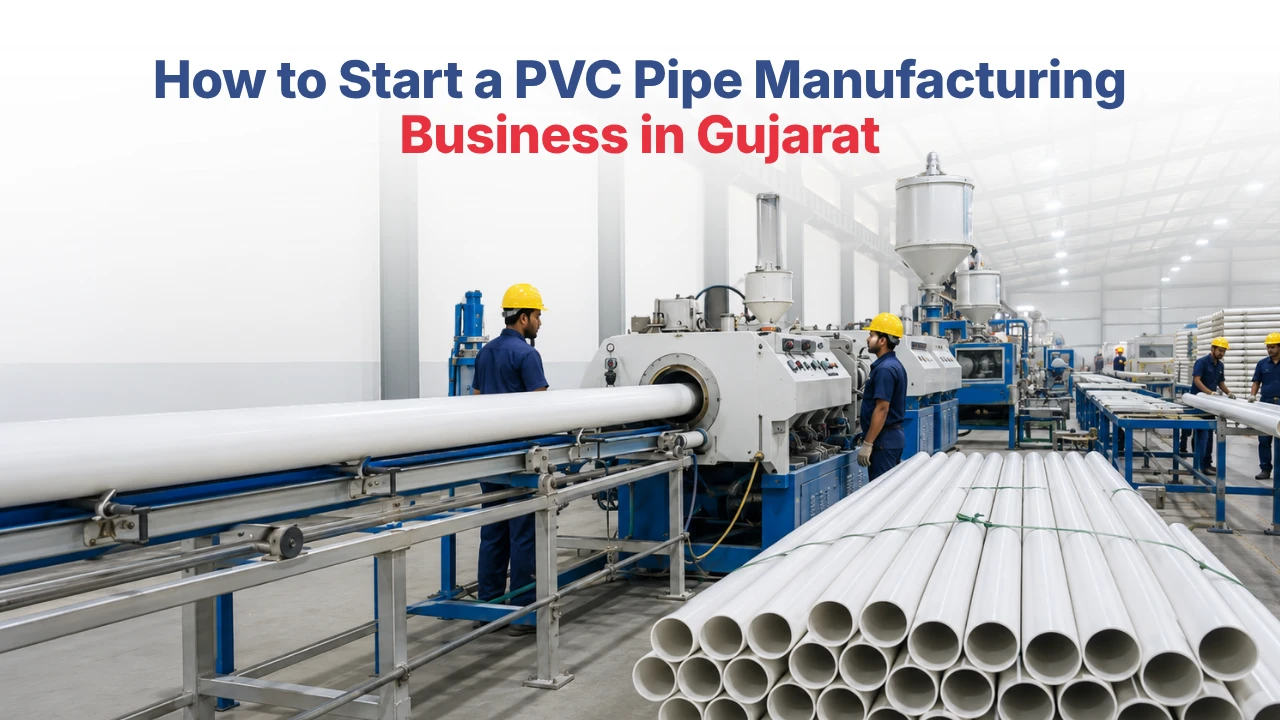
How to Start a PVC Pipe Manufacturing Business in Gujarat
The 8-step roadmap — licences, machinery, raw material and real investment ranges — plus the Gujarat GIDC and subsidy angle most guides skip, from the team that builds the machines.
To start a PVC pipe manufacturing business, you need a business registration, a factory space, an extrusion line (mixer, extruder, die, calibration and cooling, haul-off, cutter, socketing), a pollution NOC, and BIS/ISI certification under IS 4985 before you sell. A small unit typically needs ₹20 lakh–₹50 lakh in machinery and working capital; a full production line can run higher. In Gujarat, MSME units can also apply for capital, interest and power-tariff subsidies under the new Gujarat Industrial Policy 2026.
Setting up a PVC pipe factory is a real, proven business — India is one of the world’s largest PVC pipe producers, and demand keeps growing with housing, irrigation and infrastructure work. But the path from “I want to start a PVC pipe business” to “pipe is coming off my line” has a specific order: registration before machinery, machinery before production, certification before sale. This guide lays out that order step by step, written by Unique Extrusion Machinery, a PVC/uPVC/CPVC/HDPE pipe extrusion machinery manufacturer based in Vatva GIDC, Ahmedabad — so where it helps, we point to the exact machine or authority involved.
Key takeaways
- Starting a PVC pipe manufacturing business takes 8 steps: research → register → land → machinery → raw material → production → certification → sell.
- You need roughly ₹20–50 lakh for a small/mid unit’s machinery and working capital; a larger multi-size line costs more (see the investment table).
- BIS/ISI certification under IS 4985 is mandatory before you can sell water-supply uPVC pipe in India.
- A Gujarat-based unit can apply for a Gujarat Pollution Control Board (GPCB) NOC, a GIDC industrial plot, and MSME subsidies under the new Viksit Gujarat Industrial Policy 2026.
- The extrusion line — not the shed — is what decides your output, scrap rate and product range; plan machinery before you finalise plot size.
On this page
- Is it profitable?
- The 8 steps, at a glance
- Step 1–2: Registration & licences
- Step 3: Location & plant
- Step 4: Machinery
- Step 5: Raw material
- Step 6: Production
- Step 7–8: Quality & sales
- How much does it cost?
- Starting in Gujarat / Ahmedabad
- Common mistakes
- How long does it take?
- About Unique Extrusion Machinery
- FAQ
Is PVC pipe manufacturing profitable in India?
Yes — PVC pipe manufacturing is generally a profitable, scalable business in India, with steady demand from plumbing, agriculture, drainage and infrastructure. Industry sources put gross margins at roughly 20–30% and net margins around 8–12%, though this varies with resin prices, plant utilisation and product mix.[1]
PVC resin cost is the biggest swing factor — it typically makes up 70–80% of your operating cost[1] — so your margin depends more on running the extrusion line efficiently (low scrap, high uptime, the right output speed for your die) than on any one clever pricing decision. A well-matched line from a single manufacturer, rather than machines bought piecemeal from different vendors, is what usually keeps scrap and downtime low enough to protect that margin — see why customers choose Unique Extrusion Machinery.
The 8 steps to start a PVC pipe manufacturing business
The 8 steps are: market research, business registration & licences, choosing your location, buying machinery, sourcing raw material, starting production, getting quality certification, and setting up sales & distribution. Registration and certification must happen in this order — you cannot legally sell water-supply pipe without BIS/ISI certification, and you cannot get that certification without a running, compliant plant.
Decide your product mix (uPVC pressure pipe, SWR drainage, conduit, agriculture pipe, or a soft PVC garden hose) and your target buyers — local hardware distributors, contractors, government/PHED tenders, or exporters. This decides the pipe sizes — and so the machinery — you need.
Register your company/proprietorship, get Udyam (MSME), GST, a Trade Licence and a Factory Licence, and apply for a pollution NOC — see the full table below.
A GIDC industrial plot (in Gujarat) or any zoned industrial shed, with adequate power load, water and floor space for the extrusion line and raw-material storage.
A complete extrusion line: mixer, extruder, die head, calibration & cooling, haul-off, cutter and socketing machine — see the machinery table below.
PVC resin plus stabilisers, lubricants, fillers and pigment, from a resin supplier or distributor.
Mix, melt & shape, size & cool, pull, cut and socket — run trial batches before full commercial production.
BIS/ISI licensing under IS 4985 (for water-supply uPVC pipe) is mandatory before you sell into that market.
Hardware/plumbing distributors, direct-to-contractor sales, and government tender empanelment (PHED, irrigation departments) are the three common routes.
Step 1–2: Business registration, licences & permits
A PVC pipe manufacturing unit needs company registration, Udyam (MSME) registration, GST, a Trade Licence, a Factory Licence, a State Pollution Control Board NOC, and BIS/ISI certification under IS 4985. Trademark registration is optional but recommended if you plan to brand your pipe.
| Registration / licence | Issued by | Why you need it |
|---|---|---|
| Company / firm registration | MCA (Registrar of Companies) or local registrar | Legal entity to own and run the business |
| Udyam (MSME) registration | Ministry of MSME, online | Unlocks MSME loan, subsidy & priority-sector benefits — free, Aadhaar-based[2] |
| GST registration | GST department | Mandatory to invoice and sell across states |
| Trade Licence | Local municipal corporation | Permission to run a commercial/industrial activity at the site |
| Factory Licence | State Factories & Boilers department (Gujarat: Directorate of Industrial Safety & Health) | Mandatory once you run powered machinery above the state’s worker/power threshold |
| Pollution NOC — Consent to Establish (CTE) & Consent to Operate (CTO) | State Pollution Control Board (Gujarat: GPCB) | Mandatory environmental clearance before construction (CTE) and before operating (CTO)[3] |
| BIS / ISI licence (IS 4985) | Bureau of Indian Standards | Mandatory to manufacture & sell uPVC pipe for potable water in India[4] |
| Trademark registration (optional) | Trademarks Registry | Protects your brand name on your pipe and packaging |
Requirements and thresholds change by state and unit size — confirm the current Gujarat-specific Factory Licence threshold and GPCB category with the respective department before applying.
Step 3: Choose your location & set up the plant
A PVC pipe unit needs an industrial-zoned plot with three-phase power, water supply and enough covered floor space for the extrusion line, a raw-material store and finished-pipe stacking. In Gujarat, most first-time manufacturers set up on a GIDC industrial estate — see the dedicated Gujarat section below.
Floor space and power load depend entirely on which machines you run and how many pipe sizes you make — a single-line unit for one or two diameters needs far less than a multi-line plant. Exact space/power figures aren’t published here because they vary by machine selection; contact us for a layout recommendation matched to your product plan.
Step 4: Machinery required for PVC pipe manufacturing
A complete PVC pipe manufacturing line needs a high-speed mixer, an extruder (twin-screw for rigid PVC/uPVC/CPVC, single-screw for HDPE/PPR), a die head, a vacuum calibration tank, cooling tanks, a traction (haul-off) unit, a cutting unit and a socketing machine. A grinder or pulverizer to reclaim scrap is strongly recommended, not optional.
| Machine | Job it does |
|---|---|
| High-speed heater-cooler mixer | Blends resin + additives into an even compound |
| Twin-screw extruder (PVC/uPVC/RPVC) | Melts and pushes the compound through the die — the core machine |
| Conical twin-screw extruder (CPVC/uPVC/PVC) | For CPVC hot-water pipe lines |
| Single-screw / high-speed extruder (HDPE/PPR/MDPE) | For HDPE or PPR pipe if you diversify beyond PVC |
| Die heads | Set the pipe’s diameter and wall thickness |
| Vacuum calibration tank | Fixes the exact outside diameter |
| Cooling tank | Hardens the pipe before it’s pulled |
| Traction (haul-off) unit | Draws the pipe at a steady, controlled speed |
| Planetary cutting unit + tilting unit | Cuts fixed lengths on the move and lowers each pipe |
| SWR / plain socketing machine | Bells one end so pipes can be joined on site |
| Grinder / pulverizer | Reclaims trim & reject pipe back into usable compound |
Buying the line as one synchronised, turnkey system from a single manufacturer — rather than mixing machines from different vendors — is usually what keeps a new plant’s scrap rate and downtime low in its first year. See the full Unique Extrusion Machinery range or a specific line for soft PVC garden pipe.
Planning your machine list? See Unique Extrusion Machinery’s PVC pipe making machines or get a turnkey quotation.
Step 5: Source your raw material
PVC pipe is made from PVC resin blended with heat stabilisers, lubricants, fillers (usually calcium carbonate) and pigment. Resin is the single largest input cost, so a reliable, competitively priced resin supplier matters as much as your machinery choice.
Gujarat sits inside one of India’s largest petrochemical corridors (the Vadodara–Dahej–Ankleshwar belt), which gives Gujarat-based manufacturers comparatively easier access to PVC resin and additive suppliers than many other states. Confirm current resin sourcing and pricing directly with suppliers — resin prices move with crude-oil and import trends and are not quoted here.
Step 6: The production process, briefly
PVC pipe is produced by continuous extrusion: the compound is mixed, melted and shaped through the extruder and die, sized and cooled in the calibration tank, pulled and printed, cut to length, and socketed — all in one line, without stopping.
This is a large enough topic that we cover it in full, machine by machine, in a dedicated guide. Link to the process guide once it is published on uniqueextrusion.com.
Step 7–8: Quality certification & sales
BIS/ISI certification under IS 4985 is mandatory before you can manufacture and sell unplasticised (uPVC) pipe for potable water in India, and it is one of the strongest trust signals with distributors and government buyers.
The certification process involves a BIS factory inspection and ongoing sample testing (pressure, tensile, impact and dimensional tests), so your line’s consistency matters as much as your first sample. Once certified, the three common sales routes are: local plumbing/hardware distributors, direct supply to contractors and builders, and empanelment for government tenders (PHED, irrigation, municipal water schemes) — the last is often the highest-volume channel once you are BIS-certified.
How much does it cost to start a PVC pipe manufacturing business?
A small PVC pipe unit can be started for roughly ₹20–25 lakh in machinery, and a fuller line for one to two pipe-size ranges typically runs ₹35–50 lakh; total project cost including land/shed, working capital and initial resin stock can range from ₹50 lakh to several crore depending on scale. These are indicative, sourced ranges, not a quotation.
| Scale | What it includes | Indicative range |
|---|---|---|
| Entry-level small unit | Basic extrusion line, one small diameter range | ₹20–25 lakh[5] |
| Mid-size line (0.5″–4″) | ~100–150 kg/hr output line | ₹36–44 lakh[6] |
| Larger multi-size line (0.5″–8″) | Wider diameter range, higher output | ₹40.5–49.5 lakh[6] |
| Full project cost (land, shed, machinery, working capital) | Complete turnkey setup, scale-dependent | ₹50 lakh – ₹5 crore+[7] |
Raw material (resin) typically accounts for 70–80% of ongoing operating cost, with utilities around 10–15%[1] — which is why the machinery decision (output speed, scrap rate, power draw) affects your running cost far more than it affects the one-time capital figure. For an investment figure matched to your actual product plan and location, talk to Unique Extrusion Machinery directly.
Starting a PVC pipe manufacturing business in Gujarat / Ahmedabad
Gujarat is one of India’s strongest states to start PVC pipe manufacturing in — it has direct access to the Vadodara–Dahej PVC resin belt, dedicated GIDC industrial estates near Ahmedabad, and a newly launched state subsidy policy for MSME manufacturers.
GIDC industrial plots near Ahmedabad
Most first-time manufacturers in the region set up on a GIDC (Gujarat Industrial Development Corporation) estate rather than buying open land — plots come with roads, power and water infrastructure already in place, and MSMEs are an eligible allotment category.[8] Estates commonly used for plastic/light-manufacturing units around Ahmedabad include Vatva (also home to Unique Extrusion Machinery’s own facility), Naroda, Odhav and Changodar. Apply directly through GIDC’s allotment process; a local GIDC advisory consultant can help if you’re applying for the first time.
GPCB — the pollution NOC process
In Gujarat, the pollution NOC runs through the Gujarat Pollution Control Board (GPCB) in two stages: a Consent to Establish (CTE) before you start construction, and a Consent to Operate (CTO) before you begin production.[3] Apply for CTE as soon as your plot and machinery layout are finalised — it typically needs to be in hand well before construction starts, so leave it early in your timeline, not at the end.
Viksit Gujarat Industrial Policy 2026 — MSME subsidies
Gujarat launched the Viksit Gujarat Industrial Policy 2026 on 15 June 2026, effective for five years.[9] For MSME manufacturing units, it allows a combination of incentives — capital subsidy, interest subsidy and power-tariff support — reported up to 50% for eligible MSME units, plus 100% reimbursement of the employer’s EPF contribution for 5 years and a 100% electricity duty exemption.[10]
| Incentive | Reported benefit |
|---|---|
| Capital / interest / power-tariff subsidy | Combined, up to 50% (subject to ceilings) |
| EPF reimbursement | 100% of employer’s contribution, for 5 years |
| Electricity duty exemption | 100%, under the Gujarat Electricity Duty Act |
| Other support | Quality certification, technology acquisition, patent registration assistance |
Important: the policy was announced on 15 June 2026; as of this guide’s last update, the Gujarat Industries & Mines Department had not yet released the detailed Government Resolution (GR) that fixes final eligibility criteria and exact subsidy quantum.[11] Treat the figures above as the policy’s public announcement, not a guaranteed entitlement — confirm current terms with your GIDC/Industries office or a policy consultant before budgeting around them.
Common mistakes first-time PVC pipe manufacturers make
- ✓ Buying machinery before finalising the product mix. Your pipe-size range decides your die, extruder size and calibration setup — deciding this after buying machines is expensive to fix.
- ✓ Starting construction before the GPCB Consent to Establish (CTE) is in hand. This can delay your Consent to Operate and push back your production start.
- ✓ Mixing machines from different vendors without checking they run at matched speeds. A haul-off pulling faster or slower than the extruder output causes wall-thickness and ovality problems from day one.
- ✓ Underestimating working capital for resin. Resin is 70–80% of operating cost[1] — running short mid-month stalls production even with a fully paid-for line.
- ✓ Applying for BIS/ISI certification too late. Government and most large distributor orders require it upfront — factor the inspection and testing timeline into your launch date, not after.
How long does it take to start a PVC pipe manufacturing business?
Most first-time units take roughly 4–8 months from registration to commercial production — the pollution NOC (CTE/CTO) and BIS/ISI certification are usually the longest single steps, so start them as early as your plot and machinery layout allow.
About Unique Extrusion Machinery
Unique Extrusion Machinery Pvt. Ltd. is a plastic extrusion machinery manufacturer based in Vatva GIDC, Ahmedabad, Gujarat. The company builds complete, turnkey pipe extrusion lines for PVC, uPVC, CPVC and HDPE pipe — from the mixer to the socketing machine — with a focus on energy efficiency, reliable output and long-term after-sales support. Over 10+ years it has built 900+ machines for customers in plumbing, agriculture, telecom, power, construction and infrastructure across India and export markets. Explore the manufacturing facilities or read our quality policies.
Founder/leadership names and the “900+ installations / 10+ years / ISO” figures are carried over from the client’s live money page and a previously delivered post — please reconfirm current wording before this post is published.
Ready to start your PVC pipe manufacturing line?
Unique Extrusion Machinery designs and builds complete, turnkey PVC, uPVC, CPVC and HDPE pipe extrusion lines from our Vatva GIDC facility in Ahmedabad — matched to your product plan and budget.
How to start a PVC pipe manufacturing business — FAQ
Is PVC pipe manufacturing profitable in India?
Yes — it’s generally considered a profitable, scalable manufacturing business, with gross margins reported around 20–30% and net margins around 8–12%, though margins move with resin prices and plant efficiency.[1]
How much investment is needed to start a PVC pipe manufacturing business?
A small unit’s machinery can start around ₹20–25 lakh, a fuller single-range line around ₹35–50 lakh, and a complete project including land, shed and working capital can run from ₹50 lakh to several crore depending on scale.[5][6][7] See the investment table above for the breakdown.
What licences are required for PVC pipe manufacturing?
You typically need company registration, Udyam (MSME) registration, GST, a Trade Licence, a Factory Licence, a State Pollution Control Board NOC (CTE/CTO), and BIS/ISI certification under IS 4985 to sell water-supply pipe. See the full licence table above.
What machinery is needed to start a PVC pipe manufacturing business?
A complete line needs a high-speed mixer, a twin-screw (or single-screw for HDPE/PPR) extruder, a die head, a vacuum calibration tank, cooling tanks, a traction unit, a cutting unit and a socketing machine, plus a grinder or pulverizer to reclaim scrap. See the Unique Extrusion Machinery range.
Is BIS/ISI certification mandatory for PVC pipe manufacturing?
Yes — for unplasticised PVC (uPVC) pipe used in potable water supply, BIS/ISI certification under IS 4985 is mandatory in India before you can manufacture and sell it.[4]
What subsidies are available for a PVC pipe manufacturing unit in Gujarat?
MSME manufacturing units in Gujarat can apply for capital, interest and power-tariff subsidies (reported up to 50% combined), 100% EPF reimbursement for 5 years, and a 100% electricity duty exemption under the Viksit Gujarat Industrial Policy 2026. The detailed Government Resolution was still pending at the time of writing — confirm exact terms before budgeting around them.
How do I get a GIDC plot for a PVC pipe factory in Ahmedabad?
Apply through GIDC’s industrial plot allotment process for an estate near Ahmedabad such as Vatva, Naroda, Odhav or Changodar; MSME manufacturing units are an eligible allotment category.[8] A local GIDC advisory consultant can help first-time applicants navigate the process.
How long does it take to start a PVC pipe manufacturing business?
Most first-time units take roughly 4–8 months from registration to commercial production, with the pollution NOC and BIS/ISI certification usually the longest single steps — start both as early as possible.
Unique Extrusion Machinery Technical Team
The engineering team at Unique Extrusion Machinery Pvt. Ltd., Vatva GIDC, Ahmedabad, designs and builds complete PVC, uPVC, CPVC and HDPE pipe extrusion lines, with 900+ machines built to date. This guide draws on hands-on experience helping first-time customers plan and commission new pipe lines in Gujarat.