



PVC Pipe Manufacturing Plant Machine List: Every Machine You Need

PVC Pipe Manufacturing Plant Machine List: Every Machine You Need
What machines are required for a PVC pipe manufacturing plant? A PVC pipe manufacturing plant needs ten machines working as one line: a high-speed mixer, a twin-screw extruder, a die head, a vacuum calibration tank, a cooling tank, a traction unit, a planetary cutter, tilting and stacking units, a socketing machine, and a grinder or pulverizer for scrap.
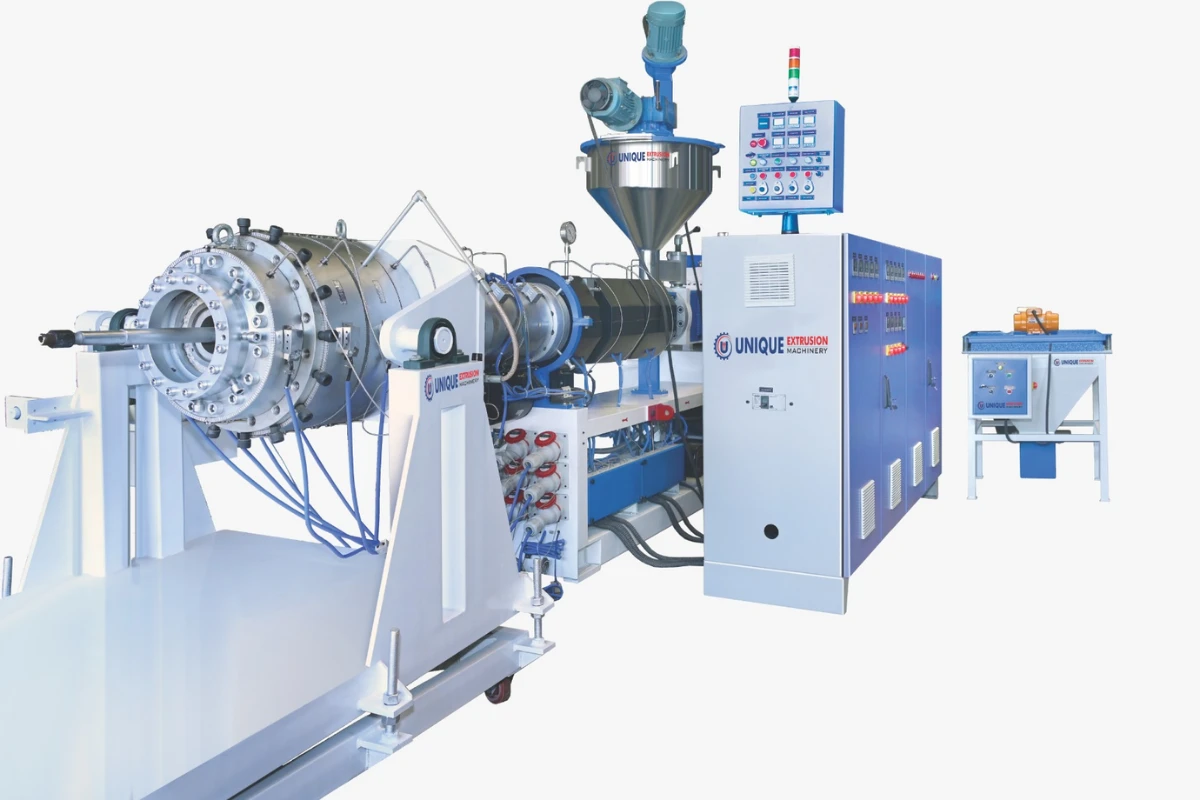
The core of a PVC pipe line: extruder, die head, control panel and dosing unit. The full plant adds the calibration tank, cooling tank, haul-off, cutter and stacking units shown below.
Key takeaways
- A complete PVC pipe plant uses 10 machines, arranged as one continuous line.
- 7 are essential to make pipe at all. Three (socketing, coiler, pulverizer) depend on the pipe you sell.
- The extruder decides your output in kg per hour. Every other machine must be matched to it.
- Rigid PVC pipe uses a twin-screw extruder. HDPE and PPR pipe use a single-screw extruder — they are not interchangeable.
- Machine cost is driven by output, pipe diameter range, and automation level — not by brand alone.
- Buying the line from one maker avoids the matching problems that stall mixed-supplier plants.
On this page
The complete PVC pipe manufacturing plant machine list
| # | Machine | What it does | Essential? |
|---|---|---|---|
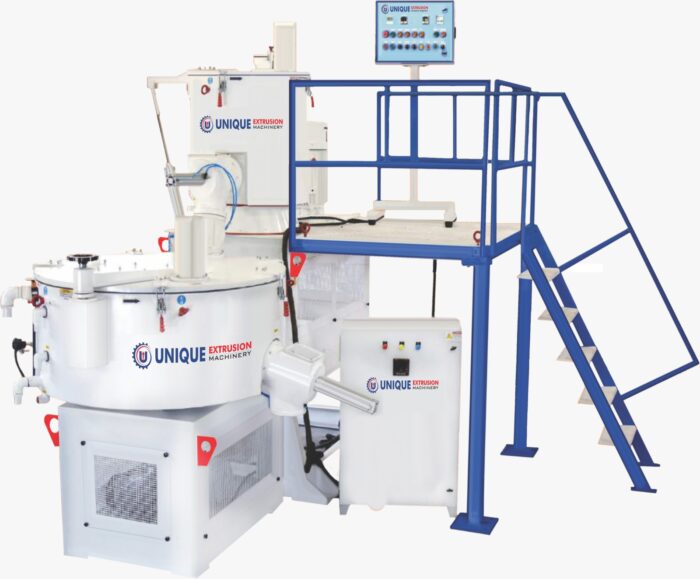
| 1 | High-speed heater–cooler mixer | Blends PVC resin with stabilisers, lubricants and fillers into a dry, even compound | Yes |
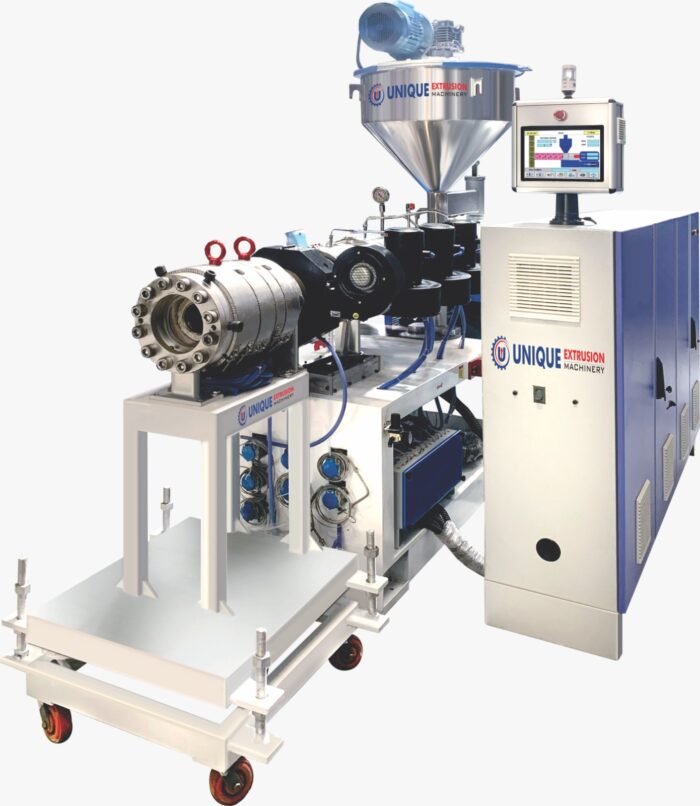
| 2 | Twin-screw extruder | Melts the compound and pushes it forward under pressure — sets your output in kg/hr | Yes |
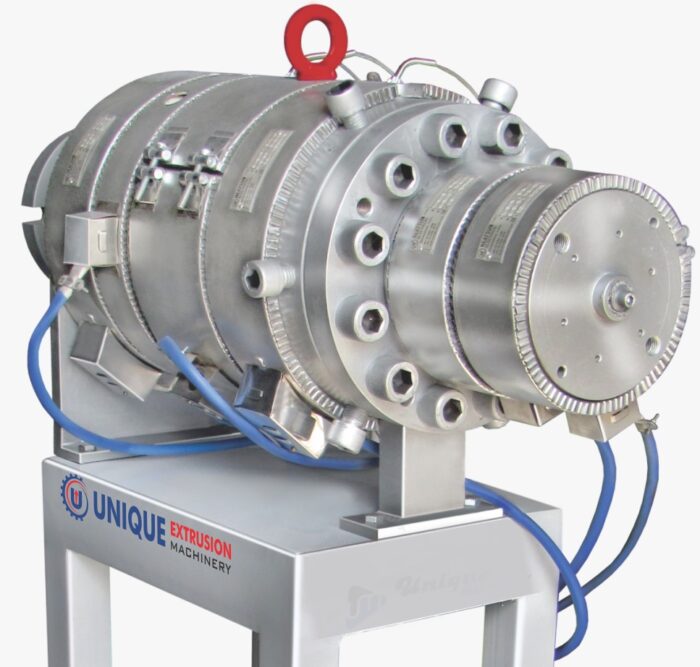
| 3 | Die head and tooling | Forms the melt into a pipe of the diameter and wall thickness you want | Yes |
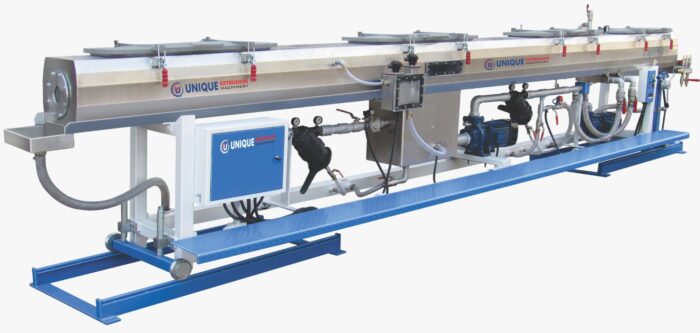
| 4 | Vacuum calibration tank | Holds the soft pipe to its exact outer diameter using vacuum, and starts cooling it | Yes |
| 5 | Cooling tank | Cools the pipe fully so it holds its shape and passes pressure tests | Yes |
| 6 | Traction (haul-off) unit | Pulls the pipe at a set speed — this is what controls wall thickness | Yes |
| 7 | Planetary cutting unit | Cuts pipe to length while the line keeps running, with a clean burr-free edge | Yes |
| 8 | Tilting / stacking unit | Tips cut pipes off the line and collects them for bundling | Recommended |
| 9 | Socketing (belling) machine | Forms the socket end so pipes join — SWR or plain socket type | If you sell socketed pipe |
| 10 | Grinder / pulverizer unit | Grinds start-up scrap and rejects back into usable material | Strongly advised |
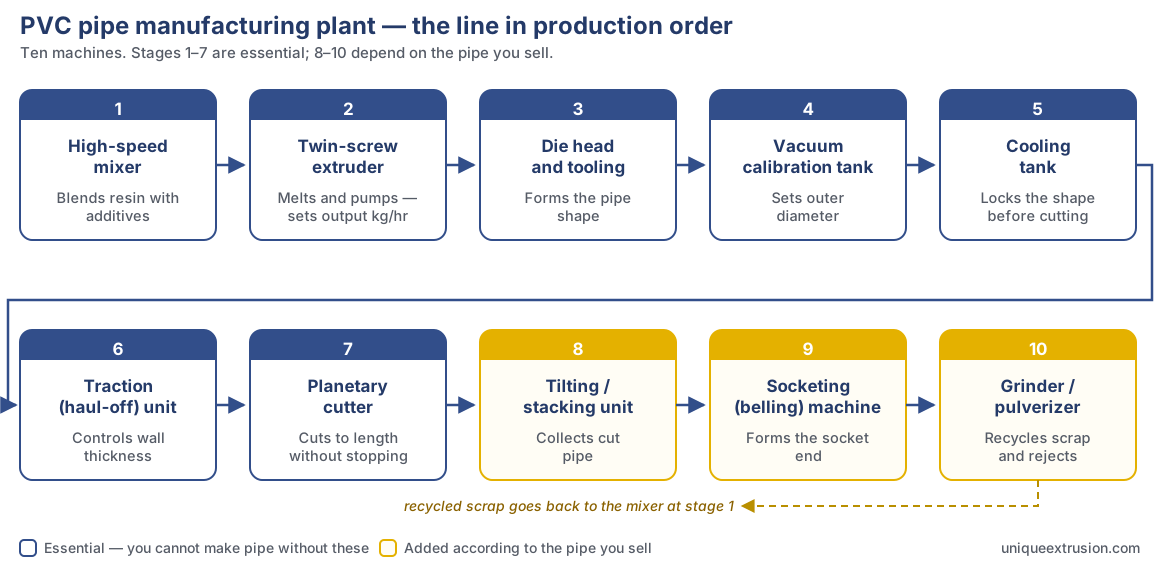
The ten machines in production order. Stages 1–7 are essential; 8–10 are added according to the pipe you sell. Scrap from the grinder returns to the mixer at stage 1.
What is the minimum machinery to start a small PVC pipe unit?
The minimum machinery for a small PVC pipe unit is seven machines: a high-speed mixer, a twin-screw extruder, a die head, a vacuum calibration tank, a cooling tank, a traction unit and a cutting unit. Without all seven you cannot produce saleable pipe. Socketing, coiling and grinding machines can be added later.
Core 7 — you cannot make pipe without these
- High-speed heater–cooler mixer
- Twin-screw extruder
- Die head and tooling
- Vacuum calibration tank
- Cooling tank
- Traction (haul-off) unit
- Planetary cutting unit
Add when your product needs it
- Tilting / stacking unit — saves labour once you run longer shifts
- Socketing machine — needed for SWR and plumbing pipe with a bell end
- Grinder / pulverizer — pays back quickly by recycling scrap
- Pipe coiler — only for flexible or small-diameter coiled pipe
- Printing unit — for batch codes and standard marking
A word of caution. Skipping the grinder is the most common false economy we see. PVC start-up scrap is generated on every shift change and every die change. Without a grinder it goes to waste; with one it goes back into the mixer.
Every machine in the PVC pipe plant, explained
1. High-speed heater–cooler mixer
2. Twin-screw extruder
3. Die head and tooling
4. Vacuum calibration tank
5. Cooling tank
6. Traction (haul-off) unit
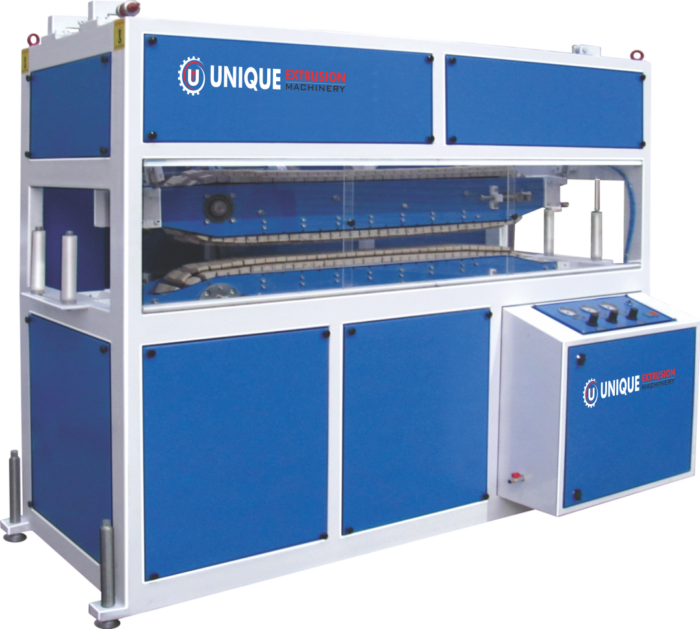
7. Planetary cutting unit
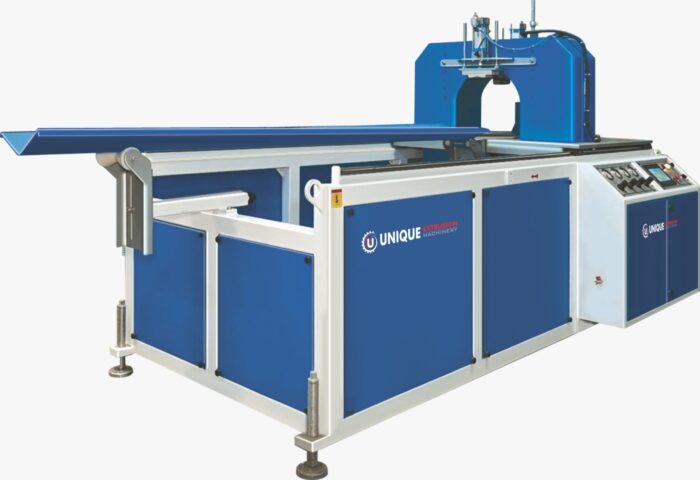
8. Tilting and stacking unit
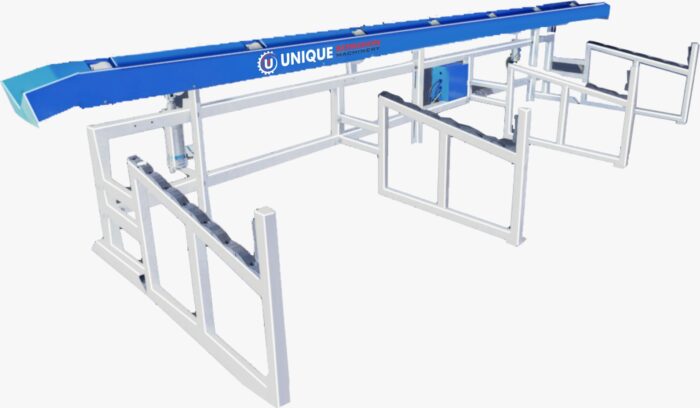
9. Socketing (belling) machine
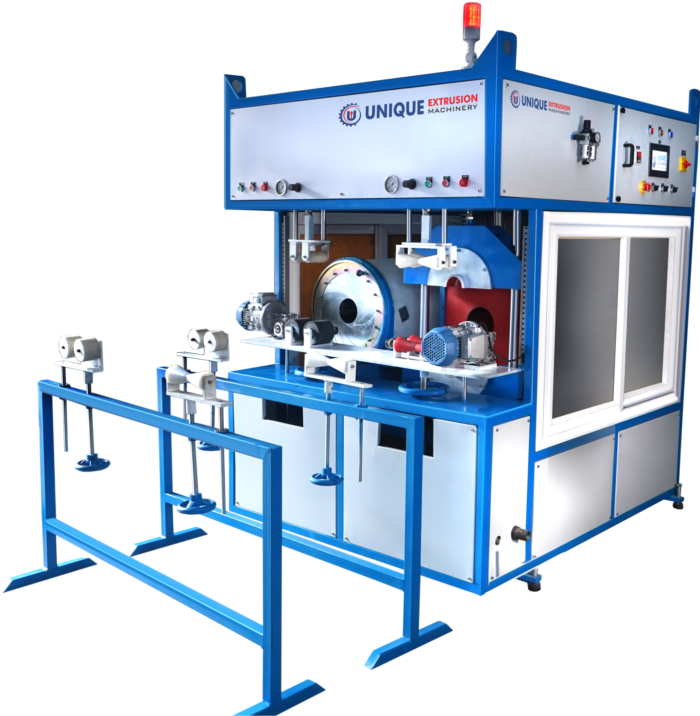
10. Grinder and pulverizer units
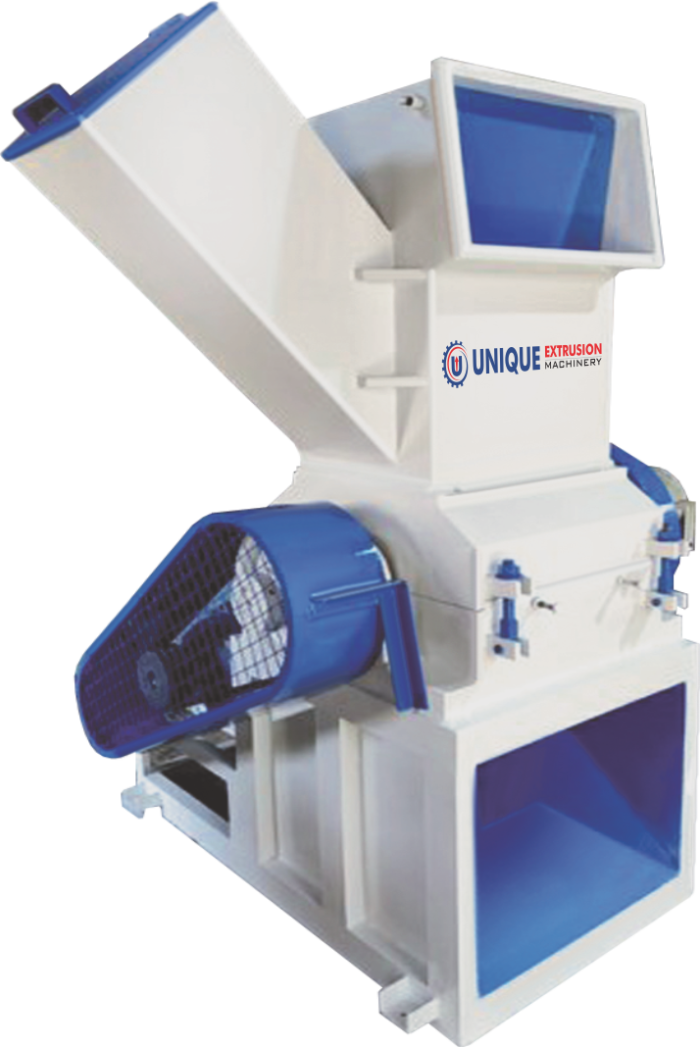
Want this machine list quoted for your own output target? See the full PVC pipe manufacturing machine range built at our Vatva, Ahmedabad works.
Which extruder do you need — twin screw, conical or single screw?
Rigid PVC and uPVC pipe needs a parallel twin-screw extruder. CPVC and some uPVC compounds run better on a conical twin-screw extruder, which gives more mixing at the feed end. HDPE, PPR and MDPE pipe need a single-screw extruder instead. The choice follows your material, not your budget.
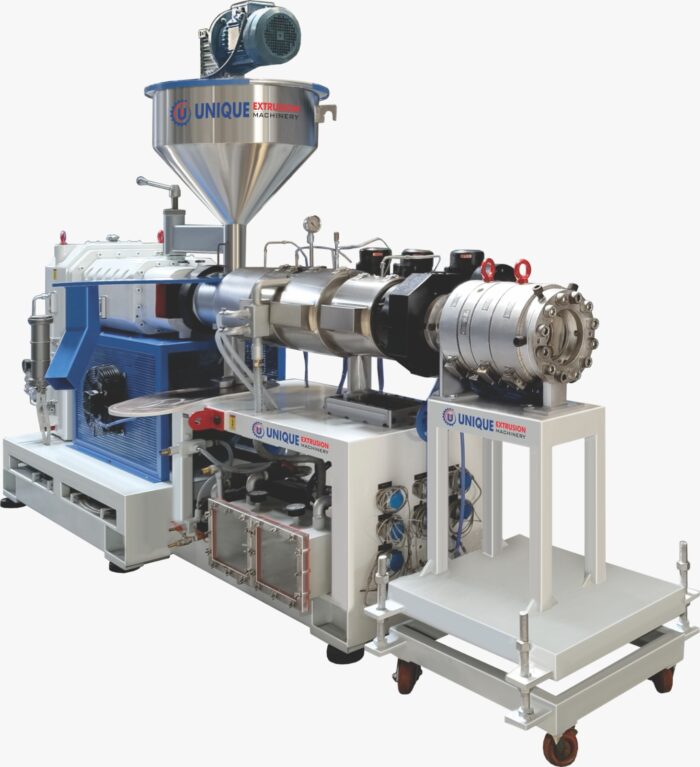
Conical twin-screw — CUETS 51×105 to 92×188, 100–450 kg/hr, 16–630 mm pipe.
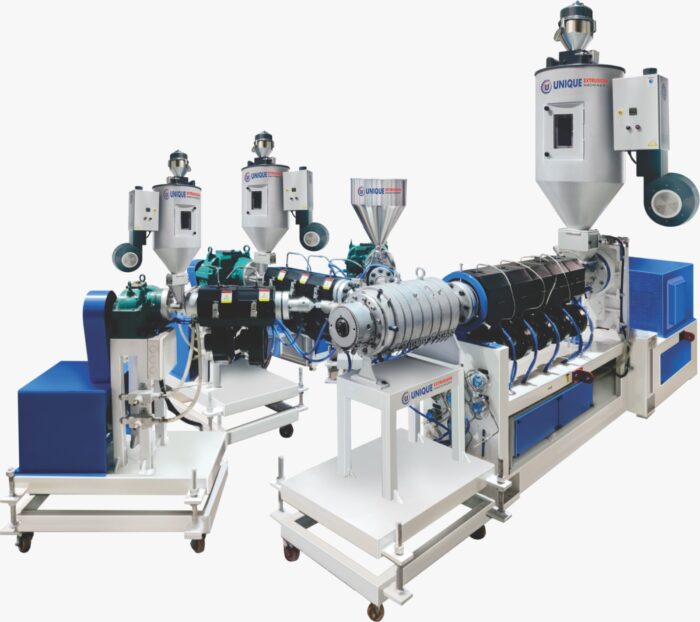
High-speed single-screw for HDPE, PPR and MDPE — 140–850 kg/hr across the range.
| Extruder type | Best for | Why |
|---|---|---|
| Parallel twin-screw | PVC, uPVC, RPVC rigid pipe | Even heating and steady output at higher capacities — the standard choice for rigid pipe |
| Conical twin-screw | CPVC, uPVC, PVC | Larger feed end gives stronger mixing and gentler shear for heat-sensitive CPVC compounds |
| Single-screw (high speed) | HDPE, PPR, MDPE pipe | These materials are not heat-sensitive the way PVC is, so one screw is enough |
| Soft PVC extruder | Flexible garden and braided hose | Built for plasticised soft PVC, usually paired with a coiler rather than a cutter |
What decides the cost of a PVC pipe manufacturing plant?
Four things decide what a PVC pipe plant costs: the output you need in kg per hour, the range of pipe diameters you want to make, how much of the line is automated, and which material you are running. Two quotations for “a PVC pipe plant” can differ several times over on these four points alone.
Output (kg per hour)
Pipe diameter range
Level of automation
Material
What is often left out of a quotation
How much power, water and floor space does a PVC pipe plant need?
- Connected electrical load (kW). The extruder motor, heaters, vacuum pump, chiller and grinder all draw power. Get the total connected load and running load for your selected line, then size the electrical connection and any DG backup accordingly.
- Cooling water and chiller capacity. The calibration and cooling tanks need continuously circulated, cooled water. This is a recurring cost and a common oversight in project reports.
- Compressed air. Needed for pneumatic clamps, cutters and socketing machines.
- Straight-line floor length. A pipe line must be laid out straight — mixer, extruder, tanks, traction, cutter and stacking all in a row. The line length, plus space to remove cut pipe at the end, drives your shed dimensions more than floor area alone does.
- Storage. Rigid pipe is bulky and light. Finished-goods storage typically needs more space than the production line itself.
Planning note: power, water and floor-space requirements vary with output, pipe diameter and automation. Unique Extrusion Machinery provides a utility schedule for the selected line as part of project planning.
IS 4985 and what your machines have to deliver
- The vacuum calibration tank holds outer diameter within tolerance.
- The traction unit holds wall thickness steady, which is what the pressure rating depends on.
- The cooling tank ensures the pipe is fully set, so it does not deform or fail testing later.
Common mistakes when buying a PVC pipe plant
- Buying machines from different suppliers to save money. Each machine works, but they do not synchronise. When output drops, no supplier accepts responsibility. A single-source turnkey line avoids this.
- Sizing the extruder for today’s orders. Output is the hardest thing to upgrade later, because everything downstream is matched to it.
- Ignoring the die list. The extruder does not decide which pipe sizes you can sell — the dies do.
- Treating the grinder as optional. Scrap is generated every single shift.
- Comparing quotations on the total only. Compare item by item — dies, chiller, vacuum pump, installation, training and spares are the usual differences.
- Not seeing a line running. A machine standing in a workshop tells you nothing about how it behaves at production speed.
About Unique Extrusion Machinery
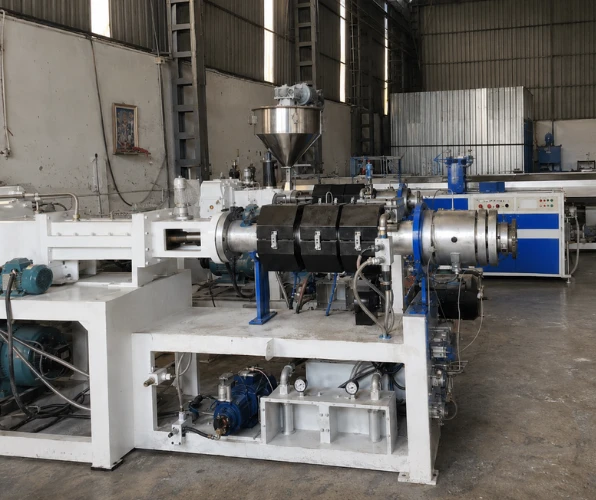
- 900+ extrusion lines installed
- 10+ years building extrusion machinery
- ISO-certified manufacturing
- In-house manufacturing, installation, commissioning and operator training
PVC pipe plant machinery — FAQ
What machines are required for a PVC pipe manufacturing plant?
Ten machines: a high-speed heater–cooler mixer, a twin-screw extruder, a die head, a vacuum calibration tank, a cooling tank, a traction unit, a planetary cutter, a tilting/stacking unit, a socketing machine and a grinder or pulverizer. Seven of these are essential; socketing, coiling and grinding depend on the pipe you sell
What is the minimum machinery to start a small PVC pipe unit?
Seven machines: mixer, twin-screw extruder, die head, vacuum calibration tank, cooling tank, traction unit and cutting unit. That is the smallest set that produces saleable pipe. A grinder should be added early, because scrap is created on every shift change
Which extruder is used for PVC pipe — twin screw or single screw?
Rigid PVC pipe uses a twin-screw extruder. PVC is heat-sensitive, and two intermeshing screws give the gentle, even heating it needs. Single-screw extruders are used for HDPE, PPR and MDPE pipe, not for rigid PVC
What is a vacuum calibration tank and why is it needed?
A vacuum calibration tank uses vacuum to hold the soft pipe leaving the die against a sizing sleeve, fixing its outer diameter precisely while water starts cooling it. Without it, pipe would leave the die out of round and out of tolerance, and would fail IS 4985 dimensional checks
Do I need a socketing machine?
Only if you sell pipe that joins by pushing one end into another — which covers most plumbing, SWR and drainage pipe in India. Pipe sold for solvent-weld fittings or coiled flexible pipe does not need one. Check what your distributors expect before deciding
How much does a PVC pipe plant cost in India?
There is no single figure, because the cost depends on four things: output in kg per hour, the pipe diameter range, the level of automation and the material. The same phrase “PVC pipe plant” can describe very different machines. Ask for an itemised quotation against your own output target rather than comparing totals
Can the same line make uPVC, CPVC and HDPE pipe?
Partly. The downstream machines — calibration tank, cooling tank, traction unit and cutter — can often be shared. The extruder and die head must change: PVC and uPVC use a parallel twin-screw, CPVC often uses a conical twin-screw, and HDPE needs a single-screw extruder
How much power and floor space does a PVC pipe plant need?
It depends on the line size, so ask your supplier for a written utility schedule covering connected load in kW, cooling water and chiller capacity, compressed air, and the straight-line floor length. Pipe lines must be laid out in a straight row, so shed length matters more than total floor area
Unique Extrusion Machinery Technical Team
Get this machine list quoted for your plant
Sources & further reading
- Bureau of Indian Standards — bis.gov.in. IS 4985 covers unplasticised PVC pipes for potable water supplies in India.
- BIS “Know Your Standards” portal — services.bis.gov.in, for looking up the full text and scope of Indian Standards.
- Central Institute of Petrochemicals Engineering & Technology (CIPET) — cipet.gov.in, for plastics processing training and testing services in India.