



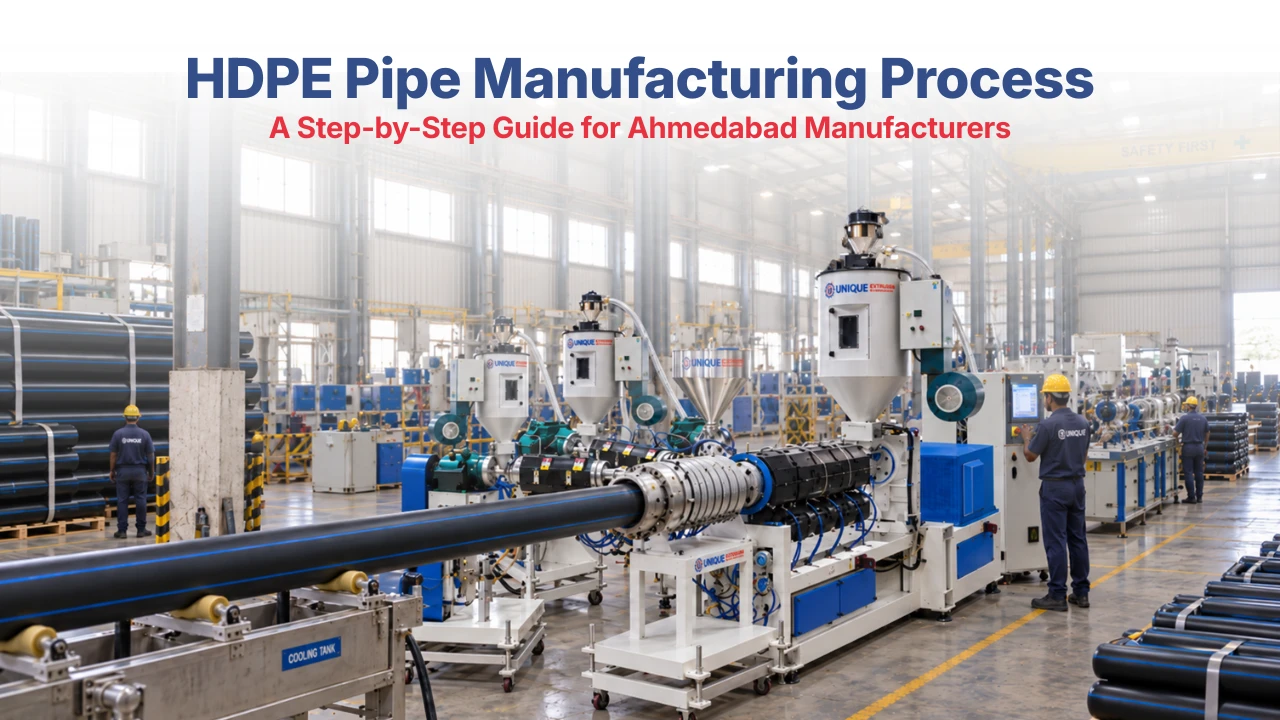
HDPE Pipe Manufacturing Process: A Step-by-Step Guide for Ahmedabad Manufacturers

Process Guide
Every stage of the HDPE pipe extrusion process explained by the people who build the machines — what happens, which machine does it, what the settings should be, and what goes wrong when they are off.
How is HDPE pipe manufactured? HDPE pipe is made by continuous extrusion. PE 80 or PE 100 granules are dried and fed into a heated barrel, melted by a rotating screw at roughly 160–230 °C, and forced through an annular die head to form a soft tube. That tube is vacuum-calibrated to exact diameter, water-cooled, pulled by a haul-off, printed, then cut or coiled.
The HDPE pipe manufacturing process runs as one unbroken line, from granule hopper to finished coil, in these eight stages:
- Raw material selection and drying — PE 80 or PE 100 granules with carbon black.
- Dosing and feeding — gravimetric dosing into the extruder hopper.
- Melting in the extruder — a single screw melts and homogenises the polymer.
- Die head forming — the melt becomes an annular tube.
- Vacuum calibration — the outside diameter is fixed to size.
- Cooling — water tanks set the shape permanently.
- Haul-off and marking — pull speed sets wall thickness; the pipe is printed.
- Cutting or coiling — straight lengths or coils, then stacking.
★ Key takeaways
- Extrusion, not moulding. The HDPE pipe manufacturing process is continuous, so every metre is made by the settings running at that moment.
- The machine decides quality, not just the resin. Good PE 100 on a badly set line still fails IS 4984 testing.
- Wall thickness comes from haul-off speed, not from the die. Pull faster and the wall gets thinner.
- Single-screw extruders are standard for HDPE, because PE arrives as consistent pre-compounded pellets.
- Output is measured in kg/hr, but you sell metres. The conversion depends entirely on pipe size — 400 kg/hr is about 880 m/hr of 63 mm pipe but only about 36 m/hr of 315 mm.
- In India the finished pipe must meet IS 4984 for potable water, or IS 14333 for sewerage and telecom duct.
On this page
- What HDPE pipe is made from
- The 8 stages, one by one
- Process settings at each stage
- The machines in an HDPE pipe line
- Sizing your line: kg/hr to metres/hr
- What goes wrong at each stage
- IS 4984 and BIS testing
- Starting HDPE pipe production in Ahmedabad
- Why the process decides pipe quality
- Frequently asked questions
What is HDPE pipe made from?
HDPE pipe is made from high-density polyethylene granules, supplied in pressure-pipe grades PE 63, PE 80 or PE 100. The granules already contain about 2–3% finely dispersed carbon black, which is what makes the pipe black and protects it from sunlight. Antioxidants and UV stabilisers are compounded in by the resin producer.
The grade number is not a marketing label. It is the pressure the material can safely hold for 50 years, expressed in bar × 10. PE 100 is stronger than PE 80, so a PE 100 pipe of the same pressure class can have a thinner wall — which means less resin per metre and a lower cost per metre.
Three material properties matter before you ever switch the extruder on, and a serious plant tests them on incoming material:
- Melt Flow Index (MFI) — how easily the melt flows. Batch-to-batch drift here shows up immediately as wall-thickness variation.
- Oxidation Induction Time (OIT) — how much antioxidant protection is left in the resin. Low OIT means the pipe ages badly, even if it passes on day one.
- Carbon black content and dispersion — the amount matters, but so does how evenly it is spread. Poorly dispersed carbon black creates weak spots that fail slow-crack-growth testing.
On recycled material: reprocessed or off-spec resin cannot guarantee the molecular weight distribution and long-term hydrostatic strength that IS 4984 requires. Pipe for potable water must be made from virgin-grade compound. Recycled HDPE has legitimate uses — non-pressure duct and conduit — but not pressure pipe for drinking water.
The HDPE pipe manufacturing process, stage by stage
Here is what physically happens to the material at each stage, and which machine does it. This is the core of the HDPE pipe extrusion process.
Raw material drying and preparation
PE granules absorb a small amount of moisture in storage. That moisture turns to steam inside the barrel and leaves voids or silver streaks in the pipe wall. The granules are dried in a hopper dryer, typically for two to four hours, before they go anywhere near the extruder.
Any colour masterbatch or additive is checked here too. If you are compounding your own blend rather than buying ready-made granules, this is where a high-speed heater cooler mixer does the work.
Machine: hopper dryer and material handling; optionally a high-speed mixer.
Dosing and feeding
Dried granules are metered into the extruder hopper. A gravimetric dosing unit weighs the material as it feeds, so the line knows exactly how many kilograms per hour are going in. That number is what lets the control system hold wall thickness steady rather than guessing.
Reground material from your own trimmings can be blended back in at a controlled percentage at this point — a PVC/HDPE grinder unit is what produces that regrind.
Machine: gravimetric dosing unit; grinder for in-house regrind.
Melting and homogenising in the extruder
This is the heart of the line. A single rotating screw inside a heated barrel does three jobs at once: it conveys the granules forward, it melts them using both barrel heaters and the friction of the screw itself, and it mixes the melt until temperature and pressure are uniform across the whole flow.
For HDPE, a single-screw extruder is the standard choice, because PE arrives as consistent pre-compounded pellets that do not need the aggressive mixing a twin screw provides. The screw’s L/D ratio — its length divided by its diameter — decides how much distance the material has to melt evenly in. A 37:1 high-speed screw gives far better melt homogeneity than a 24:1 screw at the same output.
A barrier screw separates the still-solid granules from the already-molten polymer along the screw, which raises output and holds melt temperature steadier than a conventional design.
Machine: single-screw extruder, High Speed series.
Die head forming
The melt is pushed into an annular die head, which turns a solid flow of polymer into a hollow tube. The gap between the outer die ring and the inner mandrel sets the starting wall thickness; the die diameter sets the starting outside diameter. Both are larger than the finished pipe, because the tube is stretched slightly before it sets.
Die centring is critical and unforgiving. If the mandrel sits even slightly off-centre, the pipe comes out thick on one side and thin on the other — and the thin side is where it will burst under pressure test.
Machine: pipe die head, sized to the pipe range.
Vacuum calibration
The soft tube passes straight into a vacuum calibration tank. Inside, a sizing sleeve of the exact finished diameter sits under water, and a vacuum pump draws the tube’s outer surface tight against that sleeve. This is what makes an HDPE pipe round and dimensionally exact rather than merely tube-shaped.
Too little vacuum and the pipe pulls away from the sleeve, going undersize and oval. Too much and the surface drags on the sleeve, leaving scoring and stress marks. The correct level depends on pipe diameter, wall thickness and line speed.
Machine: vacuum calibration tank.
Cooling
Calibration only sets the outside. The wall is still hot right through, so the pipe now runs through one or more spray or immersion cooling tanks that bring it down to handling temperature gradually.
Gradual is the key word. Cool too slowly and thick-wall pipe sags under its own weight before it sets. Cool too fast and you freeze internal stresses into the wall, which show up later as reversion failures or cracking in service. Multi-section tanks with staged water temperatures exist precisely to manage this.
Machine: cooling tank, single or multi-section.
Haul-off and marking
A caterpillar haul-off grips the cooled pipe between rubber-padded tracks and pulls it through the entire line at a constant speed. This unit is doing something more important than transport: haul-off speed is what actually sets the final wall thickness. Pull faster than the extruder delivers and the wall thins; pull slower and it thickens. Output and haul-off speed must stay locked in ratio.
An inkjet or laser printer then marks the pipe with size, grade, pressure class, standard number, batch, date and manufacturer name — the marking line IS 4984 requires.
Machine: traction / haul-off unit and an inline printer.
Cutting or coiling
What happens at the end depends on pipe size. Larger diameters are cut into straight lengths — usually 6 metres in India — by a planetary cutter that travels along with the moving pipe while it cuts, so the line never stops and the cut is square and burr-free.
Smaller diameters, typically up to about 110 mm, are wound onto coils instead. Coiled pipe means fewer joints in the field, which is why irrigation and house-connection pipe is normally supplied this way.
Finished lengths are then tilted down onto a stacking table and bundled.
Machine: planetary cutting unit or pipe coiler, plus tilting unit.
Process settings at each stage
Typical working ranges for an HDPE pipe line are: barrel zones rising from about 160 °C at the feed end to 200 °C at the metering zone, die head 190–230 °C, calibration vacuum around 0.2–0.5 bar, and cooling water at 15–25 °C. Exact values depend on the resin grade, pipe size and wall thickness.
Very few guides to the HDPE pipe extrusion process publish these in one place, so here they are. Treat them as starting points for commissioning, not fixed rules — your resin supplier’s datasheet governs, and every pipe size needs its own recipe.
| Stage | Setting | Typical range | What it controls |
|---|---|---|---|
| Drying | Hopper dryer | 2–4 hours | Voids, silver streaking |
| Extruder zone 1 (feed) | Barrel temperature | ~160–175 °C | Granule conveying, feed stability |
| Extruder zones 2–4 | Barrel temperature | ~175–200 °C | Melting and homogenising |
| Die head | Melt temperature | ~190–230 °C | Surface finish, melt strength |
| Screw | L/D ratio | 24:1 to 37:1 | Melt uniformity at a given output |
| Calibration | Vacuum level | ~0.2–0.5 bar | Outside diameter, ovality |
| Cooling | Water temperature | ~15–25 °C | Internal stress, sag, reversion |
| Haul-off | Line speed | Matched to kg/hr output | Wall thickness |
The machines in an HDPE pipe manufacturing line
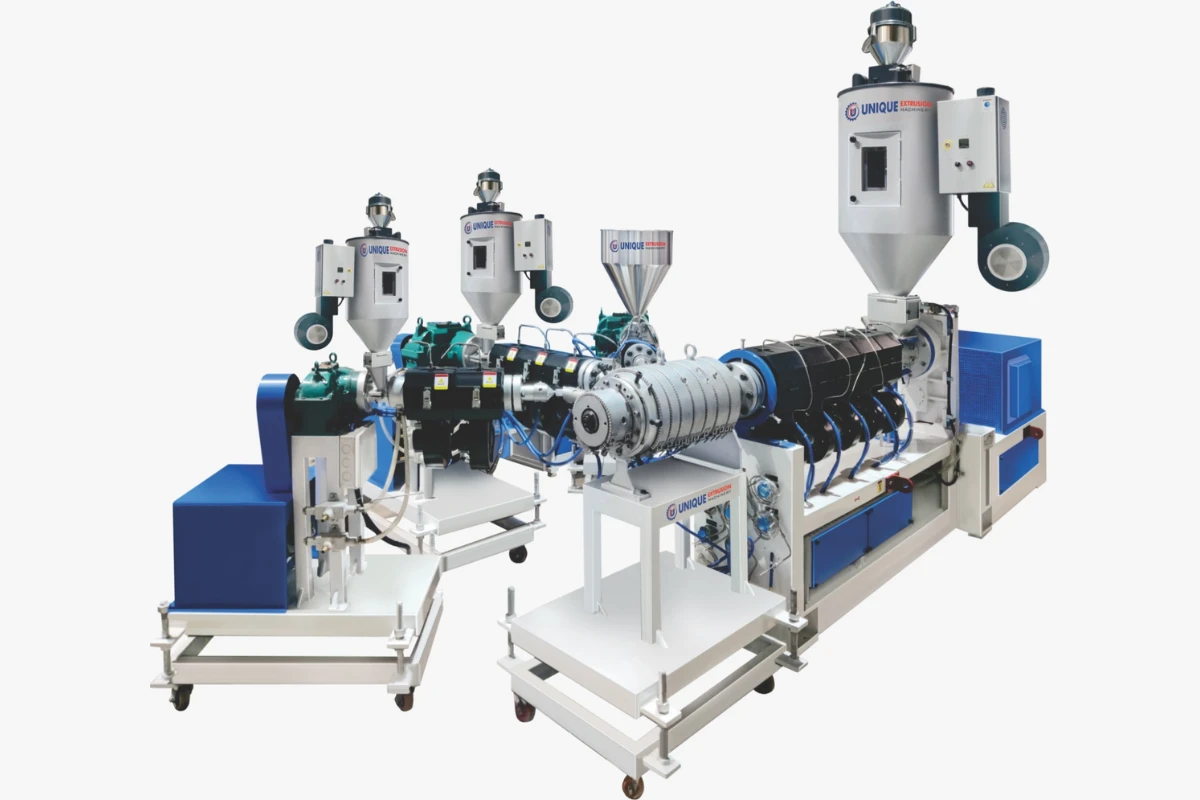
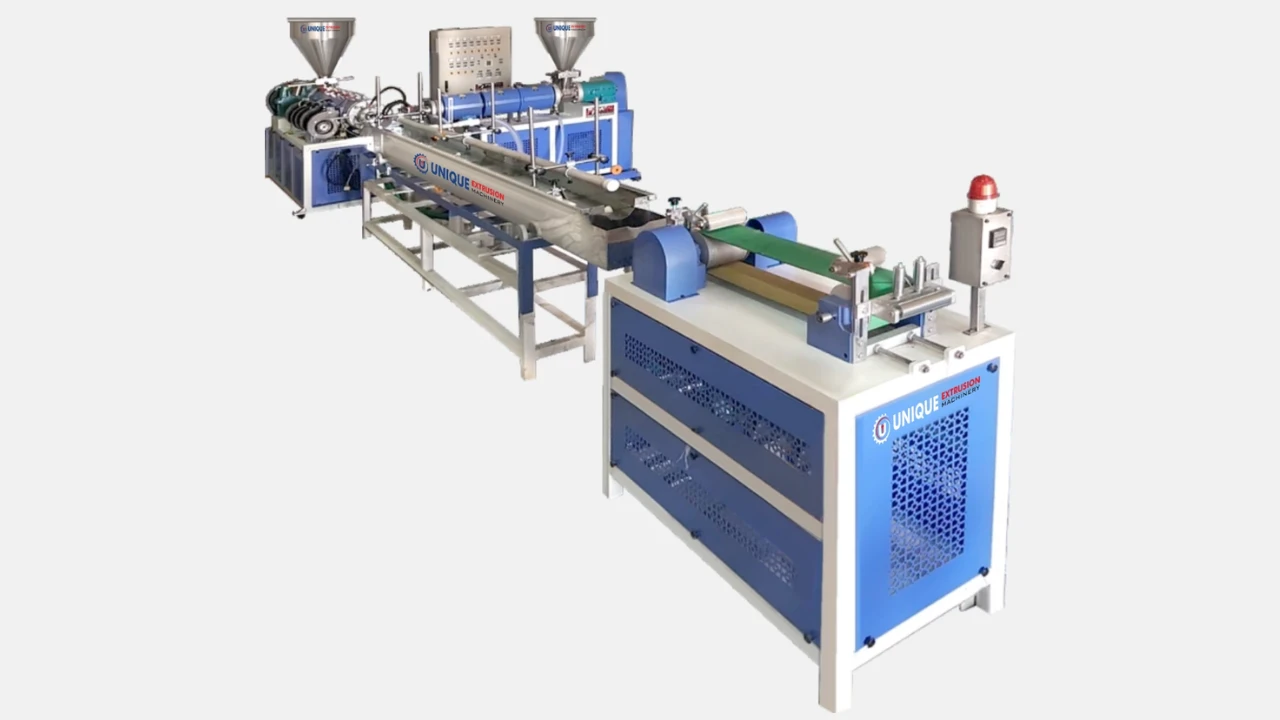
A complete HDPE pipe line needs seven core machines: a single-screw extruder, a die head, a vacuum calibration tank, a cooling tank, a haul-off (traction) unit, a cutter or coiler, and a tilting/stacking unit. A hopper dryer, dosing unit, printer, grinder and mixer are the common supporting equipment.
Because the HDPE pipe extrusion process runs as one continuous system, the machines have to be matched to each other. An extruder that can deliver 400 kg/hr is useless behind a cooling tank sized for 150 kg/hr — the pipe will not be cold enough by the time it reaches the haul-off.
The extruder is the piece that sets the ceiling on everything else. Here is our published single-screw range, so you can see how motor power, screw size and output actually relate:
| Model | Screw dia (mm) | L/D ratio | Motor (kW) | Output (kg/hr) | Pipe range (mm) |
|---|---|---|---|---|---|
| High Speed 45-45 | 45 | 37:1 | 45 | 140–160 | 20–110 |
| High Speed 45-55 | 45 | 37:1 | 55 | 180–190 | 20–110 |
| High Speed 45-75 | 45 | 37:1 | 75 | 220–240 | 20–200 |
| High Speed 45-90 | 45 | 37:1 | 90 | 300–330 | 63–315 |
| High Speed 60-110 | 60 | 37:1 | 110 | 380–400 | 63–315 |
| High Speed 60-132 | 60 | 37:1 | 132 | 500–550 | 63–400 |
| High Speed 75-200 | 75 | 37:1 | 200 | 650–700 | 110–400 |
| High Speed 75-250 | 75 | 37:1 | 250 | 800–850 | 110–630 |
Two things worth noticing in that table. First, every High Speed model runs a 37:1 L/D ratio — the extra screw length is what allows high output without sacrificing melt quality. Second, the pipe range widens with screw size, so the model you choose is decided as much by the largest pipe you intend to make as by the tonnage you want.
Not sure which extruder size matches the pipe range you plan to produce? See the full HDPE pipe machine range, or tell us your pipe sizes and we will work back to the line configuration.
If you are weighing up screw technology in general — including for a PVC line alongside your HDPE one — our detailed comparison of twin screw vs single screw extruders covers where each one belongs. For a complete equipment checklist, see the pipe plant machine list.
How to size a line: converting kg/hr into metres per hour
Extruder output is quoted in kilograms per hour, but pipe is sold in metres. To convert, divide the output by the pipe’s weight per metre. A 400 kg/hr line produces roughly 880 m/hr of 63 mm pipe, 300 m/hr of 110 mm pipe, or only 36 m/hr of 315 mm pipe — the same machine, wildly different metres.
This is the calculation most first-time buyers skip, and it is the one that decides whether your line can actually service your order book. The weight per metre of an HDPE pipe is:
kg per metre = π × (OD − wall) × wall × 0.955
OD and wall in metres. 0.955 is the approximate density of HDPE in kg per litre (955 kg/m³). Then: metres per hour = output in kg/hr ÷ kg per metre. | Pipe OD | Indicative wall | Weight per metre | Metres per hour at 400 kg/hr |
|---|---|---|---|
| 63 mm | 2.5 mm | ~0.45 kg/m | ~880 m/hr |
| 110 mm | 4.2 mm | ~1.33 kg/m | ~300 m/hr |
| 315 mm | 12.1 mm | ~11.0 kg/m | ~36 m/hr |
The practical lesson: if your market is small-diameter irrigation and house-connection pipe, a mid-size extruder gives you enormous metreage. If you are chasing large-diameter water supply tenders, you need serious tonnage to produce a meaningful length per shift — and you need the downstream cooling to match.
What goes wrong at each stage — and why
Most HDPE pipe defects trace back to one specific stage. Voids come from wet material, uneven wall thickness comes from a mis-centred die, ovality comes from wrong vacuum, sag comes from cooling that is too slow for the wall thickness, and wall variation along the length comes from haul-off speed drifting out of ratio with output.
This table is the fastest troubleshooting route we know for the HDPE pipe extrusion process. Find the symptom, and it tells you which machine to look at.
| Defect you see | Stage | Usual cause | What to check |
|---|---|---|---|
| Voids, bubbles, silver streaks | Drying / feeding | Moisture in the granules | Dryer time and temperature; hopper seal |
| Black specks, contamination | Feeding | Dirty regrind or hopper | Clean hopper; screen regrind; magnet trap |
| Rough inner surface, gels, unmelted spots | Extruder | Melt temperature too low, or worn screw | Raise mid-zone temperatures; measure screw and barrel wear |
| Wall thick on one side, thin on the other | Die head | Die not centred, or uneven die heating | Re-centre the mandrel; test each die heater band |
| Ovality, undersize outside diameter | Calibration | Vacuum too low, or worn sizing sleeve | Vacuum level; sleeve condition; water level in tank |
| Surface scoring and drag marks | Calibration | Vacuum too high | Reduce vacuum; check sleeve lubrication |
| Sag — thick bottom wall on large pipe | Cooling | Melt strength too low for the wall thickness; cooling too slow | Higher-melt-strength grade; staged cooling; internal cooling for heavy walls |
| Warping, or failure in the reversion test | Cooling | Cooling too fast, freezing in internal stress | Raise first-tank water temperature; stage the cooling |
| Wall thickness drifting along the length | Haul-off | Line speed out of ratio with extruder output | Lock haul-off to gravimetric output; check pad pressure and slip |
| Burrs or out-of-square cut ends | Cutting | Blunt blade or misaligned clamp | Replace the blade; realign the travelling clamp |
Sag is the one that catches people out. It only appears when you move up to large diameters and heavy walls, so a line that made perfect 110 mm pipe for two years can suddenly produce out-of-spec 400 mm pipe. The molten polymer simply flows downward under gravity before it sets. Fixing it is a combination of resin choice, cooling strategy and sometimes rotating the pipe — not a setting you can dial in on the extruder alone.
IS 4984 and BIS: what the finished pipe must pass
In India, HDPE pipe for potable water supply is governed by IS 4984, and HDPE pipe for sewerage and telecom duct by IS 14333. To sell under the ISI mark you need a BIS licence, which requires an in-house testing laboratory, documented process control, and a factory inspection. For Indian manufacturers the licence process typically takes around 30 days.
IS 4984 does not just specify the finished dimensions. It sets the acceptable material grades, the pressure classes, the marking requirements and a full test regime. Your process settings are what determine whether the pipe passes.
| Test | What it checks | Process stage that controls it |
|---|---|---|
| Visual and dimensional | Smooth clean bore, outside diameter, wall thickness, ovality | Die head, calibration, haul-off |
| Hydrostatic pressure | The pipe holds rated pressure without bursting or leaking | Wall thickness consistency and melt quality |
| Reversion (longitudinal shrinkage) | The pipe does not shrink excessively when reheated | Cooling rate and residual internal stress |
| Carbon black content and dispersion | UV protection is present and evenly distributed | Raw material and melt homogenising |
| Density | The material really is the declared grade | Raw material |
| Melt Flow Rate | The resin has not degraded during processing | Raw material and barrel temperatures |
| Oxidation Induction Time | Enough antioxidant remains for long service life | Raw material; overheating destroys it |
| Tensile strength / elongation at break | The pipe is ductile, not brittle | Melt quality and cooling |
Read that third column again, because it is the point of this whole article. Almost every test on the list is decided by how the line was set, not by which resin you bought. You can buy the best PE 100 in the market and still fail reversion because your first cooling tank is too cold.
The current standard text and licence procedure are published by the Bureau of Indian Standards.
Starting HDPE pipe production in Ahmedabad and Gujarat
Ahmedabad is one of the best places in India to set up HDPE pipe production. The GIDC estates at Vatva, Naroda, Odhav and Changodar offer ready industrial plots with three-phase power, Gujarat’s petrochemical belt shortens the resin supply chain, and the city’s extrusion machinery cluster means your machine builder, spares and service engineers are local.
Three practical advantages matter more than people expect when you are actually running a line:
- Service response time. An extruder down for three days is three days of lost production. When your machine builder is in the same city, a service engineer can be on your floor the same day rather than on a flight.
- Commissioning support. Getting a new line to produce saleable pipe means dialling in a recipe for every pipe size. That is far easier when the people who built the machine can come back repeatedly during the first weeks.
- Spares availability. Screws, barrels, heater bands, sizing sleeves and haul-off pads are wear items. Local sourcing turns a two-week wait into an afternoon.
On the regulatory side, a new unit in Gujarat needs GPCB consent to establish and consent to operate before production, a GIDC or private industrial plot, an electricity connection sized to your total connected load, and Udyam registration. The BIS licence for the ISI mark comes after you can demonstrate consistent production and in-house testing.
Unique Extrusion Machinery builds the complete machinery for the HDPE pipe manufacturing process from our own plant at Vatva GIDC Estate, Ahmedabad. You can see the facility on our manufacturing facilities page.
Why the manufacturing process decides pipe quality
HDPE pipe is a commodity in the sense that everyone quotes the same grades and the same standard numbers. It is not a commodity in the sense that all pipe performs alike. Two plants can buy identical PE 100 and produce pipe with very different service lives.
The difference sits in four control points of the HDPE pipe manufacturing process, each one walked through above:
- Melt quality — set by screw design, L/D ratio and barrel temperature profile.
- Dimensional accuracy — set by die centring and vacuum calibration.
- Internal stress — set by the cooling profile.
- Wall consistency — set by holding haul-off speed in ratio with output.
Every one of those is a machine capability before it is an operator skill. A line built with a 37:1 barrier screw, a properly sized vacuum tank and staged cooling makes it straightforward to hit IS 4984 consistently. A line built down to a price makes it a daily fight.
That is the honest reason to care about your extrusion line specification, and it is the same reasoning behind our guide to the PVC pipe manufacturing process, where the material behaves differently but the principle is identical.
Frequently asked questions about the HDPE pipe manufacturing process
What is the HDPE pipe manufacturing process in short?
The HDPE pipe manufacturing process has eight stages, run as one continuous extrusion line: drying the granules, dosing and feeding, melting in a single-screw extruder, forming the tube in an annular die head, vacuum calibration to fix the diameter, water cooling, haul-off and marking, then cutting into lengths or winding into coils
What raw material is used to make HDPE pipe?
Pressure-pipe grade high-density polyethylene granules — PE 63, PE 80 or PE 100 — already compounded with roughly 2–3% finely dispersed carbon black plus antioxidants and UV stabilisers. Pipe for potable water must use virgin-grade compound, not recycled resin
Why is HDPE pipe black?
Because of the carbon black compounded into the resin. Carbon black absorbs ultraviolet light and stops it degrading the polymer, which is what lets HDPE pipe be stored and used outdoors for years without losing strength. Its even dispersion is a tested requirement under IS 4984
What temperature is used in HDPE pipe extrusion?
Barrel zones typically rise from around 160 °C at the feed end to about 200 °C at the metering zone, with the die head running roughly 190–230 °C. These are starting points only — the exact profile depends on the resin grade, the pipe diameter and the wall thickness, and should follow your resin supplier’s datasheet
Which extruder is used for HDPE pipe — single screw or twin screw?
A single-screw extruder. HDPE is supplied as consistent pre-compounded pellets, so it does not need the aggressive mixing action of a twin screw. Twin-screw extruders are used for PVC, where the feed is usually a powder dry-blend that must be mixed and melted at the same time
What is vacuum calibration in HDPE pipe manufacturing?
Vacuum calibration is the stage that fixes the pipe’s outside diameter. The soft tube leaving the die head enters a water-filled tank containing a sizing sleeve of the exact finished diameter, and a vacuum pump pulls the pipe’s outer surface tight against that sleeve while cold water begins to set the shape. Without it the pipe would be oval and dimensionally inconsistent
What decides the wall thickness of an HDPE pipe?
Haul-off speed, in ratio with extruder output. The die head sets a starting wall, but the caterpillar haul-off then stretches the tube as it pulls it through the line. Pull faster than the extruder delivers and the wall gets thinner; pull slower and it thickens. This is why gravimetric dosing and locked speed ratio control matter
Which Indian standard applies to HDPE pipe?
IS 4984 covers high-density polyethylene pipes for potable water supply, and IS 14333 covers HDPE pipes for sewerage and telecom duct applications. Selling under the ISI mark requires a BIS licence, which involves a factory inspection and an in-house testing laboratory. For Indian manufacturers the process typically takes around 30 days
Why does large-diameter HDPE pipe sag during production?
Because the molten polymer flows downward under its own weight before it has cooled enough to hold shape. It becomes a real problem on thick-wall pipe, where the wall cools slowly from the outside in. The result is a pipe with a thicker bottom wall than top. Countermeasures include choosing a resin with higher melt strength, staging the cooling, and on very heavy walls, internal cooling or rotation
How much pipe can one HDPE line produce per hour?
It depends entirely on pipe size, because output is measured in kilograms while pipe is sold in metres. A 400 kg/hr line produces roughly 880 metres per hour of 63 mm pipe, about 300 metres per hour of 110 mm pipe, or only around 36 metres per hour of 315 mm pipe. Divide the hourly output by the pipe’s weight per metre to get your figure
Planning an HDPE pipe line?
About the author
Unique Extrusion Machinery Technical Team designs and builds plastic pipe extrusion machinery at Vatva GIDC Estate, Ahmedabad. Our engineers commission HDPE, MDPE, PPR, PVC and CPVC pipe lines and support them in production, which is where the process detail in this article comes from — the settings, the failure modes and the fixes are ones we work through with customers on real lines.