



Conical vs Parallel Twin Screw Extruder for PVC Pipe: Which Should You Buy?

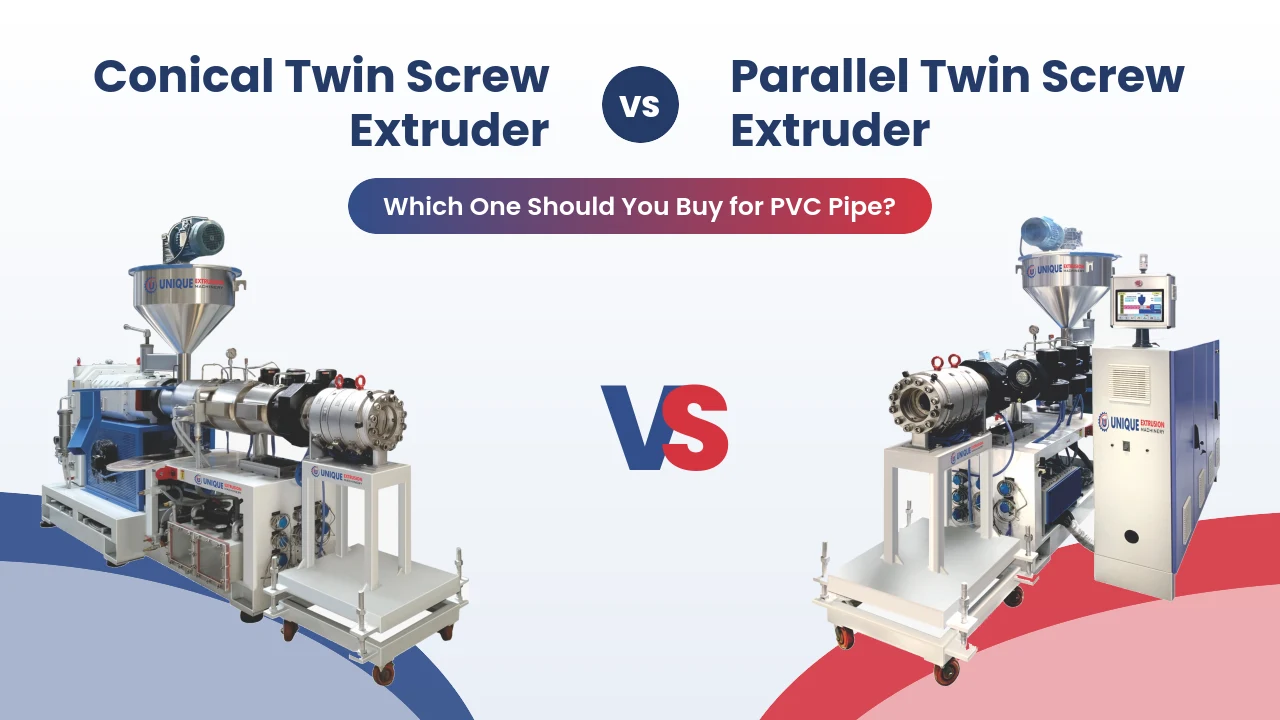
Machine Selection Guide
Two suppliers quote you two different machines for the same pipe range — and the prices don’t match. Here is the real difference, with specs from both machines, written by a company that builds both.
The difference is the screw shape. A conical twin screw extruder has cone-shaped screws — wide at the feed, narrow at the discharge — giving high powder intake, high torque and low shear. A parallel twin screw extruder has two straight screws of equal diameter, giving a longer processing length, better degassing and more even wear.
For most PVC pipe work both will make good pipe. Conical suits CPVC, small-to-mid pipe and tight budgets. Parallel suits heavily filled compounds, recycled material and high steady output.
Key takeaways
- Both are counter-rotating. For PVC pipe, the two screws always turn in opposite directions. That is not what separates conical from parallel — the shape is.
- Conical = intake, torque and gentleness. The wide feed end swallows light PVC powder; the narrow discharge end turns slowly in surface terms, so the material does not overheat.
- Parallel = length. A higher L/D ratio means more time to melt the material properly and more room for degassing — which is what filled and recycled compounds need.
- CPVC leans conical. CPVC degrades fastest of all, so the low-shear, short-residence route is the safer one.
- Heavy calcium carbonate leans parallel. Sources genuinely disagree here — we explain both arguments below instead of picking a side.
- Conical is usually cheaper to buy; parallel is usually cheaper to keep. Judge the machine over ten years, not on the quotation.
On this page
- What’s the actual difference?
- What 65/132 and 92/188 mean
- Spec-by-spec comparison
- Which type wins on each criterion?
- When to choose conical vs parallel
- If you fit both lists
- Which one for CPVC pipe?
- Which handles more filler?
- Pick by what you make
- Cost over ten years
- For Ahmedabad & Gujarat makers
- Common mistakes
- About Unique Extrusion Machinery
- FAQ
What's the actual difference between conical and parallel twin screw extruders?
Start with what the two machines share, because it is most of the machine. Both are twin screw extruders: two screws turning inside a heated barrel, meshing with each other. For PVC pipe both are counter-rotating — the screws turn in opposite directions. That matters because PVC is heat-sensitive. It does not melt cleanly like polyethylene; it softens and gels, and if you hold it too hot for too long it burns. Counter-rotating screws push material forward in a controlled way and wipe each other clean, so no pocket of PVC sits in the barrel degrading.
So both machines take PVC dry blend, melt it, and pump it to the die. The difference is the shape of the screws, and that one difference changes almost everything about how the machine behaves.
What the taper actually does
Three things follow from the cone shape, and they are the real case for a conical twin screw extruder:
- It swallows more powder. PVC dry blend is a light, fluffy powder, not dense pellets. A wide feed end has far more volume to fill per turn, so the machine takes in plenty of material without having to spin fast.
- It gives the gearbox something to push. At the feed end the screw cores are thick and the two screw centres are far apart. Thick cores transmit high torque without risk of twisting a screw, and the wide spacing leaves room for standard, rugged thrust bearings — the part that takes all the backward force from the die.
- It keeps shear low where it matters. This is the one most people miss. Surface speed depends on diameter, so at the narrow discharge end the screw surface is moving slowly even at the same rpm. Low surface speed means low shear, and low shear means less friction heat. On a conical machine you control gelation mostly with barrel and screw temperature rather than by shearing the material — which is exactly how you want to treat PVC.
What the straight screw actually does
A parallel twin screw extruder gives up the big mouth and buys length instead. Length is measured as the L/D ratio — screw length divided by screw diameter. Our parallel machines run from 18:1 up to 28:1, and some parallel PVC ranges built for compounding go to 30:1. What that length buys:
- More residence time. The material spends longer under controlled conditions, so it has time to gel fully and evenly. Half-gelled PVC makes brittle pipe that fails the drop test.
- Room for degassing. PVC dry blend carries moisture and air, and gelation releases volatiles. A longer barrel has space for proper vent zones to pull them out. Trapped gas shows up as surface pocks and internal voids.
- Even, predictable wear. Same diameter everywhere means the screws and barrel wear in a uniform pattern, which is easier to measure and plan for.
- Headroom at the top end. Constant-diameter screws scale up more simply, which is why high steady-output lines tend to be parallel.
A conical twin screw extruder optimises the entrance — intake volume, torque and gentleness. A parallel twin screw extruder optimises the journey — time, degassing and consistency.
What do model numbers like 65/132 and 92/188 mean?
Every conical quotation you receive will have a number like this on it, and almost nobody explains it. It is simply the two ends of the cone.
65 / 132
- First number — 65 mm
- Screw diameter at the small (discharge) end, nearest the die.
- Second number — 132 mm
- Screw diameter at the large (feed) end, under the hopper.
So a 92/188 conical machine tapers from 188 mm at the hopper down to 92 mm at the die — a big machine. A 51/105 is a small one. The bigger the pair of numbers, the bigger the pipe and output it is built for.
Parallel machines are named differently, because there is only one diameter to name. You will see a single screw diameter plus an L/D ratio — for example 65 mm at 22:1 — or an output-based model name. If a quotation gives you one number, it is a parallel machine; if it gives you two separated by a slash or a cross, it is conical.
Conical vs parallel twin screw extruder: spec-by-spec comparison
This is the part that is hard to find anywhere else. Most comparison articles are written by companies that sell only one of the two types, so they describe the difference but never put real numbers side by side. We build both, so here are both ranges as we actually supply them.
| Model | Min pipe OD | Max pipe OD | Output | Main AC drive |
|---|---|---|---|---|
| CUETS 51×105 | 16 mm | 110 mm | 100 kg/hr | 11 kW |
| CUETS 55×120 | 16 mm | 200 mm | 150 kg/hr | 15 kW |
| CUETS 65×132 | 63 mm | 225 mm | 250 kg/hr | 37 kW |
| CUETS 80×156 | 110 mm | 315 mm | 350 kg/hr | 55 kW |
| CUETS 92×188 | 315 mm | 630 mm | 450 kg/hr | 75 kW |
Scroll the table sideways on a phone.
| Model | Screw dia | Speed | L/D | Motor | Output | Pipe range |
|---|---|---|---|---|---|---|
| UETS 110 | 52 mm | 5–50 rpm | 18:1 | 11 kW | 90–100 kg/hr | 16–110 mm |
| UETS 170 | 52 mm | 4–45 rpm | 25:1 | 15 kW | 150–170 kg/hr | 16–200 mm |
| UETS 200 | 65 mm | 5–53 rpm | 18:1 | 22 kW | 180–200 kg/hr | 20–200 mm |
| UETS 250 | 65 mm | 5–53 rpm | 22:1 | 22 kW | 230–250 kg/hr | 63–250 mm |
| UETS 350 | 70 mm | 5–53 rpm | 28:1 | 30 kW | 330–350 kg/hr | 63–350 mm |
| UETS 450 | 90 mm | 4–40 rpm | 22:1 | 45 kW | 420–450 kg/hr | 110–400 mm |
| UETS 550 | 90 mm | 4–40 rpm | 25:1 | 56 kW | 520–550 kg/hr | 110–400 mm |
| UETS 700 | 91 mm | 4–40 rpm | 28:1 | 75 kW | 650–700 kg/hr | 110–400 mm |
Two things these tables tell you that a brochure won't
1. At the same motor size, the two types buy you different things. Compare the 75 kW machines. The parallel UETS 700 gives 650–700 kg/hr but tops out at 400 mm pipe. The conical CUETS 92×188 gives 450 kg/hr but reaches 630 mm pipe. Same connected load, two different capabilities: the parallel buys throughput, the conical buys diameter reach. If your plan is 400 mm and below in volume, that is a point for parallel. If you want to quote 500 mm and 630 mm jobs, the conical frame is what gets you there.
2. Notice how each range is specified. The conical range is listed by pipe diameter band. The parallel range is listed by screw size and L/D. That is not an accident — it reflects how each type is actually chosen. Conical machines are usually selected around the pipe size you want to make; parallel machines are usually selected around the output and the material you want to process.
Output ratings across the industry are not quoted on a common basis. Some builders publish peak figures on an easy formulation; others publish what the machine will hold shift after shift on a filled dry blend. Always ask a supplier which formulation and which pipe size their kg/hr figure refers to — otherwise you are comparing two different tests.


Which type wins on each criterion?
Eleven criteria that actually come up when buyers compare the two. “Leans” means the usual case, not a rule without exceptions — your formulation and pipe mix can flip several of these.
Count them up and it is roughly five to five with one disputed — which is the honest answer, and the reason this decision is worth ten minutes of reading rather than a coin toss.
When should you choose conical, and when parallel?
Choose a conical twin screw extruder if…
- You are making CPVC pipe, or plan to.
- Your range is mostly small to mid-size pipe — plumbing, conduit, SWR, agricultural pipe up to around 225–315 mm.
- You want the lowest entry cost for a given pipe range, because capital is tight on the first line.
- You run a clean, well-controlled dry blend with moderate filler.
- You need to reach large diameters — our 92×188 frame goes to 630 mm.
- Floor space is limited; a conical machine is physically shorter for the same job.
Typical buyer: a first or second line, mixed small-diameter products, or a CPVC entrant.
Choose a parallel twin screw extruder if…
- You run heavily filled compounds — high calcium carbonate to bring the cost per metre down.
- You feed recycled or reground material, where bulk density and contamination vary.
- You need high, steady output on a narrow range of sizes, day after day.
- You are chasing pressure-pipe quality where full, even gelation decides whether you pass the hydrostatic test.
- You want predictable maintenance and the lowest cost per tonne over the machine’s life.
- You may add compounding or pelletising work later.
Typical buyer: an established manufacturer scaling a known product, or anyone running aggressive filled formulations.
What if you genuinely fit both lists?
Plenty of manufacturers do, and then the tie-breaker is not the extruder at all — it is what else is in the line. The extruder is one machine in a chain that also includes a heater-cooler mixer, die head, vacuum calibration tank, cooling tank, traction unit and planetary cutter. If your downstream is already sized for 400 mm, buying a 630 mm-capable extruder buys you nothing until the rest catches up. Our PVC pipe plant machine list walks through every machine in the line and what each one decides.
The other honest tie-breaker: if two suppliers quote you two types at similar prices, pick the one whose spares you can get in a day. A stopped line costs more than any spec difference on this page.
Which twin screw extruder is better for CPVC pipe?
For CPVC pipe, the conical twin screw extruder is usually the safer choice. CPVC degrades faster and at a lower temperature than uPVC, so the priority is low shear and short, predictable residence time. A conical screw delivers both, and lets you control gelation with barrel and screw temperature rather than by shearing the material.
CPVC is PVC with extra chlorine added. That is what lets it carry hot water — in India it is covered by IS 15778, for hot and cold water distribution up to 82 °C — and it is also what makes it fragile to process. The processing window between “properly gelled” and “degrading” is narrow. Push it and you get yellowing, black specks, and a smell on the shop floor that tells you the batch is gone.
Two things protect CPVC in an extruder: don’t shear it hard, and don’t let any of it sit still. Counter-rotating intermeshing screws handle the second, because they wipe each other clean, so no pocket of material lingers and slowly cooks. The conical shape handles the first, with its low surface speed at the discharge end.
There is a third requirement that is easy to overlook: screw cooling. On CPVC you often need to pull heat out of the screws, not add it. Our conical twin screw extruder carries a screw oil cooling system specifically for CPVC temperature control, which is why it is the machine we put forward for CPVC work.
Parallel twin screw extruders do run CPVC successfully — they are counter-rotating too, and a well-specified parallel machine with proper screw cooling and a shorter, gentler screw profile works. It is a matter of which machine gives you more margin for error. On CPVC, conical gives you more.
Which handles more calcium carbonate filler?
Here the industry genuinely disagrees, and we would rather say so than quietly pick the answer that suits us.
Calcium carbonate is the cheap mineral filler that brings down the cost per metre of PVC pipe. In India it is used heavily, especially in non-pressure products. Two camps:
"Parallel handles filler better"
Bausano, an Italian builder of parallel PVC extruders, argues that for compounds around 100 phr calcium carbonate you want a parallel machine, for two reasons:
- The longer L/D gives the filler time to be properly wetted and the resin time to gel around it. Under-gelled filled PVC is brittle.
- Calcium carbonate is abrasive. A constant-diameter barrel has more metal in the right places and wears more evenly, so barrel life is longer.
"Conical handles filler better"
Several Indian conical suppliers argue the opposite — that conical machines bear higher filler loading and so cut material cost further. Their reasoning:
- Filled dry blend is denser and harder to feed. The wide feed end and high compression handle it without starving the screws.
- Filled compounds need more torque at low speed, which is exactly what thick conical screw cores deliver.
How to actually settle it for your plant
Notice that the two camps are not really contradicting each other. One is talking about getting filled material through the machine (feeding and torque — conical’s strength). The other is talking about what the pipe is like afterwards, and what the machine looks like in three years (gelation quality and abrasion life — parallel’s strength). Both can be true at once.
So the filler level only decides the machine on pressure pipe, where gelation quality is what the hydrostatic test measures — there, lean parallel. On non-pressure pipe either type will run a heavily filled blend, and the next section settles it on pipe size and budget instead.
If heavy filler is anywhere in your plan, specify bi-metallic screws and barrels with tungsten coating and treat spares as a running cost, not an accident. Calcium carbonate is abrasive and it will shorten screw and barrel life on a conical or a parallel machine alike. Both our ranges are built this way as standard.
Pick by what you actually make
The fastest route to an answer is to stop comparing machines and start from your product mix.
| What you make | Typical sizes | Leans | Why |
|---|---|---|---|
| CPVC plumbing pipe | 15–50 mm | Conical | Heat-sensitive; needs low shear, short residence and screw cooling |
| uPVC pressure pipe (IS 4985) | 20–315 mm | Either — parallel if heavily filled | Full gelation decides the hydrostatic test |
| SWR / drainage pipe | 75–160 mm | Either; conical on cost | Non-pressure, high filler, price-driven market |
| Electrical conduit | 20–50 mm | Conical | Small sizes, high filler, low capital |
| Agricultural / borewell pipe | 63–200 mm | Either | Output and pipe range matter more than screw shape |
| Large-diameter pipe | 315–630 mm | Conical frame (92×188) | Diameter reach; parallel range tops out at 400 mm |
| Recycled-content pipe | Any | Parallel | Variable feed and contamination need length and venting |
| High-volume single size | Narrow range | Parallel | Highest steady output per machine |
| Soft PVC garden pipe | 12–32 mm | Different machine entirely | Flexible PVC uses a dedicated garden pipe line |
Not sure which row you are in? Send us your pipe sizes, your formulation and your target output and we will tell you which type we would quote — and why. Ask for a machine recommendation →
Cost: what you pay on day one vs over ten years
Comparing quotations on purchase price alone is the most expensive mistake on this page. Four cost lines move in different directions between the two types.
1. Purchase price
For the same pipe range, a conical twin screw extruder is generally the lower-priced machine. It is physically shorter, needs less barrel and screw material, and its gearbox and thrust bearing arrangement is simpler because the wide feed end leaves room for standard bearings. That is a genuine engineering saving, not a corner cut.
2. Screw and barrel replacement — the line people forget
Screws and barrels are wear parts. On a filled PVC formulation they are the biggest recurring machine cost you have, and the two types behave differently:
- Conical screws can often be adjusted. Because the screws are tapered, moving them slightly forward in the barrel restores the running clearance and recovers lost output. That buys real extra life. A parallel screw cannot do this — once the clearance opens up, output drops and stays down until you replace.
- Conical barrels generally cost more to replace, and wear unevenly because every point along the barrel has a different diameter. Parallel barrels are simpler and generally last longer against abrasive filler.
So conical gives you a cheaper machine and a tool to stretch screw life; parallel gives you a longer-lived, cheaper-to-renew barrel. Which wins depends almost entirely on how abrasive your formulation is. Ask any supplier for the replacement price of a complete screw and barrel set before you sign, and put that number in your ten-year plan.
3. Power
Both camps claim the energy advantage, and the honest answer is that it depends on sizing. A conical machine running at the right point draws low current because it is not relying on shear to plasticise. A parallel machine of the right size can be very efficient per kilogram at high steady output. What reliably wastes power is an oversized machine running slowly — you pay for heating a barrel you are not using. Size the extruder to the output you will actually run, not to the output you hope for in five years.
Worth asking about on either type: both our ranges can be supplied with PLC-based heating control that cuts heating power by roughly 10–15%, plus internal and external gearbox oil cooling to keep the gearbox temperature stable through a long shift.
4. Floor space and civil work
A conical machine is shorter, so the extruder end of the line takes less length. On a tight shed that can decide the layout — and once you add the vacuum tank, cooling tanks, haul-off and cutter, a PVC pipe line needs more length than first-time buyers expect.
“What will a complete replacement screw and barrel set cost me, and how many tonnes should I expect from one set on my formulation?” A supplier who can answer that specifically knows their machine. A supplier who can’t is guessing.
What this decision means for Ahmedabad and Gujarat manufacturers
Gujarat is one of India’s densest clusters of plastic pipe manufacturing, and Ahmedabad — Vatva, Naroda, Odhav, Changodar — is at the centre of it. Four things make the conical-versus-parallel decision land differently here than it would for a European or Chinese buyer.
Dry blend is the norm, not the exception
Indian PVC pipe plants almost always mix their own dry blend on site, using a high-speed heater-cooler mixer, rather than buying ready-made compound pellets. That means your extruder is always feeding light powder, which plays to the conical machine’s wide feed end. It also means your blend recipe — and its consistency from batch to batch — matters as much as the extruder you choose. An inconsistent blend will embarrass either machine.
Filler economics are sharper here
Competition in the Indian pipe market is fierce on price, and calcium carbonate loading is one of the main levers manufacturers pull. That makes the filler question above more than academic — and it makes screw and barrel wear a real line item in your costing, not a footnote. Whichever type you buy, specify bi-metallic screws and barrels with tungsten coating and plan for the spares.
IS 4985, IS 15778 and the test you have to pass
Your pipe has to meet the relevant Indian standard regardless of which extruder made it — IS 4985 for uPVC pipes for potable water, IS 15778 for CPVC hot and cold water pipes. BIS testing looks at dimensions, and at properties that come straight from how well the material was gelled and how evenly the wall was formed. The extruder type does not get you an ISI mark; process control does. Our PVC pipe manufacturing process guide walks through which stage controls which test.
Spares in hours, not weeks
This is the practical argument for buying locally, and it is the one that shows up in your profit-and-loss statement. An imported machine with a six-week lead time on a screw set means six weeks of a cold line. We build at Vatva GIDC in Ahmedabad, which means screws, barrels, heaters and gearbox parts for both our conical and parallel ranges come from the same city as most of our customers. You can also come and watch the machine run before you buy it — see our manufacturing facilities.
Common mistakes when choosing between conical and parallel
- Comparing kg/hr figures that were measured differently. One supplier’s 350 kg/hr may be peak output on an unfilled blend; another’s may be sustained output on 30 phr filler. Always ask which formulation and which pipe size the number refers to.
- Buying on purchase price and ignoring the screw and barrel set. On an abrasive filled formulation, wear parts can outweigh the price difference between the two machine types within a few years.
- Oversizing “for future growth”. A big extruder running slowly wastes power, gels unevenly and gives you worse pipe than a right-sized machine at its design point.
- Choosing the extruder before the pipe range. Decide what you will make and in what volume first. The extruder type then follows from it, usually obviously.
- Assuming conical means “cheap” and parallel means “premium”. They are different engineering answers to different problems, not two quality grades. A well-built conical machine beats a badly built parallel one every time.
- Planning CPVC later, but buying only for uPVC now. If CPVC is anywhere in your plan, say so at the quotation stage — screw design and cooling need to account for it from the start.
- Forgetting the rest of the line. The extruder cannot make pipe larger than your die head and vacuum tank allow. Size the whole line together, not machine by machine.
- Not asking who services it. Ask where the engineer comes from and how fast. On a line that runs three shifts, response time is worth more than a small spec advantage.
About Unique Extrusion Machinery
We are a PVC and HDPE pipe extrusion machinery manufacturer based at Vatva GIDC, Ahmedabad, with over 10 years in pipe extrusion and 900+ extrusion lines installed in India and abroad. We are an ISO certified manufacturer.
We build both machine types discussed on this page — the conical twin screw extruder for CPVC, uPVC and PVC and the parallel twin screw extruder for PVC, uPVC and RPVC — along with single-screw extruders for HDPE, PPR and MDPE and every downstream machine in a complete PVC pipe manufacturing plant. Because we sell both twin screw types, we have no reason to talk you into the wrong one — which is more than can be said for most of the parallel vs conical twin screw extruder comparisons you will find online, nearly all of which are published by companies that build only one of the two.
Related reading: twin screw vs single screw extruder (the decision one step before this one) · PVC pipe plant machine list · HDPE vs PVC pipe — which should you manufacture? · why manufacturers choose us.
Still not sure which twin screw extruder fits your line?
Tell us three things — the pipe sizes you want to make, your formulation including filler level, and your target output in kg/hr — and our technical team will tell you whether we would quote conical or parallel for your plant, and why. No obligation.
Or compare the two directly: conical twin screw extruder · parallel twin screw extruder
Conical vs parallel twin screw extruder — FAQ
What is the difference between conical and parallel twin screw extruders?
The screws. A conical twin screw extruder has tapered, cone-shaped screws — wide at the feed end, narrow at the discharge end — which gives high powder intake, high torque and low shear. A parallel twin screw extruder has two straight screws of the same diameter end to end, which gives a longer processing length, better degassing and more even wear. Both are counter-rotating for PVC pipe.
Which twin screw extruder is best for PVC pipe?
Both make good PVC pipe — the right answer depends on your product. Conical suits CPVC, small-to-mid pipe sizes, large-diameter work on a bigger frame, and tighter budgets. Parallel suits heavily filled compounds, recycled material, pressure pipe where full gelation is critical, and high steady output. If you are making standard uPVC pipe up to 315 mm with moderate filler, pipe size and output will decide it rather than screw shape.
Why are conical twin screws tapered?
Three reasons. The wide feed end holds much more volume per turn, which suits light PVC dry-blend powder. The thick screw cores and wide centre distance at the feed end let the machine transmit high torque and use standard, rugged thrust bearings. And the narrow discharge end has a low surface speed, so shear and friction heat stay low near the die — important for a material that burns easily.
Which is better for CPVC pipe, conical or parallel?
Conical is usually the safer choice for CPVC. CPVC degrades faster and at lower temperature than uPVC, so you want low shear and short, predictable residence time — both of which the conical geometry provides. Screw cooling matters too: on CPVC you often need to remove heat from the screws rather than add it. Parallel machines can run CPVC with the right screw design and cooling, but conical leaves more margin for error.
Which type handles more calcium carbonate filler?
Sources genuinely disagree, usually along the lines of what they sell. Parallel builders argue the longer L/D gives filled compounds time to gel properly and that constant-diameter barrels resist abrasion better. Conical suppliers argue the wide feed end and high torque feed dense filled blend more easily. Both are right about different things. In practice: for heavily filled pressure pipe lean parallel, because gelation quality decides the hydrostatic test; for heavily filled non-pressure pipe conical handles it well. Either way, specify bi-metallic screws and barrels with tungsten coating.
What do the numbers 65/132, 80/156 and 92/188 mean?
They are the two ends of the cone, in millimetres. The first number is the screw diameter at the small discharge end nearest the die; the second is the diameter at the large feed end under the hopper. So 92/188 tapers from 188 mm down to 92 mm. Larger pairs of numbers mean bigger machines for bigger pipe and higher output. Parallel machines are named with a single screw diameter plus an L/D ratio instead — if a quotation shows one diameter it is parallel, if it shows two it is conical.
Which uses less power for the same output?
It depends on sizing rather than on type — and both camps claim the advantage. A conical machine draws low current because it plasticises mainly through controlled temperature rather than shear. A well-sized parallel machine can be very efficient per kilogram at high steady output. The reliable way to waste power is to oversize the extruder and run it slowly, because you pay to heat barrel length you are not using. PLC-based heating control can cut heating power by roughly 10–15% on either type.
Which wears out faster, and what does replacement cost?
They wear differently. Conical screws wear unevenly because every point has a different diameter — but they can often be moved slightly forward in the barrel to restore running clearance and recover output, which a parallel screw cannot do. Conical barrels generally cost more to replace. Parallel screws and barrels wear more evenly and typically last longer against abrasive filler, but once clearance opens up output drops permanently until replacement. Ask any supplier for the price of a complete screw and barrel set, and how many tonnes to expect from one set on your formulation, before you order.
Can a conical twin screw extruder make large-diameter pipe like 500 mm or 630 mm?
Yes, on a large enough frame. Our conical CUETS 92×188 covers 315–630 mm pipe, while our parallel UETS range tops out at 400 mm. So for large-diameter work the conical frame is what provides the diameter reach — though remember the extruder is only part of it. Your die head, vacuum calibration tank, cooling tanks and haul-off all have to be sized for the same diameter.
Is a conical twin screw extruder cheaper than a parallel one?
For the same pipe range, generally yes on purchase price — a conical machine is shorter, uses less screw and barrel material, and has a simpler gearbox and thrust bearing arrangement. But purchase price is not the whole cost. Parallel machines usually have cheaper, longer-lasting barrels, so over a ten-year life on an abrasive filled formulation the gap narrows and can reverse. Compare the machine price and the replacement screw and barrel price together.
Do both types use counter-rotating screws?
For rigid PVC pipe, yes. Both conical and parallel twin screw extruders for PVC run counter-rotating — the screws turn in opposite directions, which gives controlled forward conveying and a self-wiping action that stops material sitting in the barrel and degrading. Co-rotating twin screws exist but are used for compounding and masterbatch work, not rigid PVC pipe extrusion.
Can I run the same dies and downstream equipment on both types?
Usually yes, provided the output and pipe range match. The die head mounts to the extruder’s discharge flange, and the vacuum calibration tank, cooling tanks, traction unit and cutter all work from pipe size and line speed, not from screw shape. If you are replacing one extruder type with another on an existing line, the things to check are the discharge flange and adaptor, the output rating against your downstream cooling capacity, and the floor length available.
Written by the Unique Extrusion Machinery Technical Team
We design, build and commission PVC, CPVC and HDPE pipe extrusion lines from our works at Vatva GIDC, Ahmedabad, and have installed 900+ lines in India and abroad. The specifications in this article are from our own conical and parallel machine ranges. We build both types, so this comparison is not a pitch for one of them.
Spotted something you would argue with? We would rather be corrected than wrong — tell us.
Machine specifications on this page are from our current product range and may change as designs are updated. Output figures depend on formulation, pipe size and line conditions. For figures binding on a quotation, contact us.