



PVC Pipe Manufacturing Process

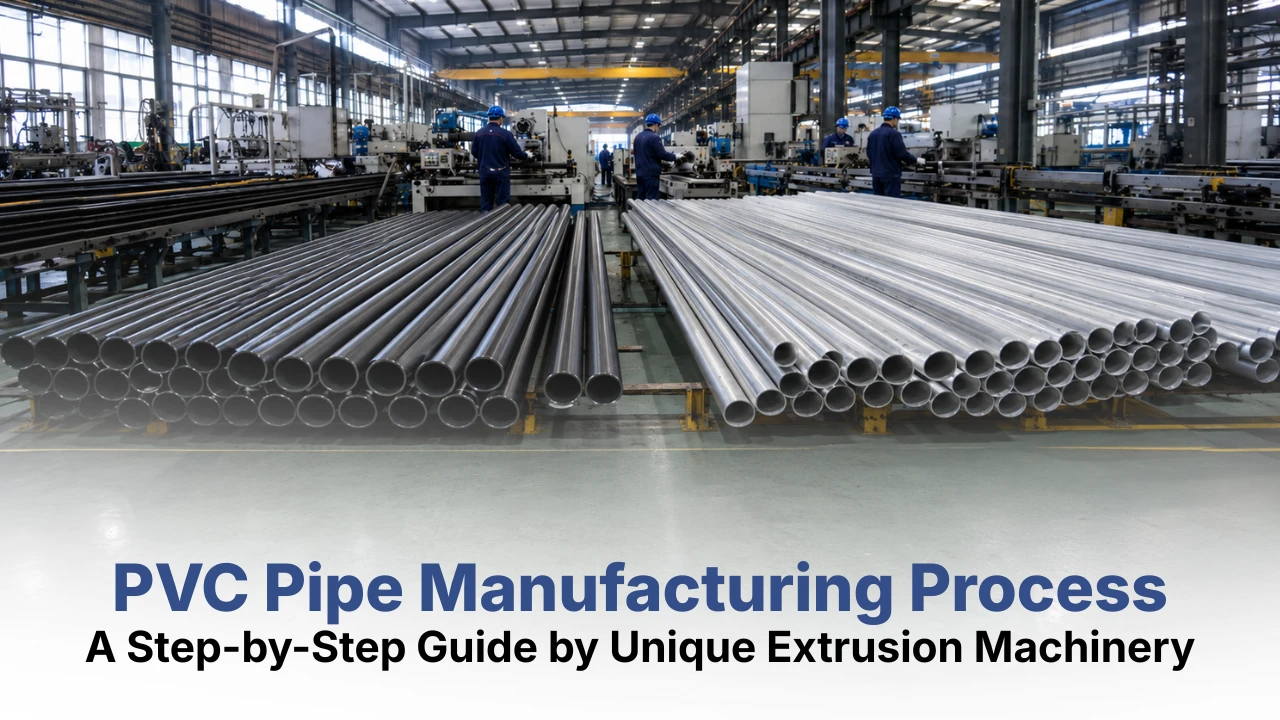
PVC Pipe Manufacturing Process: A Step-by-Step Guide by Unique Extrusion Machinery
How PVC pipe is made — from raw resin to finished, socketed pipe — explained simply by the team that builds the extrusion machines.
By Unique Extrusion Machinery Technical Team
Pipe Extrusion Engineers, Ahmedabad
Published: July 2026
Updated: July 2026
7 min read
A complete PVC pipe extrusion line by Unique Extrusion Machinery, Ahmedabad — built for precision, energy efficiency and high output.
The PVC pipe manufacturing process turns PVC resin into finished pipe by extrusion. Resin is mixed with additives, melted in a screw extruder, and shaped by a die. The soft pipe is then sized and cooled in a vacuum calibration tank, pulled by a haul-off, printed, cut to length, and socketed. Quality tests against standards such as IS 4985 finish the job.
Whether you are planning a pipe factory or just want to understand how plastic powder becomes a strong water pipe, this guide keeps it simple. At Unique Extrusion Machinery we build complete PVC, uPVC, CPVC and HDPE pipe extrusion lines, so at each step we also point to the machine that does the work.
Key takeaways
- PVC pipe is made by extrusion — a continuous, one-line process.
- Six simple stages: mix → melt & shape → size & cool → pull & print → cut → socket.
- The raw material is PVC resin plus stabilisers, lubricants, fillers and pigment.
- The extruder and die decide the pipe’s size, strength and finish.
- In India, water-supply uPVC pipe must meet IS 4985 and carry the ISI mark.
On this page
What is PVC pipe? (PVC vs uPVC vs CPVC)
PVC pipe is a rigid plastic pipe made from polyvinyl chloride. For water and drainage it is usually uPVC (unplasticised PVC), which is stiff and strong. Flexible PVC is softer, for hoses and conduit. CPVC is treated to handle hot water. All three are made by the same extrusion process, using different compounds.
| Type | Full form | Key property | Typical use |
|---|---|---|---|
| uPVC | Unplasticised PVC | Rigid and strong | Water supply, drainage, SWR (IS 4985) |
| PVC (flexible) | Plasticised PVC | Soft and bendable | Garden hose, flexible conduit |
| CPVC | Chlorinated PVC | Handles hot water | Hot & cold plumbing |
Unique Extrusion Machinery builds dedicated lines for each — including a conical twin-screw extruder for CPVC/uPVC/PVC and a soft PVC garden-pipe machine.
What raw materials are used to make PVC pipe?
PVC pipe is made from PVC resin blended with a few additives. The resin is the base. Stabilisers stop it burning when heated, lubricants help it flow, fillers add stiffness and cut cost, and pigment gives colour. The recipe (the “formulation”) controls how strong and smooth the pipe is.
| Ingredient | Role | Common example |
|---|---|---|
| PVC resin | Base polymer — the pipe body | Suspension-grade resin |
| Heat stabiliser | Prevents burning during melting | Calcium–zinc stabiliser |
| Lubricants | Flow + mould release | Waxes, calcium stearate |
| Filler | Stiffness and lower cost | Calcium carbonate |
| Pigment | Colour (grey, white) | Titanium dioxide |
Even mixing is the first job — done in a high-speed heater–cooler mixer before the compound reaches the extruder.
How is PVC pipe manufactured? Step by step
PVC pipe is manufactured by extrusion in six simple stages. Raw compound goes in at one end and finished pipe comes out the other, in one continuous line — mix, melt and shape, size and cool, pull and print, cut, and socket.
Mix the compound.
PVC resin and additives are blended into an even powder in a heater–cooler mixer.
Melt & shape.
The powder is melted in a twin-screw extruder and pushed through a die head that forms the pipe’s diameter and wall.
Size & cool.
A vacuum calibration tank sets the exact outside diameter, then cooling tanks harden the pipe.
Pull & print.
A traction (haul-off) unit draws the pipe at a steady speed while a printer marks the size and standard.
Cut to length.
A planetary cutting unit cuts fixed lengths on the move; a tilting unit lowers each pipe.
Socket & check.
One end is belled on a socketing machine, pipes are tested, and trim is reclaimed by a grinder.
Because every machine must run in step, Unique Extrusion Machinery supplies the whole line as one synchronised, turnkey system — you can see the full machine range here.
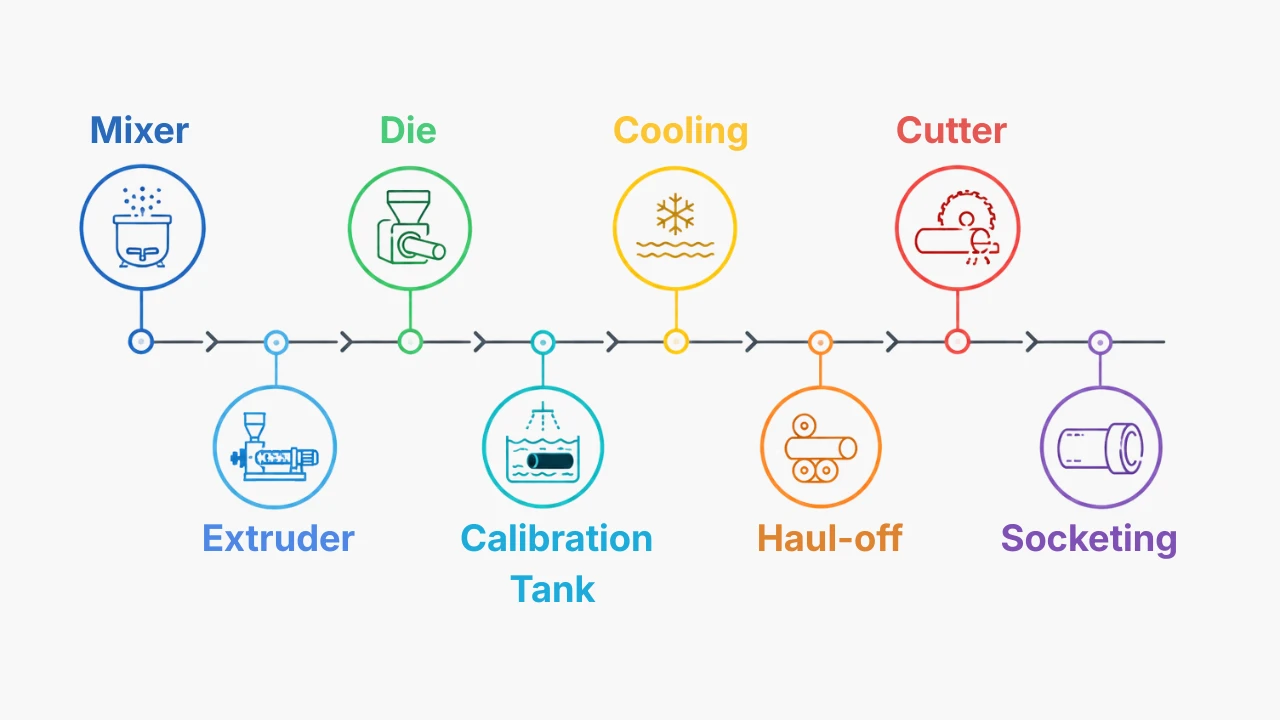
PVC pipe extrusion — process flow: mixer → extruder → die → calibration tank → cooling → haul-off → cutter → socketing.
What quality tests and standards apply? (IS 4985 / ISI)
In India, uPVC pipe for potable water must meet IS 4985 and carry the ISI mark. The standard, set by the Bureau of Indian Standards (BIS), fixes the pipe’s size, pressure rating and tests. ISI certification under IS 4985 is mandatory to supply this pipe in India.
Common tests include the hydrostatic pressure test (it won’t burst under pressure), tensile strength, impact resistance, the reversion test (the pipe wasn’t over-stressed), and density & dimension checks. Steady machinery is what makes these easy to pass, batch after batch — see how we approach it in our quality policies. Full details are published by BIS (IS 4985).
Common PVC pipe defects — and how good machinery prevents them
Most pipe defects come from the line, not the operator. Here are the usual ones.
| Defect | Usual cause | Machinery fix |
|---|---|---|
| Uneven wall thickness | Haul-off speed not matched to output | Synchronised drive + traction control |
| Ovality (out-of-round) | Poor sizing / weak vacuum | Correct vacuum calibration & cooling |
| Burn marks | Overheating in the barrel | Precise barrel temperature zones |
| Brittle pipe | Poor mixing or degraded melt | Even compounding + gentle twin-screw melting |
A well-built, well-matched line keeps pipe in tolerance at high output — the difference between a plant that just runs and one that runs profitably. That is what our machines are engineered for.
About Unique Extrusion Machinery
Unique Extrusion Machinery Pvt. Ltd. is a plastic extrusion machinery manufacturer based in Vatva GIDC, Ahmedabad, Gujarat. The company builds complete, turnkey pipe extrusion lines for PVC, uPVC, CPVC and HDPE pipe — from the mixer to the socketing machine — with a focus on energy efficiency, reliable output and long-term after-sales support. Over 10+ years it has built 900+ machines for customers in plumbing, agriculture, telecom, power, construction and infrastructure across India and export markets. You can tour the manufacturing facilities or read why customers choose Unique Extrusion Machinery.
Founder & company story
Unique Extrusion Machinery was built by engineers with a genuine passion for extrusion technology. For over a decade, the company has grown from its Vatva GIDC workshop into a trusted maker of complete pipe extrusion lines, guided by the Managing Directors Mr. Sagar Kanojiya and Mr. Sumit Kanojiya.
Their approach is simple: keep quality in-house and keep the customer close to new technology. Critical components such as screws and barrels are machined in the company’s own facility — not outsourced — and every line runs a full production trial before it leaves the floor. The team delivers turnkey: design, installation, operator training, remote diagnostics and dependable service for the life of the machine.
The group’s work culture rests on five values it carries forward from its founders — Integrity, Efficacy, Accountability, Unity and Agility. Read the full story and meet the team on the About Us page.
Planning a PVC pipe plant?
Unique Extrusion Machinery designs and builds complete PVC, uPVC, CPVC and HDPE pipe extrusion lines — tuned for steady quality, low scrap and low power use.
PVC pipe manufacturing process — FAQ
PVC pipe is made from PVC resin (polyvinyl chloride) mixed with a few additives: heat stabilisers, lubricants, fillers such as calcium carbonate, and pigment. The resin forms the body of the pipe; the additives control its strength, finish and how easily it flows during extrusion.
PVC pipe is manufactured by extrusion in six stages: mix the resin and additives, melt and shape the compound through an extruder and die, size and cool it in a vacuum calibration tank, pull and print it, cut it to length, and socket the end. Raw compound goes in and finished pipe comes out continuously.
The core PVC pipe manufacturing machine is the extruder — usually a twin-screw extruder for rigid pipe. A full line also needs a heater–cooler mixer, die head, vacuum calibration tank, cooling tank, traction unit, cutting unit and a socketing machine. You can view each on the Unique Extrusion Machinery machine range.
uPVC is rigid, unplasticised PVC used for water and drainage pipe. Flexible PVC has plasticiser added to make it bendable, for hoses and conduit. CPVC is chlorinated PVC that handles hot water. All three are produced by the same extrusion process with different compounds.
In India, unplasticised PVC (uPVC) pipes for potable water are covered by IS 4985 from the Bureau of Indian Standards. Pipes meeting it carry the ISI mark, and ISI certification under IS 4985 is mandatory to supply these pipes in India.
To start PVC pipe manufacturing you need a complete extrusion line: a high-speed mixer, a twin-screw or single-screw extruder, a die head, a vacuum calibration tank, cooling tanks, a traction unit, a cutting unit and a socketing machine, plus reclaim equipment. Unique Extrusion Machinery supplies the full turnkey line — contact us to get started.
Unique Extrusion Machinery Technical Team
The engineering team at Unique Extrusion Machinery Pvt. Ltd., Vatva GIDC, Ahmedabad, designs and builds complete PVC, uPVC, CPVC and HDPE pipe extrusion lines, with 900+ machines built to date. This guide reflects hands-on experience commissioning pipe lines under Managing Directors Mr. Sagar Kanojiya and Mr. Sumit Kanojiya.